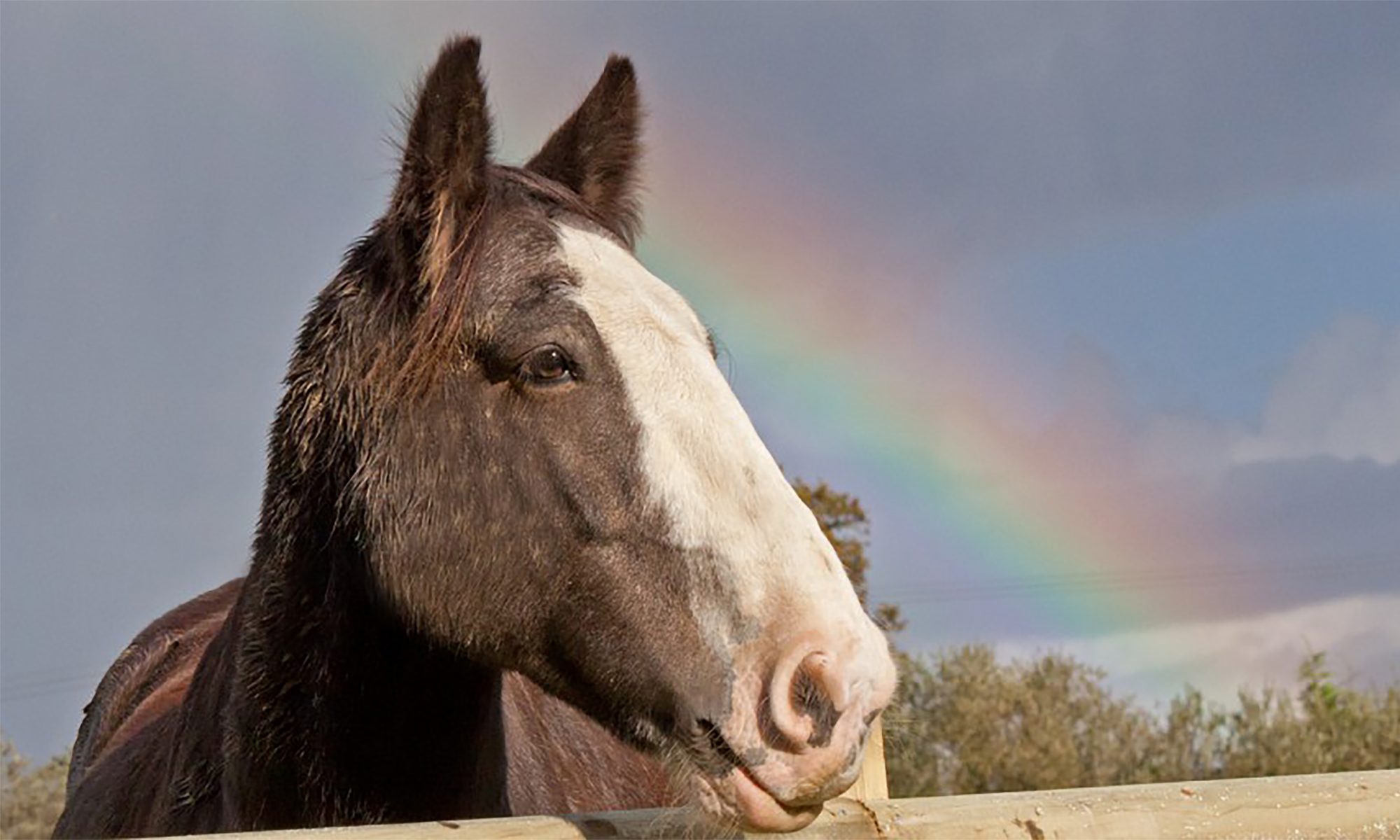
Counter conditioning alongside systematic desensitisation is very powerful. If we do slow desensitisation we can get horses accepting of aversive stimuli, but if we pair that with an appetitive – food or scratches or anything the horse values and wants more of – then we can change how they feel about the aversive. It can even become something they want, rather than something they just tolerate.
Too often we halter horses and spray them, clip them etc, without thinking about how the horse feels, horses sometimes provide a lot of feedback in the form of pulling away, fidgeting or even being openly petrified, but often they just shut down as they feel they can’t say “no”. So what do some people do in those scenarios were they acknowledge the horse has a problem? They may hold them tighter, tell them off and even sedated them to be clipped.
How much better is it to take time to desensitise and counter condition? Well Mojo was petrified of fly spray, the first time I sprayed him was in his stable and he nearly squashed me against the wall he spooked so much.
What did I do about it? Well I started systematic desensitisation and counter conditioning. Starting at a distance with the spray so he noticed but did not react, all at liberty – then they can flee if necessary. I used my verbal bridge signal “good” and rewarded him – sometimes with a scratch, sometimes with a treat.
Gradually over the last few weeks he will stand next to me and not flinch when the water is sprayed, (I used water to conserve the fly spray – but need to counter condition the smell of the fly spray once he is OK being sprayed.)
Today I did this in the field and he stayed and stood still whilst I sprayed water high in the air so the droplets actually fell on him, a few weeks ago he would have startled big time and run off.
I can now spray his legs from about a metre away but if I get too close he looks aways – so there is still some conflict present.
We must be very mindful of avoiding conflict – he wants the treats or scratches but is still unsure about the spray – this is why slow progress is better than force.
Clipping will be next but as he was sedated last time it may take much longer to overcome that fear.
He is still a little touch sensitive on his head, but getting better, he was targeting my hand today with his cheek – that is a new behaviour and not solid yet.
His feathers are still a sensitive area, but I can brush them and put cream on the sore bits if I run my hand down his legs, he gets a big butt scratch for that.
I have had Mojo for just over 2 months now so he has come a long way. He is very quick to learn new things and very eager to participate in the shaping programs.
 Positive Horsemanship.