What’s in a word?

What is in a word?

Take learning theory and peoples interpretations, some say release of pressure is a reward some say it is a relief at best.

What is certain is that in operant conditioning terms it is negative reinforcement, therefore for the release/relief to happen there has to be an aversive stimulus applied first. Once the animal complies with our request the stimulus is removed.

So it may be leg aids – use and remove as soon as the horse complies, it may be ground work – apply an aversive stimulus to form a behaviour e.g teaching a horse to back up. Often people teach back up using a light touch on the chest – getting firmer until the horse backs, the pressure is removed on the slightest of movements.

I don’t wish to argue about various methods of horsemanship – it is a personal choice but the more I learn about the emotions involved the more I wish to use positive reinforcement as much as possible.

We do live in a world where most people use aversive stimuli to form behaviours, so our horses need to understand other peoples cues.

Dictionary defintions:

Reinforcement – The action or process of reinforcing or strengthening; The process of encouraging or establishing a belief or pattern of behaviour

Stimuli – A thing that arouses activity or energy in someone or something; a spur or incentive; A thing or event that evokes a specific functional reaction in an organ or tissue

Reward – A thing given in recognition of service, effort, or achievement; A fair return for good or bad behaviour:

Relief – A feeling of reassurance and relaxation following release from anxiety or distress; The alleviation of pain, discomfort, or distress

Release – Allow or enable to escape from confinement; set free: Allow (something) to move, act, or flow freely; Remove restrictions or obligations from (someone or something) so that they become available for other activity: Allow (something) to return to its resting position by ceasing to put pressure on it:

Aversive – Someone or something that arouses a strong dislike or disinclination.

References
http://www.oxforddictionaries.com

http://www.equitationscience.com/aversive-stimuli – some are challenging the notion that horses are not safe unless we use negative reinforcement.

Connection Training
Academy of Positive Horsemanship

Read and decide, which would you prefer for yourself? Also worth looking at the emotions involved in negative versus positive reinforcement.

http://www.thehorse.com/articles/33927/study-human-interaction-shapes-horses-negative-emotions

Jaak Panksepp describes the 7 basic emotional systems all mammals exhibit.
http://www.ncbi.nlm.nih.gov/pmc/articles/PMC3181986/

Animal Advocacy

If we have captive animals we are their advocate. We have a responsibility to care for their mental and emotional well-being as well as their physical well-being. So it is up to us to take time to learn about their ethology, anatomy and physiology, nutritional needs and how best to care for them in our man made environments.

Learn from experts, people who have studied these subjects.
As Dr Helen Spence said ” if you want to understand biology learn from a biologist; if you want to learn about a disease go to a specialist doctor or vet; if you want to learn about how animals learn (we are animals too) go to someone who has studied with experts in learning theory or a psychologist who has studied this to degree level.” This is a slight paraphrase of the actually conversation.
More information about Dr Spence http://www.helenspencehorsesense.co.uk/

There are so called “experts” in all these disciplines who do not have the correct knowledge. So if in doubt ask what qualifications they have, ask them to point you to research that supports their point of view. In this age of social media we all have to be careful who we take advice from.

It does astounds me that so many animal owners don’t know much about the anatomy and physiology of animals in their care, although it shouldn’t, as many people don’t know how their own body works.

When we were thinking of getting a budgerigar I bought a book about them, same when we inherited a cat. Before I owned horses I studied for BHS qualifications. Even though I was a senior nurse in a critical care unit I went to specialists when I wanted to learn first aid.

What I didn’t study was learning theory and I regret not doing so earlier.

Max Easey is a good source of knowledge, I did her How Animals Learn course – Max has studied with some of the best animal trainers world wide and is married to a psychologist so can check the facts with an expert.
Max has a post on Facebook about some of the language used by some horse trainers and what it actually means, don’t get sucked in by pseudo-science. Find Max on Facebook

We all want an ethical way of caring for and training our animals, so go out and ask the experts. We all utilise the principles of learning theory but don’t always understand why what we do works.

I can only speak for horses as I have more experience with them than other animals, but even with 40 years of riding and caring for horses I am still learning.

Traditional horsemanship, natural horsemanship and reward based training have a lot of common ground so we must all work together for the good of the horse.

Emotions in horses.

While studying how animals learn I have been introduced to the work of Jaak Panksepp. Panksepp is a psychologist/neuroscientist whose research suggests all mammals have the same basic emotions.

Here are some of my thoughts on the subject – just my unscientific take on the emotions felt by horses.

Affective Neuroscience
Jaak Panksepp

7 systems for emotions according to Panksepp.

1 Seeking – on all the time
2 Rage
3 Fear
4 Grief – formerly panic
5 Lust
6 Play
7 Care

We must avoid anthropomorphism – i.e projecting human feelngs and attributing them to the horse.
Marthe Kiley-Worthingting termed the phrase “conditional anthropomorphism” which allows us to see that the horse does have emotions and can express rage, fear, lust etc.

How does this relate to the way we train horses?

Panksepp describes the SEEKING system as follows:
“This emotional system is a coherently operating neuronal network that promotes a certain class of survival abilities. This system makes animals intensely interested in exploring their world and leads them to become excited when they are about to get what they desire. It eventually allows animals to find and eagerly anticipate the things they need for survival, including, of course, food, water, warmth, and their ultimate evolutionary survival need, sex. In other words, when fully aroused, it helps fill the mind with interest and motivates organisms to move their bodies effortlessly in search of the things they need, crave, and desire. In humans, this may be one of the main brain systems that generate and sustain curiosity, even for intellectual pursuits. This system is obviously quite efficient at facilitating learning, especially mastering information about where material resources are situated and the best way to obtain them. It also helps assure that our bodies will work in smoothly patterned and effective ways in such quests.”

The seeking system stimulates the dopamine pathways – http://mybrainnotes.com/brain-ocd-dopamine.html

Play, care and lust are all positive emotions – they make the horse feel good.

Rage, fear and grief all have a reason and are necessary for survival – the need to run from predators or escape from capture.

I think the positive emotions are fairly easy to understand – mutual grooming, grazing, mating, playing.

Fear is a physical response to possible attack – invokes the flight/fight response. Which in extremes can caused them to run blindly, more normally it is short lived until the danger has passed. However it takes a while for the hormones to get back to a normal level.

Rage gives a captive animal the energy to struggle free, frustration is a mild form of rage and may be experienced if the animal doesn’t get what he wants.

Grief is more of a psychological reaction to extreme (in the horses mind) events – separation from friends can invoke this reaction.

With fear we can do systematic desensitisation and counter conditioning E.G to scary objects, dogs, hosepipes etc.

Grief is less easy to deal with – gradually separation from field companions – letting realise they will return (any other strategies – please feel free to comment).

The role of food in training.

All horses seek to eat – they are designed to graze continually – they have a complex digestive system which may be compromised by not allowing this behaviour.

Some horses show self-stimulating (addictive behaviour) around food. Geldings and stallions may become sexually aroused when training. They want more and more of the food we have. To help reduce this they need to have the time to chew and process what we teach them.

This is linked to frustration and can escalate to aggression in some animals – if we are stingy with the rewards.

Fixed Action Patterns

Kondrad Lorenz and Niko Tinbergen received the Nobel Prize in 1973 for their work in developing an interpretive framework that crystallised the data they collected on animal behaviour in the field (ethology) and in the laboratory (neuroethology).

They observed what animals do and how and where the individual animals spent their time. They recognised that the behaviour of animals seemed to be constructed of elementary motor and sensory units. (Reference Animal Physiology – Eckert 4th edition 1997)

Motors units were called Fixed Actions Patterns and sensory units Key Stimuli.

The six properties of fixed action patterns:

1. they are complex motor acts, each consisting of a specific temporal sequence of components – they are not simple reflexes.
2. they are typically elicited by specific key stimuli rather than general stimuli.
3. fixed action patterns are normally elicited by an environmental stimulus: but if the experimenter removes the stimulus after the behaviour has begun, the behaviour will usually continue to completion. This all or none property distinguishes them from simple reflexes.
4. the stimulus threshold for fixed action patterns varies with the state of the animal, and the variation can be quite large.
5. when they are presented with the appropriate stimulus, all members of the species (perhaps that are the same age, sex or both) will perform a given fixed action pattern nearly identical.
6. fixed action patterns are typically performed in a recognisable form even by animals that have had no prior experience with the key stimulus. That is these patterns are inherited genetically, although in many species the patterns can change with experience.

The last property has provoked the debate about nature versus nurture and recently epigenetic studies.

All animals have innate behaviour patterns – to understand the species we must understand their ethology. What does mean in terms of horse training?

Is it this small statement that users of negative reinforcement take out of context? A horse will push another horse so we do the same?

They do use pressure when resource guarding – they push another horse off the hay – the other horse backs off. Horse innately know how to read the facial expression of other horses – so the flattening of the ears in a certain way may mean go away or I will do something more drastic.

Does this mean we have to use this system – no because the horse knows we are not a horse and therefore we do not have the same fixed action patterns.

Do horse receive positive reinforce  – yes, by grazing, mutual grooming, playing and mating.

So by our training we can habituate the horse to accept things it may be innately afraid of – e.g trailer loading, clipping etc.

Trailer Loading

Emotional systems which may be triggered:

fear – of being captured in an enclosed space
grief – separation anxiety on leaving the yard

Can we override these systems and replace with more positive emotions?

My thoughts on this are: (these are my personal and non-scientific thoughts) please correct if incorrect or you have any other suggestions.

For my example I will use trailer loading.

A trailer or lorry is an enclosed space which a horse would probably not naturally enter if he didn’t have an obvious escape route.

The horse therefore may be anxious – have a fear response on seeing a trailer – an unusual object.
We can encourage the horse forward by using negative or positive reinforcement or in some cases luring which is often a mixture of the two.

Negative reinforcement (pressure/release) – we can encourage the horse forward by applying pressure and releasing on the slightest movement forward – the removal of the stimulus (pressure) is negatively reinforcing. Repeat this over and over again and maybe go from phase 1 (a gesture to suggest the horse moves forwards) to phase 4 where there is more physical pressure put on the horse.
If all goes well the horse will eventually associate the gesture to load with an addition of the aversive stimuli and work to avoid the pressure.

The horse loads and continues to load and may even load himself. My question is – has the horse begun to like the trailer or has he loaded to avoid any unpleasant things happening? Is the innate emotion – fear – still there? Yes, they do eventually habituate to trailer loading if we are consistent.

Positive reinforcement (reward based training/clicker training) – the horse has already begun to be target trained so will follow a target to the scary lorry – bridge and treat for the slightest try.
Continue this targeting and reinforcement until the horse will load himself following the target.
Again the horse habituates to the trailer and load with us just using a cue. The inside of the lorry now has positive associations – satisfies the seeking emotion – food is provided.

So with positive reinforcement have we altered the horse emotional state from that of fear to that of seeking? So trigering dopamine release rather than just supressing the flight and fight respones?

http://www.journalvetbehavior.com/article/S1558-7878%2811%2900034-7/abstract
Above is a reference to research on the physical state of horse to trailer loading.

If grief is triggered in any scenario then that needs to be addressed as a separate problem – please add any thoughts on dealing with separation anxiety as I have limited experience.

In depressed, shut down horses the seeking system is switched off, some horses have been so micro-managed that they are afraid to offer any behviour incase they get corrected or punished – both clicker training and well timed, non-escalting pressure/release should never cause the seeking system to shut down. In fact in reward based the training the horse will often offer more behaviours in an attempt to get a reward, we can then capture the behaviour we want and reinforce.

Please feel free to comment, pull this apart and add your thoughts. I may be on the completely wrong track with all this – but it a fascinating and complex subject.
Connection Training Clinic Day 1

A few thoughts about the recent clinic in Essex.

We gathered in the stable block and talked about the areas we wanted to work on either at the clinic (for those with horses there ) or at home for the auditors.

There were a variety of issues discussed:

gaining trust
getting more whoa
getting more go
desensitisation to nasal spray
bridling a slightly head shy horse
a competition horse who went over threshold at a dressage event due to horses round the arena approaching from the right side
a horse not interested in treats or training in hand in general
even the venues owners own horse who didn’t like the arena

Getting motivation was quite a key topic, making it worthwhile for the horse to want to target objects or to stand at stationary targets. Not to be stingy with the reward!

The first session was working on getting the horse to calmly target the target stick – all the participants had a history of using reward based training. It was therefore building on and refining what they were already doing.

The session on getting more whoa was interesting as the horse seemed very calm and most unlikely to be a “bolter”. I put bolt in brackets as true bolters I think are in an extreme state of fear and not just enthusiastic and strong out hacking. Sometimes we inadvertently cause them to get over aroused – excited, especially in the company of other horses.

Shawna worked on using the target to get the horse to move and then stopping and targeting – click and treat for the stop – then add rein cues to the process. The horse got a bit confused when the rider clicked as he was still looking to Shawna as the person with the treats.
At the end of the session the rein cue had begun to mean stop.
This same horse needed to be given a nasal spray, so the process of desensitisation was discussed and he got used to having his nostrils touched but there was more work to be done on another day.

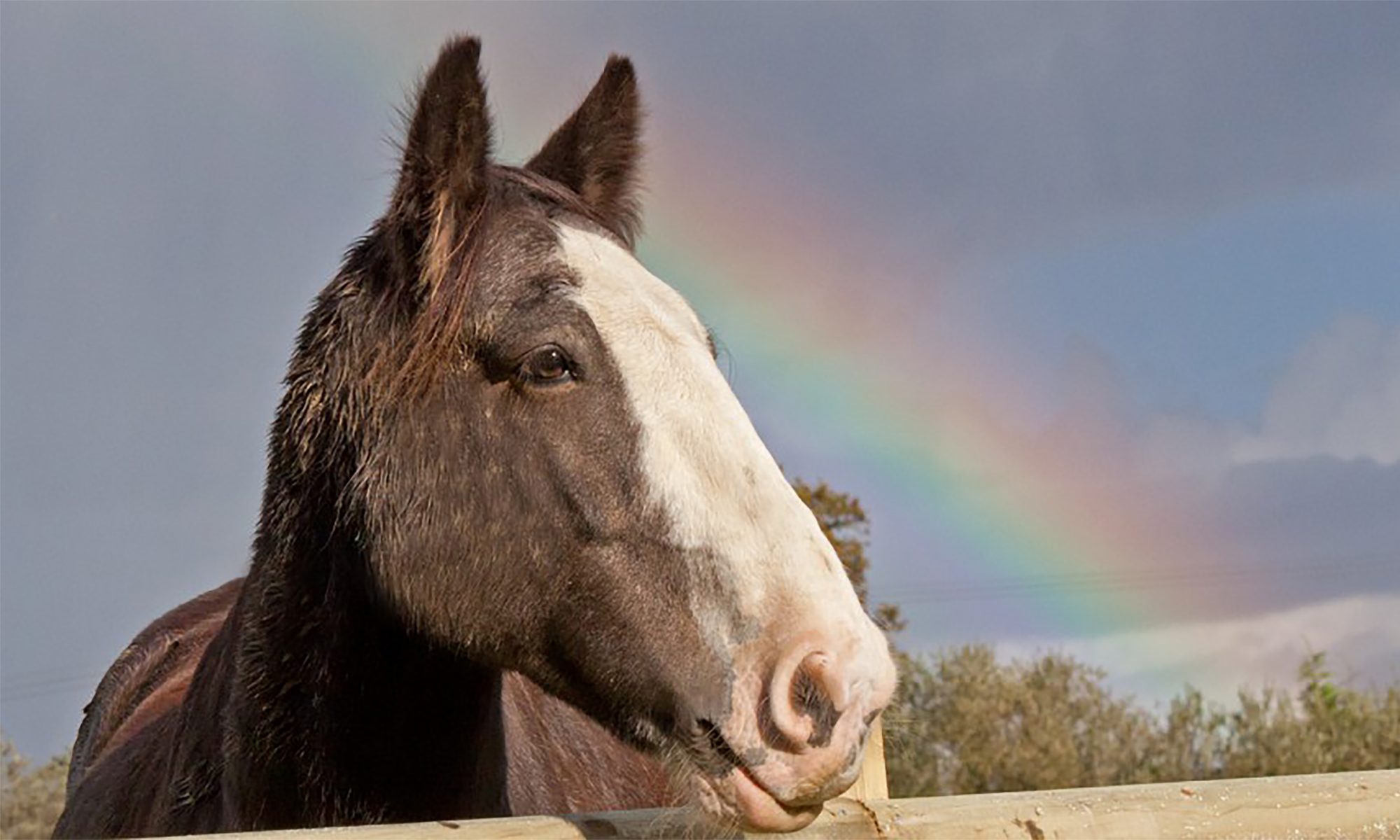
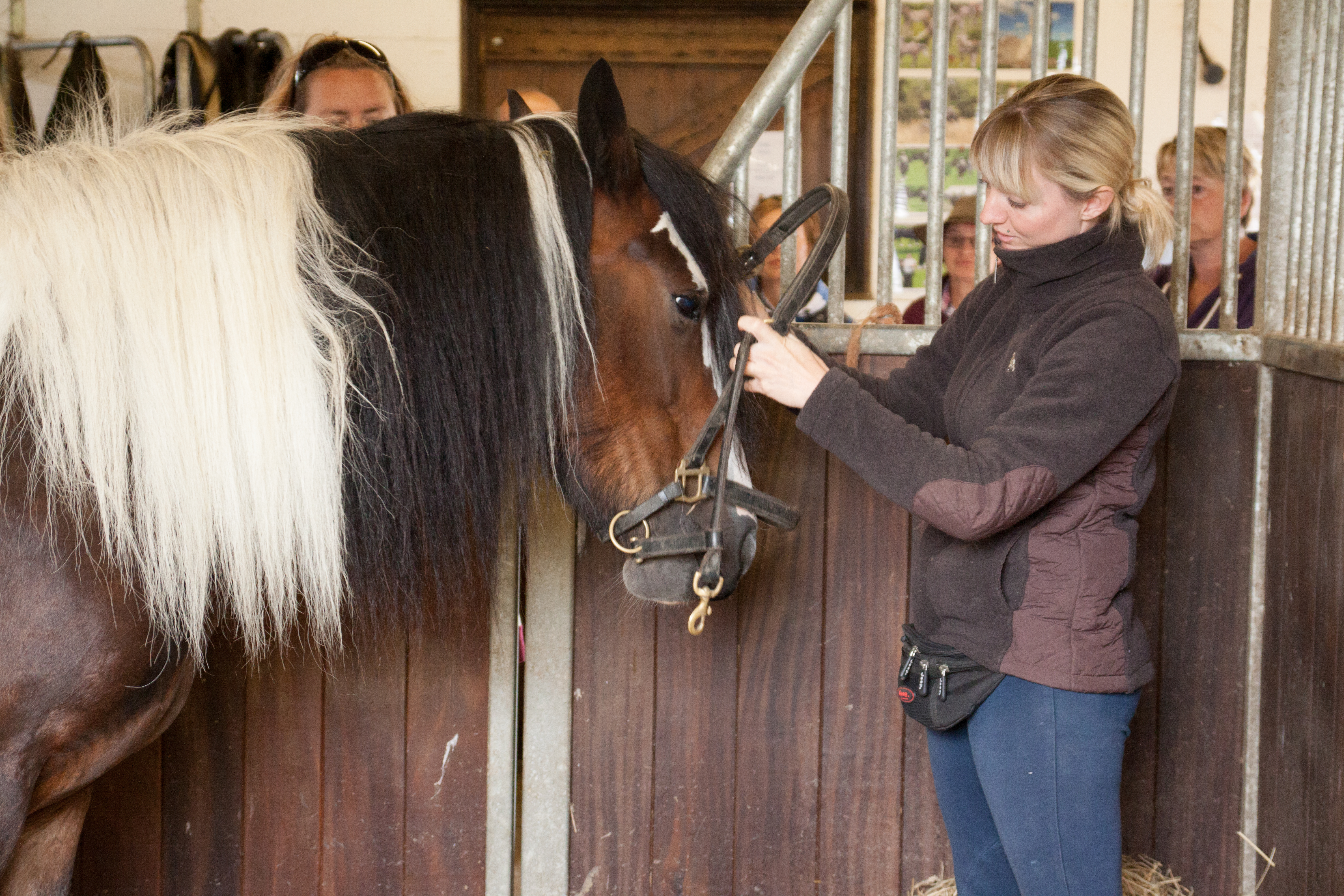
The horse with bridling issues was the one with going forwards in the school issues. Shawna worked with the horse in the stable with the owner using a leather head collar at first, gradually introducing the noseband over the nose. Desensitising to the whole process, still more sessions needed to get it solid but the horse seemed less anxious about the bridle in the end.
horse being bridledtraining a horse to be bridled


Next into the arena with the same cob – the problem was the rider wanted more forward motion with out escalating pressure. Shawna had the horse moving towards a target pole and the rider clicked and treated for the slightest forward movement.

The horse with the anxiety issues when horses or people approached from a particular side was interesting. The owner said eyes had been checked but a few people thought there may have been a more physical issue than a purely behavioural one.
Shawna had the owner with the horse online on the good side to start taking him to the side of the arena were the audience was. Several people stood up and moved as the horse went by, not much reaction on the supposed good side Changed the rein and did the same thing – a bigger reaction on that side but not overly spooked.
Clicked and treated for any calmness as he passed people. The one person went outside the arena and stood on a chair, as the horse went by she waved her arms – and the horse did a major spook and looked quite panicky. He was rewarded for being calm – he did calm down quite quickly. A few more circuits with less extreme movement from the person the other side of the hedge, gradually resulting in the horse being calmer and calmer. This too was a form of desensitisation.

Then the resident horse who seems to dislike the arena. The target was used to get him calmly walking round the arena. Gradually getting him closer and closer to the scary corner!

Shawna seemed like a magnet for the horses and sometimes the owners had difficulty getting their horses attention back to them. Shawna did move from the horse area to the spectator area a few times, with lots of breaks for the horse in between chunks of training.

What I learned from day 1 – take things at the horses pace, don’t be a greedy trainer and ask too much or too soon. Give the horses time to process and calm down after a short session. Don’t be stingy with the rewards either, jackpot after a session and leave the horse with a good feeling. Timing is everything, click/bridge for the behaviour your want at exactly the time the behaviour occurs.

A few photos from the day are on Facebook – the rest are in a Photobox gallery.

Facebook images

Connection Training Clinic

Recently I attended a clinic run by Connection Training – hosted in Essex.
Run by Shawna Karrasch and Hannah Weston.
It was great to meet so many people I had been in contact with on Facebook.

There was a variety of horses with training issues, some wouldn’t go forward and some wouldn’t stop. All people had some knowledge of reward based training so were looking for extra things to do with their horse.

I learned about sending the horse from A to B to increase forwardness and targets to get some whoa whilst adding a soft rein cue.

Clicker/reward based training is way more than just tricks.

There some photos in my Photobox Gallery

Connection Training

Ever wondered how clicker training can be added to your training?

About Connection Training


Shawna Corrin Karrasch and Hannah Weston Was-Dawson are presenting a series of demonstrations and clinics in the UK . The website has dates and costs.

There is no need to start again just add clicker training to what already works for you. Many of the UK clicker trainers have a background in Parelli but it works with traditionally trained horses too.

I am going to the one in Essex and will give feedback after the event.

As I no longer have Benny I will be concentrating on my 28 year old mare and helping Liz with her youngsters.

Kit is stiff and can’t bend but she is enjoying hacking around the local woods. Kit is voice trained already so i just add a bridge signal to let her know she is doing OK. I can’t treat from the saddle as she is too stiff to bend but she does look forward to a treat once I dismount.