March Update

Mojo has been struggling with foot lifting, I now have help in the form of Kristie Jillings of Equine Harmony

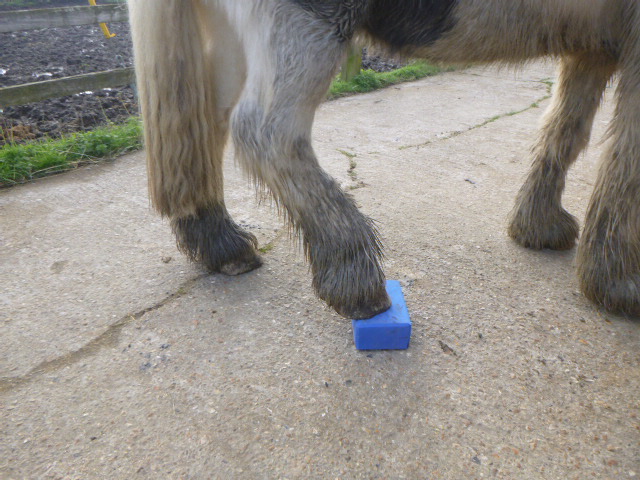
We have been training for duration of the foot lifting and now have some yoga blocks to help with his balance. So he puts his feet on the blocks for an increasing duration. So far he is fine with the fronts on the blocks and will let me place his hinds on them.

The idea is to get him to step on with the fronts one cue, then try and do the same with the hinds. Then transfer this to the hoof stand.

We continue with his stretches and exercises over raised poles and he is moving better now.

Mojo with his hind foot on a yoga block
This is his more difficult hind. Photo taken by me 5 year old granddaughter.
Mojo doing pole work.

January 31st 2020

Mojo had his appointment with the hoof trimmer. He was OK with the fronts and held them up well. However he was way over threshold by the time we got to the hinds. So Penny will come back and start with them first next time. He seemed to enjoy his red light therapy and was relaxing but still very protective of the hinds, even though he had been on bute for 4 days beforehand.

We have been training with a new head collar and really starting over with hoof care. I consulted and experienced equine behaviourist who came to see him a few weeks ago. Justine thinks it is pain related but how do we get to the bottom of this when he wont let the vet near his right hind?

We will keep on with the retraining and adding duration of his hinds legs being off the ground.

The yard has a visit booked from someone with a Theraplate machine so Mojo is booked in for that and a sports massage. He enjoyed the last massage he had and is OK with our physio too. So we will see how he is with a new person present.

May be we need to rent a few people to come and see him – so he can start associating new people with fun things.

Behaviour is Communication

What would you do if your horse had a behavioural problem?

Firstly check for any physical reasons for the behaviour – pain, ill-fitting tack, back problems, teeth, feet etc. Then check the environment is right for the horse – has he got friends, freedom and forage? Is he free from stress – e.g stabling for too long without enough forage can cause stress related problems such as gastric ulcers.
Look at the diet, is he over fed for the amount of work he is doing?
Then look at why he performs the behaviour, what is the purpose of the behaviour, is it a fear based behaviour, does he feel insecure, does he have separation anxiety etc.
Often changing the environment will make a huge difference.

Only then can a behaviour modification plan be formulated.
Training alone may never get to the root cause of the problem, at best it may put a sticking plaster over the problem, by suppressing the behaviour.
Yes you can train alternative behaviours to ones you don’t want, you can punish the behaviour e.g adding an aversive stimulus every time he performs the behaviour until he learns how to avoid the aversive and the behaviour stops. EG adding pressure to the halter every time he tries to run away. The use of aversive stimuli can either stop a behaviour (punish), or its removal can reinforce a behaviour. So are you punishing the running away or reinforcing the stopping?

Get professional help from an equine behaviourist well versed in the correct use of positive reinforcement. Behaviourists will need veterinary approval first – this is to rule out any physical cause of the behaviour.
Find one who can teach you to use systematic desensitisation and counter conditioning. This will change the emotions associated with fearful situations.
Horses are big, strong animals and we do need to stay safe but that does not have to mean using pressure halters or other controlling equipment. They may work as the horse learns to avoid the pressure but without examining the underlying cause of the problem it may reappear later.
Suppressed behaviours do have a habit of spontaneous recovery.
Horses need to feel safe, our relationships should be built on mutual trust.


2017 and onwards.

What will 2017 bring?

I am studying to be an equine behaviourist but so far am unsure whether I want to practice as a behaviourist. The equine part of the equation seems to be the easiest component. Changing peoples long held believes is very difficult, so many don’t even understand the basics of how animals learn. I don’t blame the average horse owner as they are not taught this at riding schools or even in colleges at diploma level.
If people are using pressure to motivate horses they need to understand that it is the relief of that pressure that reinforces the behaviour. This is basic negative reinforcement but I did not learn about this from the British Horse Society or even when I was doing natural horsemanship. I did learn that it is the release that teaches the behaviour but not that it was the use of an aversive stimulus nor was negative reinforcement ever mentioned.
It was only when I investigated clicker training that I learned about positive and negative reinforcement. The more I learned the more convinced I was that positive reinforcement is better for the emotional health of the horse, it gives them a choice. They can say “no” instead of being too afraid to object due to the adverse consequences of non-compliance. Even when I was doing natural horsemanship the horse was not allowed to walk away as this was seen as being “disrespectful”.

Benny taught me so much – he was very adept at escaping the escalating aversives and he introduced me to positive reinforcement.

Mojo is teaching me even more, horses can teach us so much, if we listen, than any human can.
We do not need to subscribe to any particular genre of horsemanship, we need to learn as much as we can from as many sources as possible. Only then can we truly decide what is in the best interest of the horse. To be blinkered or brainwashed by clever marketing is very limiting but unfortunately very common.
So I do find the human animal very hard to understand  – it is the human who has to change if the horse is to have a better life.

The Cook Book

The Cookbook Approach to Horse Training

There are many who would really like to know all the answers, to be able to work through a book to train the perfect equine. There are many who try to provide this service, they produce glossy ads and videos showing how you can have a rapport with your horse. Some even give you a step by step program to obtain the perfect partnership.

What is wrong with the Cookbook approach?

Well for a start each horse is different, as is each owner/rider. No horse has ever read the book so has no idea what people want him to do, he is just busy being a horse.
Any book or program can only provide a framework – the trainer needs enough knowledge to know how to adapt and improvise.

If we have a cookbook what happens if you don’t have all the ingredients for a recipe? It probably all goes wrong unless you have enough knowledge to be able to adapt a recipe or make one up from scratch.

The same can happen in horse training if all you do is watch a few videos or read a few books without a true understanding of the subject.

What knowledge does an owner need to be able to be the trainer of their horse?

They need to know how horses learn – so an understanding of operant and classical conditioning.
Some physiology and an understanding of biomechanics will help to keep the horse healthy and sound.
An understanding of equine body language and emotions is also needed.
Certain programs can teach you the basics of horse care – the BHS Horse Owners Certificate looks at the care of the horse physical needs.

Studying the learning theory and emotional side of things may be a bit more tricky. There are however excellent behaviourists around who can help and several good online resources.

However pick a course or person who is not attached to an organisation that uses only pressure/release types of training. This may have a place in training but it should not be the only way to motivate a horse. Avoid those who use escalating pressure to teach behaviours to horses. Horses are very good at learning to avoid the pressure but it can be detrimental to their emotional state.

Some organisation teach equine psychology but have an emphasis on their own brand of training, so they justify the use of aversive stimuli and ignore positive reinforcement. Some never mention that what they use is negative reinforcement so many are under the illusion of it being positive reinforcement.

We do have to be careful as any training done badly will cause problems – this goes for both negative reinforcement programs and clicker training programs. There is much more to reward based training than a clicker and some food.
To learn safely and effectively try to find someone who can come out to you or who can do some video lessons and give good feedback.

All the time I learned to ride and train via both the BHS and natural horsemanship it was never explained that I was using negative reinforcement. Natural horsemanship did teach how to apply the aversive stimulus (pressure) and that is was the release of that aversive that reinforced the behaviour. However it was never called aversive or negative reinforcement.

Most people aren’t stupid and can understand the basics of learning theory if they are given the facts. Only then can they decide what motivation to use. The horse can be motivated by learning to avoid the application of pressure (-R) or he can learn to seek something he wants (+R).

Chasing, driving, applying more pressure can lead to a horse who suppresses his natural flight response. It can even lead to complete learned helplessness. This can be seen in traditional and natural horsemanship training, the dead to the leg riding school horses, the totally bombproof horses, natural horsemanship trained ones who don’t do anything unless told (because they fear the correction).

We need a balance – a safe horse but one with character, one who feels safe to express an opinion – even when it isn’t one we agree with. How many people mount horses who don’t willing stand at the mounting block – I know I have in the past got on my horse and before I was fully onboard she would walk off.
We can of course teach this with negative reinforcement  – making the wrong thing uncomfortable and the right thing easy. However do we really have a willing horse if he only performs a behaviour to avoid the consequences of not doing so?

We can equally cause conflict if using +R if the horse is still afraid but wants the food. This is why we need to learn more than the basics, learn about different rates and types of reinforcement, learn to fade out targets and clickers for established behaviours. Learn what conflict looks like and how to recognise fear and frustration and how to avoid triggering flight responses. Learn what to do if things don’t go to plan, learn to read all the very subtle signs our horses give us.

What ever we can teach using negative reinforcement can equally be taught using positive reinforcement – the difference is how the horse feels about the process. We do need knowledge and imagination and lots of patience.

Dominance, leadership, respect are often spoken about but have little place in our relationships with horses.
Trust, partnership and providing all our horses needs is far better in my opinion.

Sinusitis

Poor Mojo had a very sticky runny nose – very smelly too. The vet attended after a couple of days as Mojo was not a happy coblet.
The vet examined teeth etc and said Mojo had an acute sinusitis, so the options were antibiotics and hope it didn’t reoccur – but that is not always the case. Or to go to the veterinary hospital for a wash out, I opted for the wash out.
Mojo was booked in for a few days later and loaded well but as he doesn’t travel too well we took it slowly. He arrived and grew a few inches looking at everything. He was put in a nice cosy stable but looked very anxious – after booking him in I left him eating hay.
He was sedated for the procedure – to insert a tube in his sinus and wash it out. I explained to the staff and the vet how frightened he can get but I thnk because he does really show his fear they may have not understood him. It is surprising how many people only recognise fear when the horse is trying to flee or shaking or showing other obvious signs.
Anyway poor Mojo was not – in the words of the staff – a good patient. Even sedated he tried to escape, so he must have been way over threshold. All I was told was “when he learns some manners he will be OK”. so many people equate a suppressed horse with one with “manners”. Mojo had an opinion and made it known but no-one listened.
How most people instill “manners” is to use aversives to such an extent that the horse learns not to object for fear of the consequences.
The plan was to leave the tube in so we could wash him out at home but the vet deemed him too dangerous for us to do this. So he came home after 3 days with no drain.
We picked him up and he walked into the lorry but panicked once shut in – so he kicked the lorry sides a bit on the way home. I have a ot of systematic desensitisation and counter conditioning to do with travelling. Once the fields are dry I may be able to park it in a field and do this at liberty.
Mojo came out of the lorry and called to the other horses – only the 3rd time I have heard him vocalise.
We turned him out with his friends and he cantered round the field and rolled and rolled. Then cantered some more – he is normally very sedate in the field, so it was obvious that he was very high on adrenaline.
Later in the day he woudn’t came any where near any person that tried to catch him, not even for a bucket of food – stressed horse often don’t eat so this is another sign of how upset he was.
The next day he was fed in the field and seemed to have calmed down a bit. Over the next few days he settled and came over to say hello and I groomed him in the field and got him to target the brushes so he could get some reinforcement.

Now he is back to normal and is due for the suture being removed. He allows me to touch his face and ears and hopefully the vet will have no problems with him as he will be at home in familiar surroundings.

We owe it to our horses to prepare them for veterinary care but sometimes things happen that we cannot foresee. I know that now I have to get him used to having a lot of people around him.

Behaviour and stress.

When looking at behavioural problems in horses we need to look at all aspects of the management and training of the horse.
It is rarely just one thing that is compromised. If you only take your horse to a trainer they will probably only look at the physical aspects of behaviour, many problems are due to how we keep horses, what we feed them as much as how we train and how often we train.
Stress is a major cause of equine behavioural problems – to much aversive training, little turnout (especially in the winter), a diet not suitable for the horses work or temperament.
All these need addressing, for feeding advice ask an independant nutritionist, for physical problems liase with your vet. Look at how aversive your training is for the horse, just because a horse is obedient does not mean he is enjoing the work. Horses are very good at learning how to avoid aversive stimuli – this is why they are easy to train. They will learn cues to perform a behaviour so we don’t have to escalate the aids.
There is a revolution in the horse world at the moment with more people learning about the impact of aversive training and turning to using more positive reinoforcement.
It is not a battle between traditional training or natural horsemanship or reward based training – it is a matter of our own consciences – what we feel is right for our horses. We know our horses better than anyone else, but I do know that I am not comfortable with chasing my horse around to make him do things, or to use pressure to force or coerce.
If we remove all tack and put down the sticks and strings what we have left is how the horse feels about us. Does your horse stay with you if you don’t have any equipment?
Is he free to leave without fear of punishment, can he just be a horse in your presence?
Of course some will stay due to previous aversive training – it can take a while for some horses to realise they can do something without being asked. Many horses are too afraid to do anything for fear of correction (punishment).
You only have to watch videos of natural horsemanship training to see horses who stand like robots until cued to do anything.
The stress, caused by being always vigilant, waiiting and watching for a cue and trying to get it right every time so they can avoid correction, can be great.
Even very animated horses are often in a state of frozen watchfulness, watching how to avoid the flick of the whip, we often see liberty trainers with sticks.
At one clinic I attended with Smoke the cliinician was insistant that the only way he could train more than one horse to do a liberty demo was to use escalating pressure – so the horse had no option but to obey or be punished.
There was some excessive waving of the lead rope and extremely big movements from the trainer to get Smoke to back up.
This is so much easier with a target stick and positive reinforcement.
So much of what I do is easier with +R, but we do have to let go all previously learned behaviour in ourselves. How do you get a precise marking of a behaviour with -R when, often, our timing is dreadful? Using a verbal bridge to mark a behaviour still need good timing but I find it is easier to click or say “good” than to release pressure.

So when you watch demos or videos or read about how to train behaviours bear in mind how the horse feels. Stress is a common cause of physical and behavioural problems. A  little stress (excitement) is good but prolonged stress e.g never being able to relax – either in the field (if he hasn’t a pair bond), stable ( if he can’t interact with other horses) or in training (due to frozen watchfulness) is not good for our horses.

My first sit on Mojo.

Behaviour is information – it is how non-verbal animals communicate. What we do with this information says a lot about us as people and trainers and caregivers.
If we get on a horse who clearly is saying “no” we are in danger of breaking any trust they have in us.
Mojo said “no” a lot when I got him, “no” to the mounting block and “no” to new people, “no” to having his feet trimmed.
It has taken a long time to gain his trust and to get on him too early would have damaged that.
Last week he had his feet trimmed by a new farrier and although a little unsure at first soon relaxed and gave the farrier his feet.
He also comes voluntarily to the mounting block and isn’t so afraid of new people.
Yesterday was the first time I have sat on him. That is all I did sit and walk 2 or 3 steps forwards. Rewarding every step and giving him a lot of fuss and reinforcement. I dismounted without any finess and he was fine with that too. So a big jackpot for all that and back to his stable for his feed.
When Liz sat on him the first time, a few months ago, he shot off and didn’t look relaxed, yesterday was totally different.
He stood nicely for his tack and even a breast plate was not an issue. That is for my benefit as it gives me a little more security with something to steady myself, if he gets frightened by environmental factors at any time.
The new yard is quiet and he is in a herd – a new one now as Smoke wouldn’t let him join his gang.

Thought for the week

I keep reading how clicker trained horses happily take wormers, are easy to bridle, learn new things quickly etc, etc. As if they have monopoly in having happy horses. Well I have had a variety of horses over the years and they all bridled themselves, all had unique personalites and were allowed to express opinions. I listened when they showed me they were unhappy with lunging or anything else.
We need to get away from this separation of training methods. We need to all work together to make the lives of horses better. We need to train without triggering fear. We need to understand horse behaviour and how they learn and how emotions are interwoven into behaviour.
Yes I agree positive reinforcement is better than escalating negative reinforcement. But we need to stop sounding holier than thou because we use more positive than negative reinforcement.
It is known that emotionally good use of positive reinforcement is beneficial, we also know that over arousal when using +R is not good.
If we can help one another instead of bickering then the horse would benefit. We ought expend our energies in helping those who really do use abusive methods find a better way. If that is teaching them the correct use of mild negative reinforcement and helping them read the horses emotions then is that a bad thing?
I strive to use positive reinforcement but we all know life happens and it is not always possible. We need to stop making people feel guilty, non of us are perfect and we all need encouragement as we learn.
PS not all pressure is negative reinforcement, not all pressure is bad. We may need to use different words to avoid confusion. Plus it is the horse who decides what is or is not aversive.

Fear responses

I was musing about words as I read an article on spooking. It asked if your horse spooked and said this is a flight response. Well how about changing the words and saying that it is a FEAR response.
As is a lot of what horses do to avoid unpleasant experiences.
Mojo ran off during his foot trimming – a FEAR response so it is up to me to make foot handling a pleasant thing not a scary one.
Horses may run to avoid the lunge whip – a FEAR response.
Horses run round a pen in “join up’ techniques – a FEAR response.
The FEAR system may just be mild anxiety or a full blown “get me out of here” response.
Horses don’t have to be trembling to be afraid, more often than not they don’t show much outward signs – it can be dangerous in the wild to show fear and weakness in the presence of predators.

So if you say you don’t train with FEAR then look carefully at what your horse is doing and why they are doing the behaviour – how it was taught and what emotional response it provokes.

Dr Helen Spence did a wonderful seminar on emotional responses and the use of pressure.

This is my write up and explains a few things better than I can, if you wish to explore this concept in more depth there are some references at the bottom of the article. These are my interpretations of course and may change as I learn more.

3 circle emotional model