Feet revisited

After treating Mojo for feather mites with powder and neem based fly spray I have gone back to basics of foot lifting.

I now need to add more duration and get him better at people holding them.

We also did some more generalisation at the jump block as well as the ordinary one – which I missed off the video due to not positioning it correctly.

To buck or not to buck?

Fight, flight or freeze?

Horses never do anything without a reason. If they buck, bolt, rear, bite or kick they are not just being “naughty”.

It may be FEAR due to pain, or FEAR due to being asked to do something they don’t understand, or even FEAR due to being unbalanced. It is up to us with our bigger brains to do the detective work and find the cause. It may be they have been inadvertently reinforced for a behaviour we don’t want. So kicking the stable door at mealtimes may increase if we always feed that horse first. The horse associates the kicking with the food.

Behaviour is the way horses communicate. Just because another horse bites, kicks or pushes another horse does not give us permission to do the same to them. We are not horses and horses know that, if we treated them as a another horse then we would need to let them recipricate. We do not want horses to bite us, kick us so we don’t allow that. Horses do not bear grudges, they push another horse and that horse moves – it is usually associated with resource guarding and is quickly forgotten.

We must get away from using labels too, horses are not “naughty”, taking the “p——“ , or any other label we might use.

Use the ABCs of behaviourism to observe what they do:-

A = Antecedent – what happened before what happened happened.

B = Behaviour – what the horse actually did in physical terms, but don’t ignore the emotions involved.

C = Consequence – is the behaviour increasing or decreasing, if it is increasing in frequency it is being reinforced by something, if it decreasing it is being punished by something.

The more we can use these criteria to describe behaviour the less likely we are to ignore what the horse is trying to communicate.

Learn to read the subtle signs of distress and defuse the situation before they become over their fear threshold.

Adrenaline (epinephrine) is the main hormone of the FEAR response, with a half life of 2-3 minutes, so we need to wait and let it dissipate before asking them to do something else.

Punishing an already fearful horse (and it can be just mild anxiety) is not at all helpful. We need to help them cope with our environment.

Horses react in several ways to threats to their safety, they look and may just freeze. If the threat is disregarded they will go back to base line, if the threat seems real they will flee. If they cannot flee they may well fight, so kick, bite, buck.

If we punish a horse who is threatening to kick or bite then we are taking away one means of communication, eventually the horse may not give a warning but just attack. This is often how aggressive horses have been treated in the past.

If we don’t go slowly enough to habituate them to saddles and having humans on their backs they may well go over their FEAR threshold and try to escape. IT IS FRIGHTENING FOR US TO BE OUT OF BALANCE AND FEEL LIKE WE ARE ABOUT TO FALL. Check this next time you trip and feel your heart rate increase. Some horses in this situation stop (FREEZE), some try to run to regain balance and may well go in to full FLIGHT mode. Some with an unbalance object (person) on their backs will buck to try and remove the object (FIGHT).

 

Mojo and the dummy body

I made a body for Mojo, I just need to stuff it more and make it heavier. The idea is to desensitise  and counter condition him to having someone mounting and being not very balanced about the process. He wasn’t bothered about the “body” after the initial sniffing at it outside the arena, it was on the fence whilst I groomed him.
The plan now is – once the body is heavier and sits better – to walk him round with the body on and get him used to someone wobbling on top.
If a horse feels out of balance with the rider it makes them fearful – just like we are if we feel unbalanced and about to fall. As the sympathetic nervous system takes over the horse may run or he may freeze. Mojo tends to run in  these situations.

Saddle, bridle and long reins.

April 19th 2016
Today I saddled and bridled Mojo in his stable, not a flinch or movement – apart from his hay eating.

Then attached the long lines but he didn’t want to leave his hay so I did take the hay net with me and tied it on the sandschool fence. Now we have just rails rather then filled in boards it is easier for him to eat it through the rails. I left him outside the school with the hay net for a while as the farrier had a horse tied up next to the gate to the school.

I then asked him to walk on and in to the school, we then just walked round with me on the left side – which is the side he likes. Then I went to the other side and we walked round a bit more. He still wont go out on a circle so more needs to be done to help him with this.

Next was some standing at the mounting block – he was excellent when I leaned over him, put pressure in the stirrup and wiggled the saddle around.

Big jackpot when he got back to the stable.

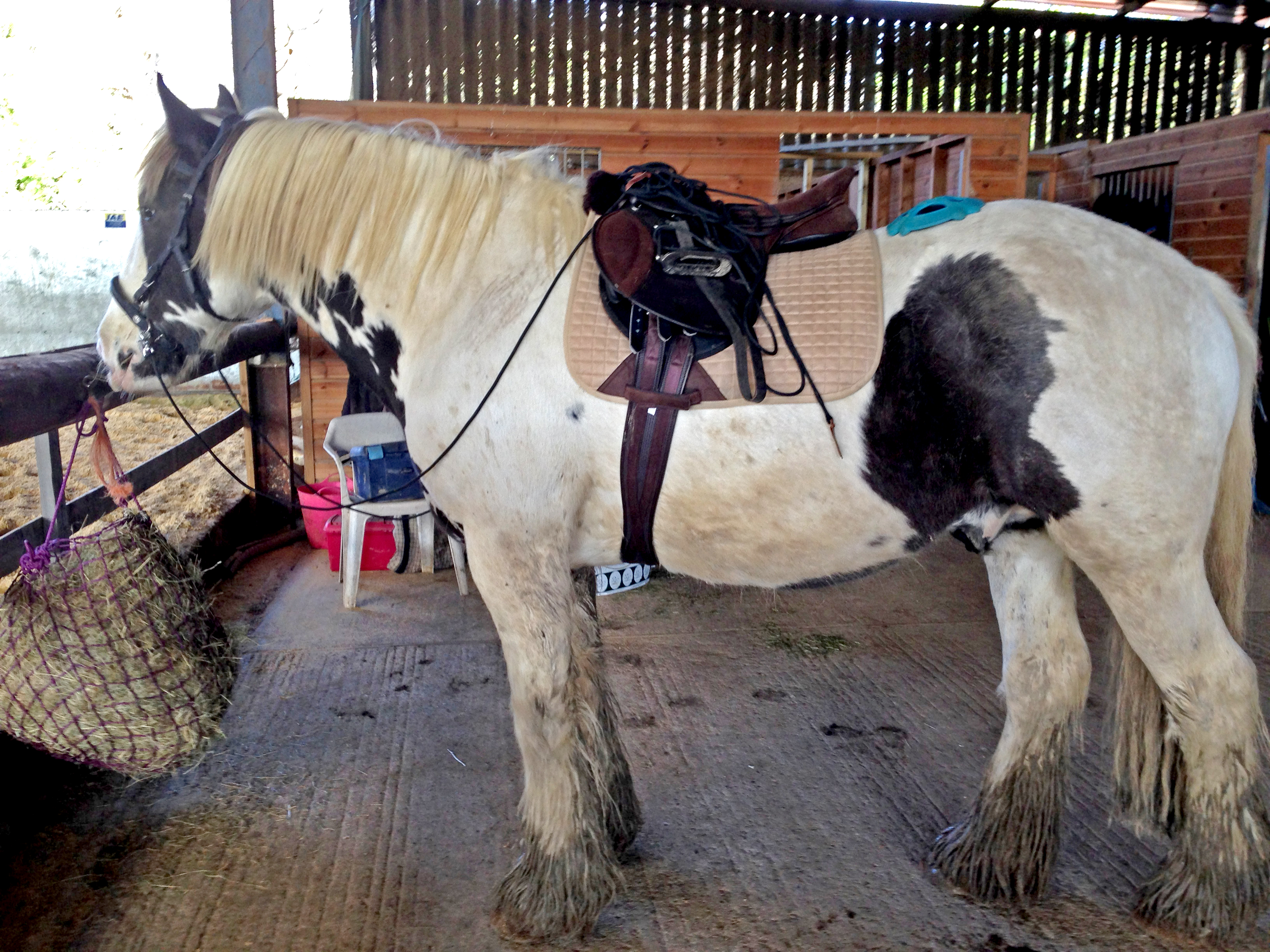
Mojo with his saddle and bridle on.

April 2016 Update

What a difference between today when I fly sprayed Mojo and last year when he tried to jump on me.
He was eating his hay and just stood whilst I sprayed him on the left side. Then he decided the smell was a bit strong, but after a sniff and a few treats he was ok when I went round the other side.
I also long lined him and he is OK on the left but still tried to put himself back on that side when I changed sides. So I got his frisbee and threw that in front of him and he walked forward and forgot all about me being on the “wrong” side.
Then added the legs and he walked round with them on. I took off the lines and pulled the legs off and pushed them off and tapped his rump with the boot. All he did was come a bit closer to the mounting block.

I have been working on leading him from the right side and he is getting better. A few days a go I had him at liberty and we walked round the school but he did try to move to the other side. So I got the frisbee and threw that for him to follow, once he was concentrating on that he was fine and very relaxed going forwards. Yesterday I did it over some poles and he was long and forward over them following the frisbee.

He did leave once to go and see if the people by the fence had anything for him, but he soon came back.

Mojo being ridden.

Today my daughter Liz came to help me with Mojo. He is still a little unsure of new people and he hasn’t seen Liz for a while. So Liz brought him in and took his rug off and gave him some chaff.
Then we got the tack out and put the mounting block and a mat in the school.
Liz then went to get Mojo out of the stable, he turned his back – as he did with me when I first started with him. Liz stood quietly and reinforced any sign of him turning round and coming to her. Held out the headcollar and let him sniff it a few times, then he let her put it on.
We tied him loosely next to his hay net and let him eat whilst we groomed and Liz cleaned his feet.
Then I saddle him and gradually and gently did up his girth. We then put on his bitless bridle and attached the 12 ft line and took him in the school.
Liz asked him to walk a few circles – he responded very well to voice cues and walked and trotted – a bit hurried at first but he soon relaxed.
We then asked him to stand by the mounting block, I counter conditioned him to Liz mounting – he was slightly tense at first but she sat quietly and he relaxed again. Then she asked him to walk forward, which he did from a voice cue.
Liz walked and trotted him around the arena, he was quite stiff round the corners but he didn’t seem anxious. We only did about 4 minutes – 2 on each rein, then Liz asked him to “whoa” and he stopped and stood queitly.

I need to do more with his fear of strangers, so he gets used to anyone handling him.
Also do some long lining to get him bending more and continue with his stretching exercises.

Mojo at the mounting block.

A bit slow at adding new posts but over the last week we have been refining the cue to come to the mounting block.
It was very windy in this clip, the barn seems to funnel the wind. So I only showed Mojo the saddle.
We did some work at coming to the mounting block, I sent him to a cone and then stood on the mounting block and called “taxi’ he comes to stand next to me but sometimes over shoots and bumps in to me. I have to be careful not to reinforce his swinging out again too. This is little snippet, the cone is just out of shot – I must be better at siting the video camera.

A few days earlier I went back to getting more impluse control round the cone square – when I am further away he gets frustrated. So I went back to working on getting Mojo walking calmly round the pole and cone square. He was still a but frustrated at times but better than when I am further away. I also tried to use a variety of reinforcers – scratches and treats.
Not really sure it all went to plan as he did try to bite the target.
A longer video this time – warts and all.

The saddling didn’t go too well as he decided to walk off before I fastened the girth, I just held the saddle and walked with him then said ‘whoa’ – he stopped and I gave him a lip curling scratch and removed the saddle.

Today I saddled him with no problems at all, and put on his bridle. Didn’t do anything else so he learns that tack doesn’t always mean he has to do anything.

Reinforcement Spectrum

If we look at the use of negative and positive reinforcement as a spectrum we are all on this spectrum, whether we know it or not.An image of the linear aspects of reinforcement
Some are at the extreme ends of the spectrum, so they only use positive reinforcement or only negative reinforcement.

My personal view is that we can be anywhere along this line as long as we aren’t extreme, as long as we don’t make people who are moving along in their horsemanship journey feel guilty.

Many extremists do make me feel uncomfortable. No-one knows our horse better than we do, what suits one may not suit another. We must tailor how we train to individual horses.

Positive reinforcement is not the choice of many because they lack understanding at this moment in time. So please be understanding of where other people are on the reinforcement spectrum and don’t be an extremist or a pedant.

If we only use one aspect of operant conditioning we may do so due to not understanding how to use all four quadrants correctly.

We do need to be mindful of the emotions involved with negative versus positive reinforcement and learn to read our horses reactions as we train.

Lets us embrace our fellow horse trainers (we are all training every time we interact with the horse). It is up to us to watch what we are reinforcing – if you get unwanted behaviours look at what reinforced the behaviour.

If you need to go to the extreme end of the spectrum using negative reinforcement then ask yourself why? What has fallen apart? How can I retrain this without being extreme?

If we go too far to the positive end our horses may get over aroused and that is not good either.

Moderation in everything is good.

We must look at the whole horse and our husbandry as well, set them up for success.

Just as Iife is never just black or white using the principles of learning theory is not either.

Often when we are young we look at life as idealists and become fixed on things being good or bad. As we mature we mellow in our understanding and reactions and become more rounded and accepting of other peoples points of view.

Please let us be mature in our acceptance of everyone on their path of learning. Whether we totally agree with them or not others often have valuable experiences to share.

Punishment is another spectrum that I may explore on another day.

Saddling Mojo

Mojo being saddle – he was very good, a bit fidgety due to the noisy tractor coming round the corner and collecting hay from the barn. I didn’t get it done up as the girth seems too small and I didn’t want to try too hard to get it fastened. It did go up last time but I need another person to gently hold the saddle in place. At no tme during this was he restrained and he was free to leave at any time.

Mojo bending to touch a target, I am trying to get duration and he seems to understand the counting. We have got up to 4 as we did with the barrel last time.

Tried it with the feet too and managed 3 before I felt him want to put it down. I clicked before he felt like he was going to snatch them back. Missed that off the video as my camera switched itself off.

Hopefully he can be ridden soon and stay calm and relaxed about it. Love this little horse – he has such an expressive character.

Short and Long reining.

I have been desensitising Mojo to the feather lines in preparation for long reining. We have done a little short reining with shorter lines but today was the first time walking with both feather lines attached. I was very unco-ordinated but Mojo was a star, targeting the cones on the circle and not being stressed by the lines on his back or even round his hocks at the end.

We did it on a small circle as the school had been watered a little too much and there was a big puddle at one end.