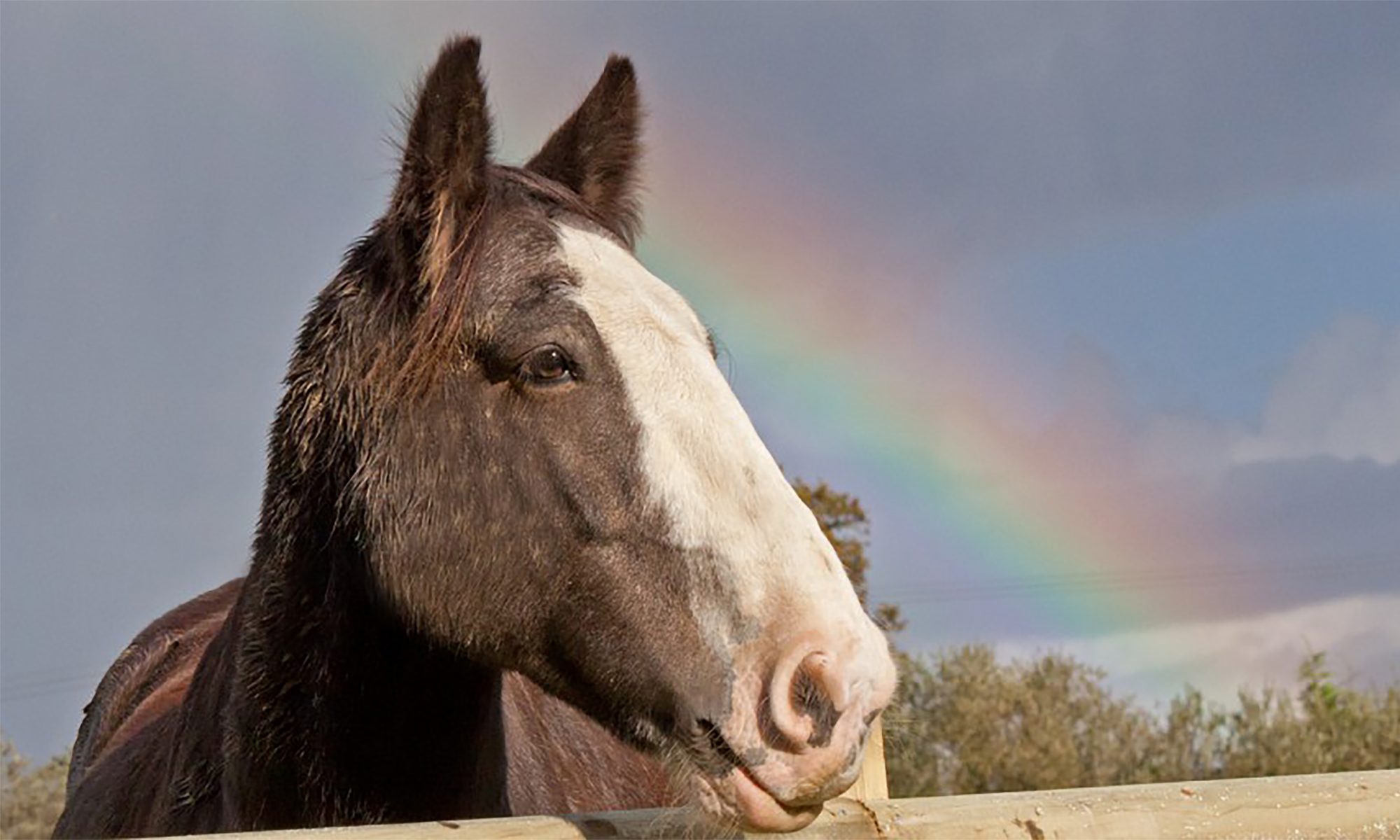
Mojo is pain free now after his Equine Touch therapy, so it is back on track with his saddle desensitisation.
I have been able to put on his numnah and surcingle with no problems, so a few days a ago I tried his saddle again. He was fine with having it on and the girth fastened and walking around with it on.
He still needs to be happy to stand at the mounting block so that is what we did today. Just with his surcingle on, it took a few attempts to get it fastened due to my clumsiness!
We got there in the end and I was very pleased with him.
Sorry for my very dusty pony!
Mojo Agility and Barrel Pushing.
Mojo October 23rd 2015
We did the barrel again today – trying to remember to feed at arms length – not sure I did that all the time. Mojo remembered he had to push the barrel, we started with 3 repetitions of 1 push and got up to 3 repetitions of 3 pushes. We finished there as I used the short side of the school and we had run out of space. Made a big fuss of him and gave him a jackpot feed.
Then I put him in the stable with his hay net (so we don’t get expelled for making a mess in the sand school)!
I put out the agility course I want to do for the Fair Horsemanship Challenge. The only thing I got wrong was not walking over the tarp with him. To do that I may need a bigger tarp, but I was very pleased with Mojo. A bit sticky through the cones but we went back and did them again afterwards and he was perfect. I may need some help with the proper video as the umbrella opening was only just in the frame. It has been a lot of fun though training each obstacle and then putting it all together.
Then came the fun bit – he has been very sticky leaving the barn and going back to the field. So we made it a fun game today – thanks Jo Hughes for the suggestion. Who would have thought a flag on a carrot stick could be so exciting.
Targeted high, targeted low and did hip over, circles and some nice shoulder-in. Mojo did not even notice the mini tractor mowing the golf field. He only grass dived twice and came straight back up to continue playing the game.
Mojo, the barrel and frustration.
I have just finished a shaping course with Jo Hughes and Carolyn Jenkinson of The Academy of Positive Horsemanship
Mojo was much more animated during this course than the last one, he got quite frustrated too when the rewards were not forth coming. I waited for a behaviour I wanted on the 3rd day and Mojo decided that was not a good idea.
I now need (with Jo Hughes help) to improve his impulse control and put the mugging on an extinction program.
Otherwise he is good with following the target and doing the agility obstacles. The umbrella was no problem when I opened and closed it several times. He couldn’t wait to stand on the tarp and his staying still on the mat is better. I now need solid cues for all these behaviours.
Then onwards with the foot lifiting – he did hold it up for a few seconds last time and I need to do this everyday and be consistent and not reward his pawing and stomping.
This is a video of him with the umbrella.
Mojo Trotting
I have struggled to get Mojo a bit more animated when following a target, probably due to me not going fast enough. So my daughter came to help today, we put 2 cones out as he stations nicely at these and then she got him to follow the target stick and upped the reinforcement for trotting, he was getting quite lively towards the end. However Liz can run faster than I can so I need to get his trotting on a cue so he can trot to the cones by himself.
Before this he was very wary meeting a new person, a few big startle responses as Liz touched him, but he soon decided she was trustworthy and really seemed to enjoy the session.
When you have a horse who is nervous like Mojo you have to go slowly and desensitise to so much. It is like starting a horse from the beginning. Restarting often takes much longer than starting a youngster with no experience of aversive methods.
Free Shaping
Wow, so much to report after my Shaping course with Peggy Hogan.
Mojo has blossomed over the last few weeks but is still touch sensitive and startles easily. I have been doing some systematic desensitisation and counter conditioning. I had a few tips from various behaviourists. Catherine Bell, Jo Hughes to name two.
It is extremely slow progress but so worth while.
So when Peggy offered this free course on Facebook I jumped in, I was nervous as I had no concept of free shaping – that is just waiting and watching what the horse offers and marking and rewarding any little tries in the right direction.
Ours taske were simple – to catch any interaction with a novel object – I used a dog toy – a football with ropes round it.
Mojo very soon got the hang of touching it, then pushing it, stamping on it, kicking it. I rewarded what I wanted more of – pushing with his nose was good and he soon learned that is what I wanted.
This was as much teaching me correct marking and timely rewarding as about helping Mojo seek out answer for himself – so no micro or even macro managing.
This is a little snippet from our sessions.
I can thoroughly recommend these courses – look on Peggy’s Facebook page or website for more information.
References
Peggy Hogan
Jo Hughes
Catherine Bell
Conditioning the bridge signal
To commence reward based training with Mojo I have first to classically condition the bridge signal. A bridge signal is to tell the horse he has done the correct behaviour, it is applied as soon as the behaviour we want occurs – the reward can then be given once the horse is calm and relaxed e.g not mugging or looking for the reward.
To condition the signal we start with the unconditioned stimulus(UCS) (food or scratches etc) and get an unconditioned response (UCR) – the horse accepting the reward. We then pair the UCS with a neutral stimulus (NS) (the bridge signal) – this can be a verbal noise or a clicker. The NS then becomes a conditioned stimulus and the UCR becomes a conditioned response as it becomes associated with the reward. So the bridge signal says “yes that is what I want”.
I decided to use a clicker to mark as a bridge signal.
Day 1
My first clicker session with Mojo didn’t go too well. My aim was to classically condition him to the clicker – so pairing the sound with the reward. However poor Mojo jumped and ran off when I clicked, it was a rather loud clicker – so now I have a softer sounding one to use to desensitise him to the sound before going any further.
Day 2
I have just been down to see him and his owner was there so we took him to the indoor school and I tried with the quieter clicker and he was fine. A few times with that and I tried the louder one and again no reaction apart from looking for a treat. I got him to stand nice and calm with his head straight. So I now feel happier about it all.
For more information about the terms used here Karen Pryor as a list which I found useful.
Jo Hughes is in the process of making a video to show how to get the head straight and to help with impulse control – so I will watch that before doing any more with Mojo. I am away for a week so will recommence once I come back. Mojo is out in the field all day and night, so is enjoying just being a horse with his friends. I will of course go and see him in the field before I go.
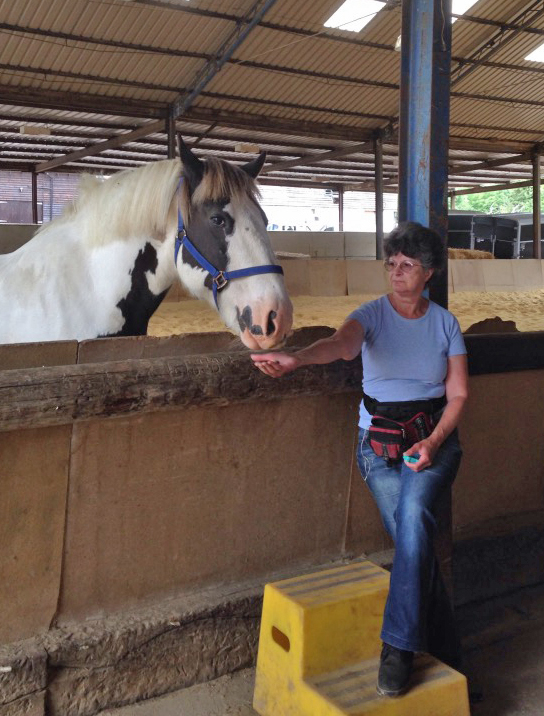
New Loan Horse
I have a new loan horse, Mojo, he is a 9 year old Irish cob abut 15.1 and piebald.
He belongs the the lady whose horse I was having lessons on and he was her daughters horse. Mojo is however a little on the sensitive side with regards to being touched. So I will spend time assessing this and doing systematic desensitisation and counter conditioning. Mojo was the field companion of Benny so I do know him quite well.

Buyer Beware!
There seems to be a rise in video courses aimed at helping people help themselves. The expansion of social media makes it easy to disseminate information to the masses.
Whilst I feel there is a need for this type of learning and there are some excellent courses available online – please choose carefully.
Choose a course that is backed up by the science of learning, where the providers can answer your questions personally.
Recently I studied with Jo Hughes of the Academy of Positive Horsemanship and learned about the ethology, and body language of equids and how emotional systems cannot be separated from behaviour. This along with learning theory gives us the tools to help our horses.
Connection Training has just launched new courses on the theory and practice of positive reinforcement. Connection Training have many courses from basic horse handling to training lateral movements inhand and under saddle all using positive reinforcement.
Horses are individuals and we need to tailor our training to each one. There is no one size fits all – so next time someones says a horse is right brained or left brained ask them exactly what that means in terms of behavioural science. We know from human psychology that left and right brained theory is inaccurate. It may be better to think of horses being either optimistic or pessimistic, but beware of labels. Ask them to explain what they do in terms of positive and negative reinforcement.
Many natural horsemanship program sound kind to the horse but use a lot of negative reinforcement with varying degrees of escalating aversive stimuli. I am not saying we should never use negative reinforcement but be aware of how it affects the emotions of the horse.
We do not need to buy into a system, follow a particular clinician or even believe everything we are told, even the most experienced horse trainers get things wrong.
All quadrants of operant conditioning along with classical conditioning are useful and help us understand what we are reinforcing or punishing in our interactions with horses.
So it is up to each person to choose how and what they learn, I do feel that with the increasing price of lessons and the intrusion of health and safety and political correctness we have lost a valuable resource in our UK riding schools.
Many people buy horses and then learn by trial and error – to the detriment of the horse or they have a few lessons on well trained horses and think they can ride anything. Owning a horse is a big commitment and we owe it to them to learn as much as we can.
My background is BHS Stages 1 and 2 plus lessons with classical riders, and many years spent caring for horses. I was manager of a livery yard, for a while, I never stopped learning.
Recently I have been overcoming some confidence issues with help from some very supportive people – a psychologist and an excellent instructor and a lovely pony belonging to a friend.
The lesson on my daughters horse was good too – this is me and Smoke, yes I do use negative reinforcement when riding other peoples horses but now I know how and why it works.

The 5 Freedoms
How often do we hear people say they use aversive stimuli (pressure/release) because horses use it between themselves? Well yes they do but it is a threat behaviour – they give fair warning too – ears back, a slight shift in weight before a kick. Horses know these signals and can get out of the way. We don’t have ears that move or tails that swish but we can use our larger brains to find a way to communicate that doesn’t involve threats and escalating pressure. It isn’t easy which is why many don’t even try or go back to using aversive stimuli even when they have learned how the horse perceives these aversives.
If we use negative reinforcement and most of us do in some form then we need to be mindful of the fact and make sure we release effectively.
Personally I don’t like to hit my horse with the clip on the end of the rope – which is advocated by some genres of horsemanship, but I do ride traditionally trained horses and so use conventional aids – negative reinforcement, leg on – leg off etc.
It is the understanding of how classical and operant conditioning works that is useful for us, to enable us to choose wisely and ethically.
What I learned at the recent Thinking Horsemans weekend was that we have a duty of care and only we can decide what we are happy to do with our horses, but it is important to be able to read the horses body language – and their emotional state before any training can begin and assess it as we progress.
It was interesting that one speaker suggested that round penning was punishment based – yes horses send other horses away but that is as a punishment, so why do we then think it good to send horses away on a circle so they can be persuaded to follow us?
I love that most reward based training starts with the horse at liberty – giving the horse a choice. I missed the second day but there was a talk about autonomy – with a scale where reinforcement and punishment was at one end of the scale and autonomy at the other end. If a horse is on line it has no choice but to stay (unless like Benny they learn to use their size to leave). Leaving tells us a lot about our relationship.
The 5 Freedoms of welfare can be used to assess whether our training is ethical.
1. Freedom from hunger and thirst. Don’t train when the animal is hungry or thirsty, they will not concentrate and may mug you if you are using positive reinforcement with food rewards.
2. Freedom from discomfort. Check that the horse has all their needs met – environmental (is it a safe area to train in) as well as physical e.g back, teeth,feet and tack are comfortable.
3. Freedom from pain – don’t add aversive stimuli if this will cause pain to the animal – e.g hitting the horse with a whip or line to insist on a behaviour. Don’t use positive punishment unless in an absolute emergency where the horse is inadequately trained.
4. Freedom to behave normally, don’t insist on a horse looking straight ahead if there are distractions – it is normal behaviour to orient towards any possible scary stimulus in the environment.
5. Freedom from fear and distress, are you sure your training doesn’t cause a fear response? Sending a horse out in a round pen uses the fear response and is punishment. Using aversive stimuli to drive the horse forward initiates the flight response, e.g traditional lunging, and natural horsemanship circling.
I am sure you can all think of other examples.
Fear
We all know that horses are innately neophobic, any new stimuli or stimuli out of context may well trigger this fear.
We owe it to our horses therefore to learn as much as possible about equine behaviour, body language and emotions. I am just coming to the end of a course on How Horses Learn, Feel and Communicate – run by Jo Hughes.
Whatever variety of horsemanship you follow – it is an excellent course. I have had horses for over 20 years and ridden for 40 years but still learned a great deal.
The module on emotions (affective neuroscience) is fascinating so even if you can’t commit to a 12 week course then there are videos and articles by Jaak Panksepp to explore.
I was not aware of the 7 emotional systems and that any aversive stimulus triggers the FEAR system. So it does seem to bit illogical to train an already fearful animal with aversive stimuli, but this is what traditional and natural horsemanship and even the equitation science people teach.
So if you do nothing else go and learn how the emotions differ between positive and negative reinforcement and decide for yourself. Study equine body language – especially the subtle signs of stress and fear.
No-one is saying you need to change how you interact with your horses but it gives you more tools to decide what is best for any particular horse at any time.
I did find limitations in certain horsemanship programmes when confronted with a horse who so obviously hated pressure (as Benny did). Maybe that was due to my lack of understanding or skill but learning about how pressure/release works and the difference it makes to the horse when you use positive reinforcement made a huge difference to Benny.
Many traditional and natural horsemen and women do use positive reinforcement and the horse world is slowly catching up with the rest of the animal training world.
Science moves on all the time and the Skinnerian models of learning theory may well be superseded, as we learn more about the emotional minds of animals (ourselves included).
So we do need to keep an open mind, don’t be afraid of what you may learn. I learned a lot from traditional and natural horsemanship but it didn’t provide all the answers.
 Positive Horsemanship.