Horse Charming

Max Easey – horse charmer extraordinaire has a website. An excellent resource for all your horse charming needs.

Horse Charming

Max has studied with some of the best positive reinforcement trainers both in the UK and the USA. As a linguist Max can explain in ways we can understand, making the learning process both educational and pleasurable.

Cognitive-Dissonance Theory

Reading through my Udemy psychology course I have got to the part about Cognitive-Dissonance Theory. This may explain why some people may be uncomfortable with the How Animal Learn course.
Where there is a discrepancy between behaviours and beliefs/attitudes there is dissonance. So people reduce this dissonance by avoiding the behaviour or changing attitudes.
Asking why you do what you do creates opportunites for recognising inconsistencies and you try to find ways to avoid these inconsistencies.
So people try and expain away behaviours (ways of training) which they have just heard are not in the animals best interest and so justify their actions.
Or they change what they do to restore consistency and avoid the dissonance.
All the course does is to present the scientific facts, it is up to us as individuals to decide whether the way we train our animals fits in wth this.

Out of the comfort zone.

Interesting post from a friend today on Facebook about how her “How Animals Learn” course and posts made some people feel uncomfortable. Why? We need this information so we can make informed choices, life is never just black or white.
We are all learning all the time, the more information we have the better able we are to assess the horse and what he/she needs with regards to training and general care.
If the theory behind how animals learn is uncomfortable then it may be due to misunderstanding, misinterpretation or even misleading ways we have been taught in the past.
We all use learning theory in our everyday life without even knowing we do so, but when someones explains why it works that can makes us really think about what we do and why.

If I praise someone for a job well done or remove toys from my child to punish a behaviour I don’t want reinforcing, it all uses quadrants of operant conditioning. Whether it is viewed as reinforcing or punishment is up to the individual concerned. If my child didn’t want the toys anyway it may not be punishing but can be neutral or reinforcing so they misbehave again.

Take time to read and learn about how our horses, dogs, cats, children learn, it does make life a lot easier as we can pick the type of learning appropriate for each individual.

Animal Advocacy

If we have captive animals we are their advocate. We have a responsibility to care for their mental and emotional well-being as well as their physical well-being. So it is up to us to take time to learn about their ethology, anatomy and physiology, nutritional needs and how best to care for them in our man made environments.

Learn from experts, people who have studied these subjects.
As Dr Helen Spence said ” if you want to understand biology learn from a biologist; if you want to learn about a disease go to a specialist doctor or vet; if you want to learn about how animals learn (we are animals too) go to someone who has studied with experts in learning theory or a psychologist who has studied this to degree level.” This is a slight paraphrase of the actually conversation.
More information about Dr Spence http://www.helenspencehorsesense.co.uk/

There are so called “experts” in all these disciplines who do not have the correct knowledge. So if in doubt ask what qualifications they have, ask them to point you to research that supports their point of view. In this age of social media we all have to be careful who we take advice from.

It does astounds me that so many animal owners don’t know much about the anatomy and physiology of animals in their care, although it shouldn’t, as many people don’t know how their own body works.

When we were thinking of getting a budgerigar I bought a book about them, same when we inherited a cat. Before I owned horses I studied for BHS qualifications. Even though I was a senior nurse in a critical care unit I went to specialists when I wanted to learn first aid.

What I didn’t study was learning theory and I regret not doing so earlier.

Max Easey is a good source of knowledge, I did her How Animals Learn course – Max has studied with some of the best animal trainers world wide and is married to a psychologist so can check the facts with an expert.
Max has a post on Facebook about some of the language used by some horse trainers and what it actually means, don’t get sucked in by pseudo-science. Find Max on Facebook

We all want an ethical way of caring for and training our animals, so go out and ask the experts. We all utilise the principles of learning theory but don’t always understand why what we do works.

I can only speak for horses as I have more experience with them than other animals, but even with 40 years of riding and caring for horses I am still learning.

Traditional horsemanship, natural horsemanship and reward based training have a lot of common ground so we must all work together for the good of the horse.

Learning about behaviour

Had a lovely evening yesterday with Suzanne Rogers and some like minded people, learning about horse behaviour. It is good that there are many people who want to learn more – even though all yesterday were holisitic horse owners. They considered the whole animal – physical and emotional wellbeing is essential for a happy horse.
We looked at the five freedoms and got some ideas how to enrich the environment of stabled and field kept horse. Some horses need to be stabled for a variety of reasons but we can help them cope. Let them see friends over the door, place hay in different areas, put vegetables in their stable in a random fashion. Also it is good to look at whether a small holed haynet or a treat ball causes the horse to become frustrated – something I never really thought about before.
Therapy horses were also mentioned – we know that horses are good therapy for people with a variety of problems but we also need to look at what effect that has on the horses emotional wellbeing.
More information on this website – http://www.learningaboutanimals.co.uk/horseclub.html

Connection Training Day 2

Once again we gathered in the barn for a short session to recap and discuss what people wanted help with.

I will be brief about day 2 as many of the sessions were working on the same concepts.
A – B’s – where the horse is sent from point A to point B using a target.

The first horse a beautiful ex-police horse had been traumatised by the police work – she had bolted in the middle of a London riot.
The owner was doing a great job of regaining trust and now wished to add some forward movement.
Firstly the owner got the horse to go to her target and then sent it to Shawnas’ target. After a few moments Shawna used a cone for the horse to target. The idea is that the horse will eventually go to the target when directed so the owner can train without an assistant.

The cone has to be fairly close to start with and the second person with the target will hold the target on the cone. A target can then be placed on the cone and the horse will go and stand by that until called back and reward of course.

Short sessions of course – plenty of time to relax and process information both for the horse and the humans.

The next horse was doing the same type of exercise as she was not very forward going in the school without pressure. Some great targeting was achieved as the light bulbs went for horse and human.
All of this at liberty so the horse is free to choose.
How good for the horse to be free to decide what he/she wants to do and for them to work it out for themselves.

Then a nice little highland pony came in – similar work with the cones and targets – this time adding a little jump in the equation and send the horse from person to person over the jump.
This adds a little variety especially to horse that like jumping.

One of the horses in the afternoon was a young colt who had only recently been gelded and was still a little pushy around his humans. The owners wanted to start him using positive reinforcement but had a huge history of using negative reinforcement with previous horses.
I do find it difficult myself to not to revert to some of my previous habits when in a difficult situation so they were doing the best they could for this horse.
Shawna went in the field with this horse and got him to stand calmly for the treats but he was still showing signs of mugging and pushing. Shawna came outside and worked in protective contact over the fence.
Any sign of relaxation and him not looking for treats was rewarded.
Then Shawna tried the A to B’s with him and being a very bright youngster he soon got the idea, with lots of enthusiasm and lots of time outs.
The owners went away with lots of ideas to help him settle down.

There was a horse who had been Parelli trained initially and then clicker trained to accept certain veterinary treatments due to a severe injury – didn’t want to move or accept treats the previous day ( I didn’t see the horse the previous day as I went to book into my B&B during that session).
The horse was taken into an area of a field where obstacles were set out and allowed to stand on a pedestal as it seemed to find that rewarding and had no problem with accomplishing the task. Little steps to take to find something the horse likes to do.

All horses need to be allowed to explore and find things out rather than being micromanaged as some horses are who have been trained using pressure and release techniques. We have a horse who was like this and is still a little unsure sometimes about what to do.

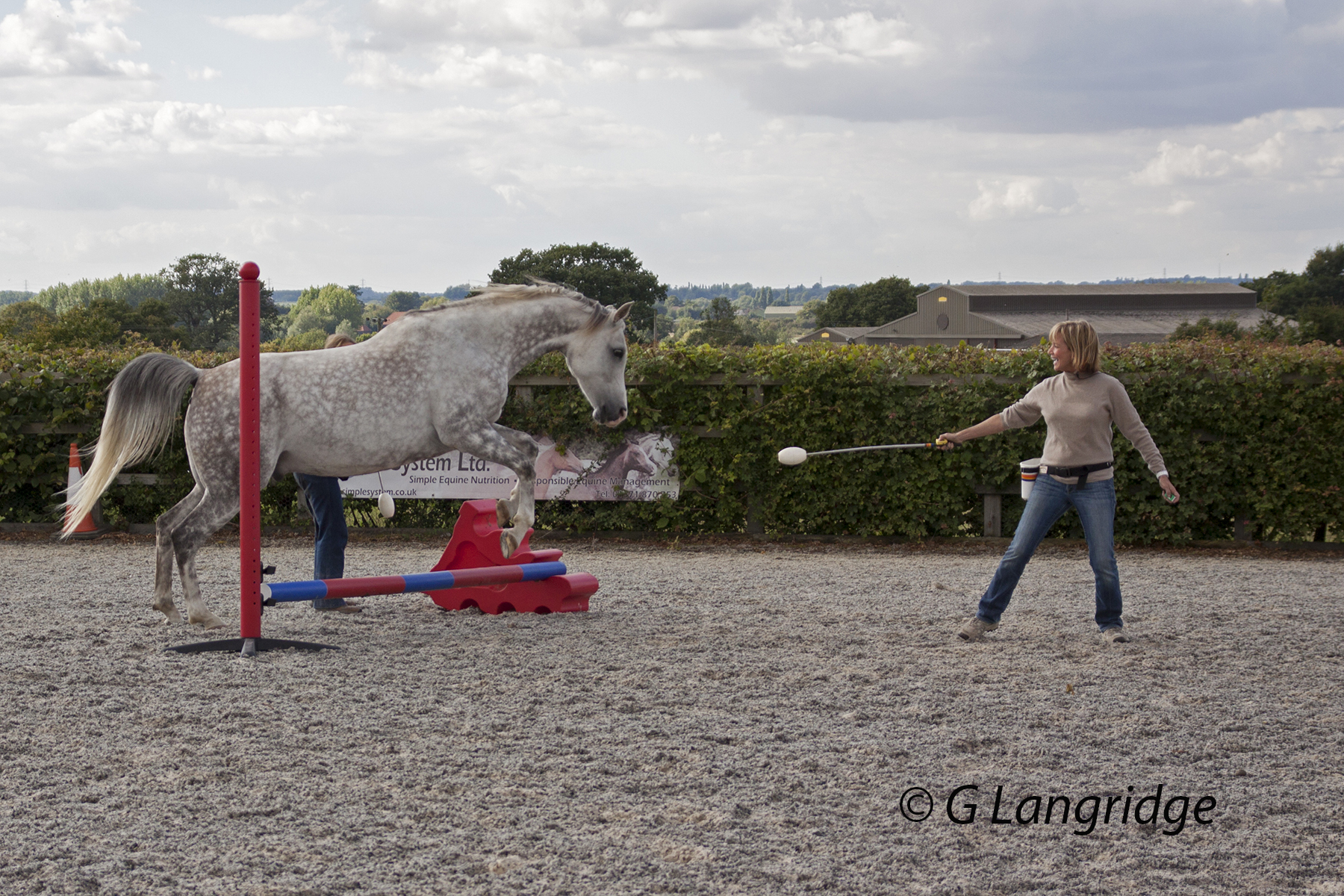
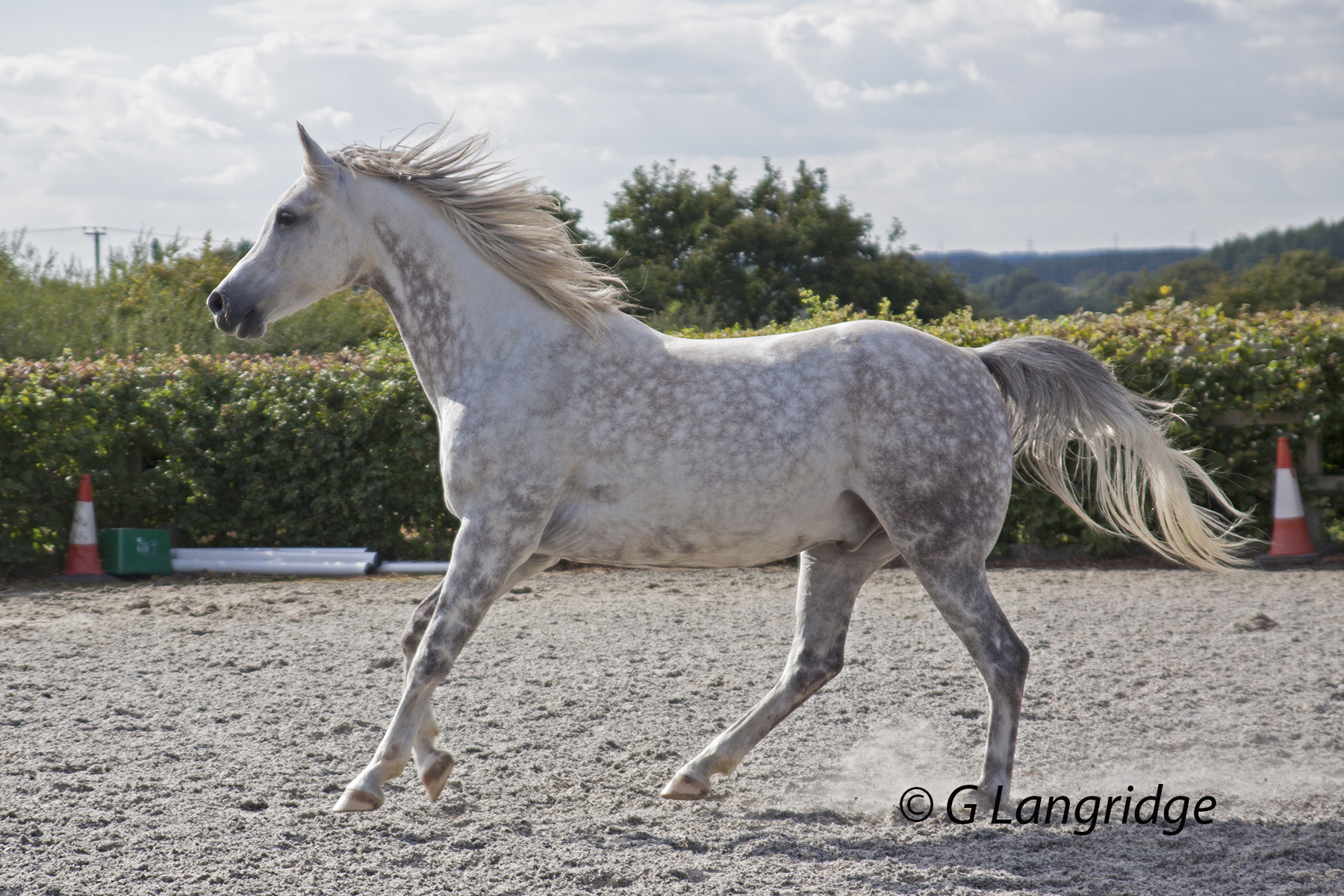
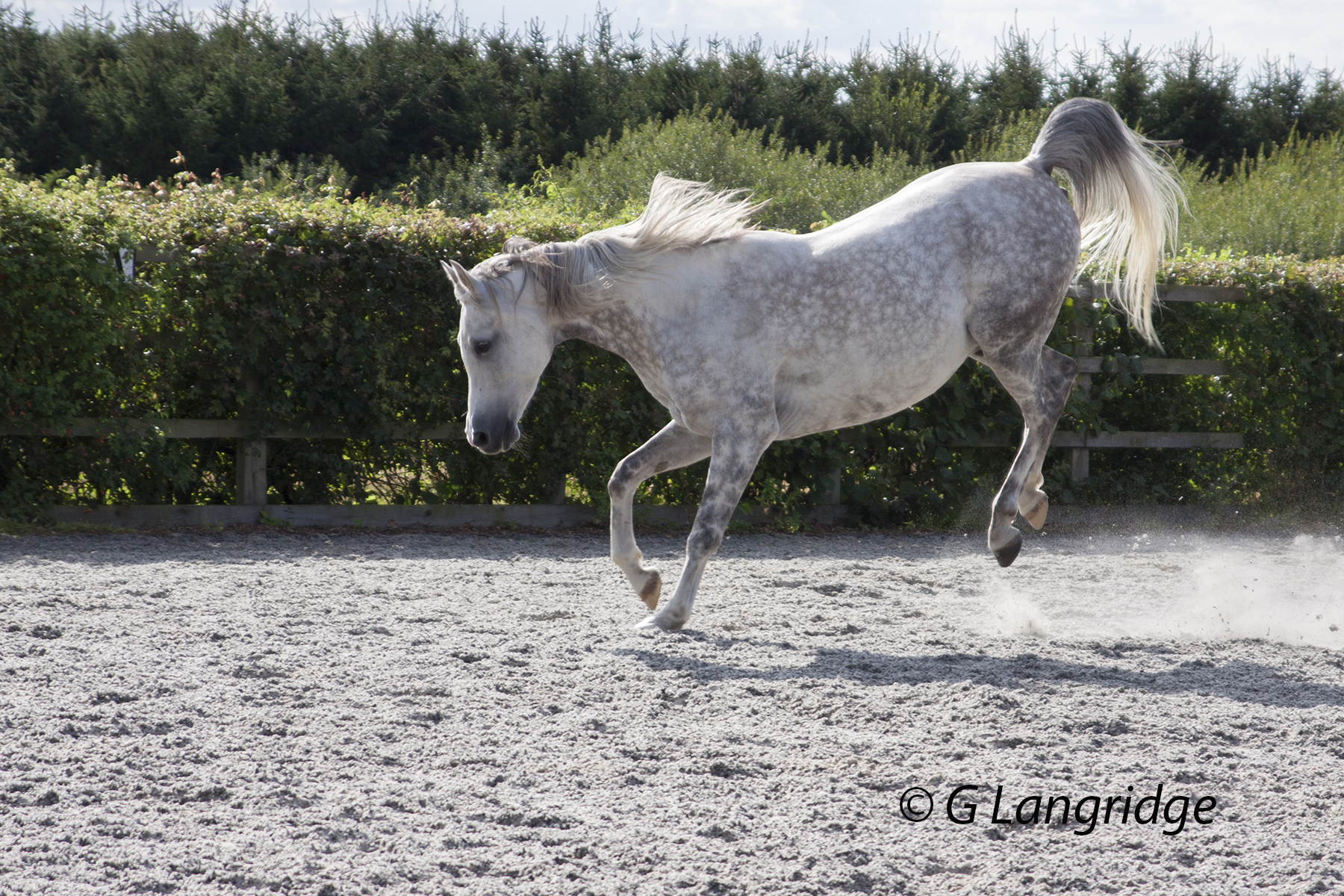
The final horse was the yard owners arab, the previous session had been more of a desensitising to the scary arena. Day 2 was about forwards – at liberty using the A to B technique, first sending the horse short distance between 2 people then longer distances and finally over a little jump.
The horse seemed to get the game quickly but Shawna – as always – seemed to be a horse magnet!
So it look a little while for him to go over the jump and not stop at Shawna.
Shawna then inadvertently demonstrated “greedy trainer syndrome”. This is where the trainer asks more of the horse than they can cope with, in this case Shawna raised the jump and over faced the horse. The fence was lowered and he jumped a couple of times and then was jackpot reinforced and allowed to run round freely, as an end to the session.
Grey arab horsegreya rab horsegrey arab horse

What did I learn – a great deal about being patient and not over facing or over stimulating the horse. Slow and sure is better than fast and furious.
How to use cones or similar to create forward motion – first with 2 people and then alone – sending the horse to targets.
Timing is crucial, bridge/click the exact moment the horse does the behaviour you wish to reinforce.
The value of stationary targeting – especially useful when trying to take horse out of fields. Although difficult if the horses are not all your own to train.

Relaxation

A non horsey friend came today for a little ride on Benny, we got some good trot sessions from a verbal cue and with him following my hand held target stick. My friend was surprised that positive reinforcement was not the norm in horse training, she has a background in special education schools so is well versed in the use of positive reinforcement.

My instructor was also surprised as I bridged and treated Benny for going past some scary jumps in the corner of the school during my lesson on Monday. He spooked at them and I took him up to have a look, bridged/treated as he relaxed next to them. Rode him past on both reins and bridged etc for calmly passing. Not many people it seems treat from the saddle in the conventional world!

Later when I took him to the field the tractor was moving large bales of straw, a bit scary but he targeted my hand and stood beside the tractor and even tried to touch it, bridged/treated and carried on to the field.

Terminology

An interesting note on Facebook about the terms people use to describe some horse training techniques. Some describe the release in pressure/release or the retreat in approach and retreat as a reward, this makes it more acceptable but is not correct. The release follows the addition of an aversive stimulus and is at the best relief but not a reward, it is negative reinforcement in that something the horse finds aversive is removed.

I must remember to use the correct terminology as well. Some groups on Facebook get very upset when I say that what they do is negative reinforcement, some admit they use it but don’t think positive reinforcement works for horses.

Personally I think we can use all quadrants of operant conditioning in training but keep the negative reinforcement as a safety measure, or use non-escalating pressure (e.g tension on a lead rope with no increase in pressure – just waiting until the horse relaxes or moves forward). Also the positive punishment can be used in extreme circumstances if it averts a dangerous situation.

New books

I received books about clicker training for Christmas – Alexandra Kurland’s Clicker Training for your Horse is excellent. Lots of sensible advice on using all quadrants of operant conditioning.
There is usually more than one solution to a problem, so the more tools we have in our tool box the better we are able to solve problems. Whether this is positive or negative reinforcement, or redirecting or counter conditioning we can decide what the best way is for our particular animal.
As my daughter has just acquired a foal all this information will be very useful. Many chapters are on foal and young horse handling.
So now after a festive family Christmas I will be off to the field to do more target training. Also I won’t chastise myself for using a little light negative reinforcement – using tactile cues e.g leg aids. What I don’t like is the escalation of pressure to elict behaviour, we now know there is a better way.

Animal Learning Theory

Animal Learning Theory

Animal learning theory is fascinating, I have read a lot about it but never really understood the different components. It is not a training method but can be used to construct or deconstruct a method.

Max Easey did a course for a group of us in West Sussex and we all went home with lots to mull over!

Classical Conditioning is learning through association, e.g. a horse will associate the sound of his owners car with the possible arrival of food. Or the wag of a finger can mean if he doesn’t do something an aversive will follow.

Counter – conditioning is presenting something they like at the same time as presenting a mildly fearful stimulus or in an environment they find mildly aversive.g treats and a scary object. It is also called perception modification. The food is only presented once they relax.

Operant Conditioning is learning by consequences:-

Positive Reinforcement – add something he likes as a consequence of performing a behaviour to increase the likelihood that he will repeat it under the same conditions.

Positive Punishment – add something he doesn’t like as the behaviour is happening to decrease/discourage a behaviour.

Negative Reinforcement – add and then take away something he doesn’t like as the behaviour is happening increase the likelihood that he will repeat it under the same conditions.

Negative Punishment – take away something or deny access to something he likes to reduce/discourage a behaviour.

All have pro’s and con’s, negative reinforcement e.g pressure/release has consequences for our relationship with the animal if we apply an aversive.

Positive punishment is also detrimental if we are associated with the aversive as we add something he doesn’t like e.g. a whip if he finds that aversive. A whip can be used as a target and not be aversive. Can cause fear which may lead to aggression or depression.

Negative reinforcement – where you put pressure on the animal as an aversive then take it away when he performs the behaviour harms the relationship if the animal looks on you as all or part of the aversive element.
An example would be back up – we ask for a back by making it uncomfortable for him to go forward – the degree of pressure used depends on where on the motivation scale the stimulus is in relationship to other motivations, so may need to be escalated. This is aversive otherwise the animal would not move, on the slightest move back the pressure is released to gain relief from the aversive. So eventually a wag of a finger makes him go back – this is so he avoids the aversive element. Likewise the draw towards you works because he considers you aversive so when you go back he feels relief when you remove yourself if you are the aversive.
Negative reinforcement can cause resentment and aggression.

This is not what I want with my horse so will be exploring positive reinforcement and negative punishment. So I reward the tries and behaviours I want and ignore and withhold the rewards for unwanted behaviour.

Timing is crucial with every motivator, as the animal needs to know immediately the consequence of his actions. All motivators (even positive reinforcement and negative punishment) can cause frustration if the animal doesn’t get what he wants.

Some mild steady pressure can guide him to the solution but it is better for him to investigate and find the answer for himself or use a target.

There will be times when in a extreme situation negative reinforcement/positive punishment may be needed for safety.

I will add more as I explore the bridge and target training with the horses.