Conditioned Responses

So you have a nice gentle horse who spooks. What do you do? According to one trainer chase it round with a bag on a stick and then when the horse tries to escape smack him with the whip.
Someone I know has also heard a trainer say “smack him hard and then give his face a rub to tell him you still love him”. Oh and smile whilst you whack the horse on the chin with the lead rope clip.

Yes we need to smile more whilst with our horses – it helps us relax but it does not make horse feel any better if what we do frightens them.
All those times you smack, tap or kick a horse to go forward you are initiating a startle response – even if you never hit your horse it has the same affect. Is hitting your boot or the sandschool floor or wall to startle the horse forwards any better for the horse?
Eventually you only have to pick up a whip or stick and the horse obeys – it looks like magic but it is a conditioned response.

In classical conditioning the first time the horse sees a whip or carrot stick it is a neutral unconditioned stimulus – it illicits no response. Once the whip or stick has been used as an aversive stimulus to provoke a response it becomes a predictor of the aversive so has been classically conditioned.

So the unconditioned stimulus is the whip when first seen, it is then paired with an aversive action and becomes a conditioned stimulus that illicits a conditioned response.

So the conditioned stimulus (CS) has been associated with the unconditioned stimulus (UCS) to create a new conditioned response (CR).

In some instances it may be the trainer who has this effect – ever seen a horse not want to be caught by one person when everyone else has no problems? It is certainly worth looking at why that might be – does the horse associate one person with having to do something he doesn’t like and the others are neutral in the mind of the horse – e.g he has no history of them schooling or riding him etc.

There are better ways to train horses, do we want our horses to be afraid to ask questions? Afraid to say no I can’t do that? Or do we want to have a horse who is not afraid to express an opinion – OK there will be some times when that opinion is unsafe but we can redirect their behaviour or teach an incompatible one.

These articles are worth a read – especially the last part of the first article where it gives this example

“Example:  A horse misbehaves with a farrier, and the farrier hits the horse several times with his rasp.  Because this horse is very sensitive, being hit causes him a lot of pain.  In this case, being hit is an unconditioned stimulus and fear is an unconditioned response.  In the future, whenever the farrier arrives the horse feels fearful and trembles.  The farrier is now the conditioned stimulus and the horse trembling is the conditioned response.  The initial event was so traumatic for the horse that it took just one pairing of farrier and pain to create the conditioned response.”

Insert any other person in the place of farrier and you can see how easy it is to create a conditioned fear response. It takes a long time to undo a fear response like this. So it may not be your farrier who caused the problem but the horse will associate any person who looks or smells like a farrier with fear.

This is why I am spending so long counter-conditioning Mojo. PS he was a super star for his foot trim yesterday.

http://www.thewayofhorses.com/03_15_behavior_conditioning.html
Classical Conditioning: How It Works With Examples

Mojo at his new yard.

Mojo moved to the yard where my daughters horses are, it will be easier if they are all together.
He was a little unstable travelling so it was a slow journey. However he arrived safe and sound and calmly walked off the lorry.

Day 2

Mojo in the new field

He was introduced to Smoke – my daughters appaloosa on the second day and had a run round. He is now in with the herd with 4 other horses.

Day 3

Mojo seems to have settled well. Put him in the school so he could have a look round. A big lorry went past so he had a little run round. Then I went in with him, as the cones were already in a line we did some targeting. He went from cone to cone on the walk on cue. Then I just stood by one cone and sent him to the cones either side of me. He was very calm and touched each cone and came back for a scratch or treat. Stood on his mat and lifted his feet. Then back to the stable yard for his feed. I picked out both front feet whilst he ate. He was just loose in the yard (with the gate closed incase he decided to go and investigate).

Feet revisited

After treating Mojo for feather mites with powder and neem based fly spray I have gone back to basics of foot lifting.

I now need to add more duration and get him better at people holding them.

We also did some more generalisation at the jump block as well as the ordinary one – which I missed off the video due to not positioning it correctly.

Impulse Control

Tuesday I saddled Mojo before I took him in the school. We did some standing at the mounting block and some flexing left and right at the block. I scratched rather than giving him food for most of the session, he did seem much better and seemed less frustrated. He was also better with the saddle today, he was eating his hay whilst I saddled him.
Then over the poles – first following the target and then without, only gave treats a few times.

Mojo stood perfectly still to have his saddle on today, not a twitch any where.
We just walked round over a pole, still not good at picking up his feet if the pole is off the ground.
He stood at the mounting block whilst I pulled down the stirrups, rocked the saddle side to side.
Must try long reining with the saddle next time.

Reinforcement Spectrum

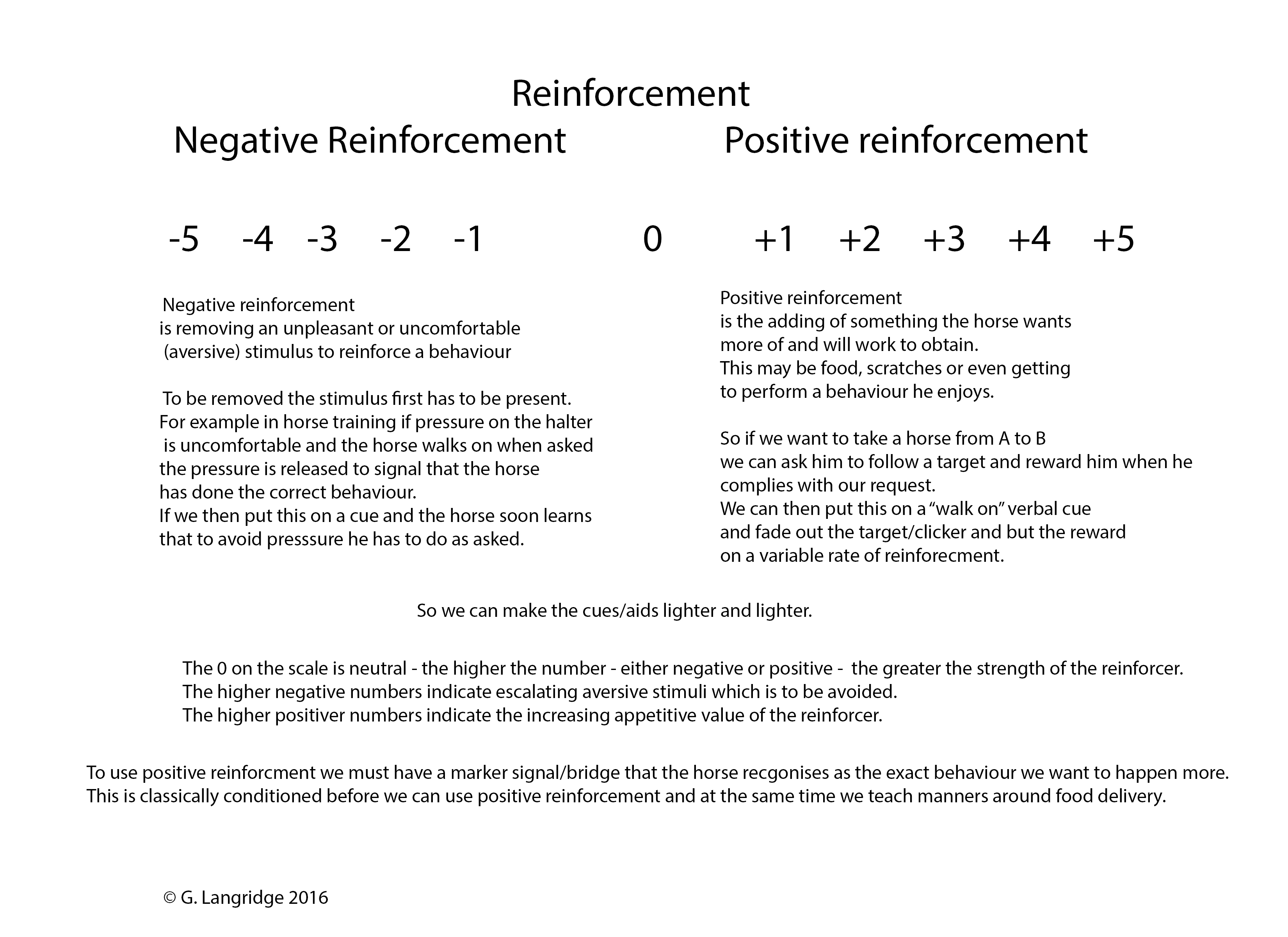
If we look at the use of negative and positive reinforcement as a spectrum we are all on this spectrum, whether we know it or not.An image of the linear aspects of reinforcement
Some are at the extreme ends of the spectrum, so they only use positive reinforcement or only negative reinforcement.

My personal view is that we can be anywhere along this line as long as we aren’t extreme, as long as we don’t make people who are moving along in their horsemanship journey feel guilty.

Many extremists do make me feel uncomfortable. No-one knows our horse better than we do, what suits one may not suit another. We must tailor how we train to individual horses.

Positive reinforcement is not the choice of many because they lack understanding at this moment in time. So please be understanding of where other people are on the reinforcement spectrum and don’t be an extremist or a pedant.

If we only use one aspect of operant conditioning we may do so due to not understanding how to use all four quadrants correctly.

We do need to be mindful of the emotions involved with negative versus positive reinforcement and learn to read our horses reactions as we train.

Lets us embrace our fellow horse trainers (we are all training every time we interact with the horse). It is up to us to watch what we are reinforcing – if you get unwanted behaviours look at what reinforced the behaviour.

If you need to go to the extreme end of the spectrum using negative reinforcement then ask yourself why? What has fallen apart? How can I retrain this without being extreme?

If we go too far to the positive end our horses may get over aroused and that is not good either.

Moderation in everything is good.

We must look at the whole horse and our husbandry as well, set them up for success.

Just as Iife is never just black or white using the principles of learning theory is not either.

Often when we are young we look at life as idealists and become fixed on things being good or bad. As we mature we mellow in our understanding and reactions and become more rounded and accepting of other peoples points of view.

Please let us be mature in our acceptance of everyone on their path of learning. Whether we totally agree with them or not others often have valuable experiences to share.

Punishment is another spectrum that I may explore on another day.

Saddling Mojo

Mojo being saddle – he was very good, a bit fidgety due to the noisy tractor coming round the corner and collecting hay from the barn. I didn’t get it done up as the girth seems too small and I didn’t want to try too hard to get it fastened. It did go up last time but I need another person to gently hold the saddle in place. At no tme during this was he restrained and he was free to leave at any time.

Mojo bending to touch a target, I am trying to get duration and he seems to understand the counting. We have got up to 4 as we did with the barrel last time.

Tried it with the feet too and managed 3 before I felt him want to put it down. I clicked before he felt like he was going to snatch them back. Missed that off the video as my camera switched itself off.

Hopefully he can be ridden soon and stay calm and relaxed about it. Love this little horse – he has such an expressive character.

Mojo Trotting a Circle

I bought a long lunge type whip, more like a stick though and then tied a bag on the end. This I used to get Mojo trotting round me – he loves to chase the bag so a longer one was easier for me to get him to trot a circle.


I now have a saddle but haven’t tried it on him yet. Will do that tomorrow and then take some photos for the saddler – it is the same size as the one he wore last week.

We had a bit of a disaster whilst foot trimming, he kicked out and somehow got his leg caught over the lead rope, and as he was tied up he panicked and broke both the head collar and the lead rope clips.
We let him settle and reassured him with lots of scratches. Then I held him so it wouldn’t happen again and he was very good with his hind feet. We do think he was a little shocked by it all and it took a while for the adrenaline to dissipate.

He seemed fine once it was all done, the other horses were being fed during the final foot being rasped. He looked but made no attempt to pull away even though he could see his tea.
He went out to the field once he had eaten his well earned tea.

Cone Cirlces

Mojo has to learn to walk forward on a verbal cue, without me or the target being a cue.
Here is our first attempt – he hasn’t seen the cones in a circle before. What a clever boy – he does learn quite quickly now.

Mojo and mounting.

Last week Liz came to help me with Mojo and saddling and mounting block acceptance. We found his saddle does not fit so didn’t walk him round in it, instead we did some desensitising to having someone lean over him. He was so good that Liz felt able to lay over him, and along his back, then sit up.
We then asked him to walk forward – I had him online as we hadn’t put a bridle and reins on him, he wlaked a step and then felt Liz’s legs on his side and he tensed and scooted off. Walked him in a circle and he calmed down and Liz hopped off.

We now need to desensitise him to legs.

Mojo, the barrel and frustration.

I have just finished a shaping course with Jo Hughes and Carolyn Jenkinson of The Academy of Positive Horsemanship

Mojo was much more animated during this course than the last one, he got quite frustrated too when the rewards were not forth coming. I waited for a behaviour I wanted on the 3rd day and Mojo decided that was not a good idea.

I now need (with Jo Hughes help) to improve his impulse control and put the mugging on an extinction program.

Otherwise he is good with following the target and doing the agility obstacles. The umbrella was no problem when I opened and closed it several times. He couldn’t wait to stand on the tarp and his staying still on the mat is better. I now need solid cues for all these behaviours.

Then onwards with the foot lifiting – he did hold it up for a few seconds last time and I need to do this everyday and be consistent and not reward his pawing and stomping.

This is a video of him with the umbrella.