Habituation in Horses

Just starting the third module on Jo Hughes Learning Theory course, I think courses like this are a must for all animal trainers, owners and those who have any interest in ethical treatment of animals. Along with the ethology of the species with which you intereact.
This module looks at habituation, desensitisation and the fine lines between this and, flooding and sensitisation.
I know I have been guilty of flooding a horse – e.g trying to desensitise Benny to wormers did not go well when I first got him, made him a lot worse.

If you put a saddle on a horse for the first time and allow it to buck it out or run until he accepts the saddle – with no means of escape – waiting until he is calm and has given in – that is flooding. That may seem obvious but there are much more subtle examples of flooding and some of it goes badly wrong.

Liz admits she flooded Smoke trying to clip him the year before last – it has taken a while to undo. Failed flooding usually ends up with a horse even more sensitised to the fearful stimulus.

Horses are neophobic so any new stimuls invokes the startle/fear respones. They do need to habituate and be desensitised to our envirnoment for them to be and feel safe. Desensitisation is a form of habituation in a controlled manner – stimulus at very low levels and gradually increased so as not to trigger a flight respone.
Flooding triggers a flight response with stimulus at full strength, with no means of escape, until the horse habituates – which may be never!

Thoughts on Desensitisation.

As I am doing a course with Jo Hughes of The Academy of Positive Horsemanship I am reading Dr. Jenifer Ziligs book How to Train Animals 101. The more I learn the more there is to be considered when training horses. Everything we do with them is teaching them something.

Although the course hasn’t got to desensitisation yet I have been seeing more and more videos of people flood desensitising horses.

Some ways to desensitise:
Habituation – exposure over time, also called passive desensitisation. A horse over time habituates to his environment and the weaker the stimulus the more rapid and persistent is the habituation.
This process can be very slow and if we wish horses to habituate to aversive stumuli e.g for possible medical intervention then counter-conditioning with systematic desensitisation is useful.

Counter-conditioning – this is classical conditioning using a reward to change the horses perception of a stimulus. “associating stimuli of opposite value, the combination of which acts to nullify the value towards neutral” (Dr. J. Zeligs – Animal Training 101)

Also 2 ways to approach stimulus exposure:

Systematic desensitisation – using small approximations of the stimulus, can be used with counter conditioning.

Flooding – unrelenting exposure to the stimulus – this is not a recommended technique.

More on flooding by Helen Spence – Flooding and Learned Helplessness

Also from Dr.Sue McDonnell about “sacking out” often used as a euphemism for flooding.
“Unpredictable Fear”

Recently I read this statement:

“Sometimes a horse will put up the greatest resistance just before he comes through. I call it ‘the darkest hour before the dawn’. When the horse has tried all the avenues of his natural instinct of self-preservation and puts up its greatest resistance; is when people will usually give-up or get mad. If they would just be patient, the horse is about to come around.'” – Tom Dorrance.

I would like to deconstruct this statement and ask why the horse feels he needs to take flight or to fight.

The horse has 4 reactions to a fearful situation: first they may freeze – look at the threat, then they may try to flee, if flight isn’t successful – as in a confined space – they may try to fight the threat.
If the threatening predator is still present after all these attempts the horse may give in and freeze or try appeasement behaviours to look less of a threat to the predator.
Then they appear submissive but can actually be in a state of learned helplessness.

In the above scenario the human is the predator – so what happened to the natural horsemanship principle that we should not act like a predator?

The above is a classic way to flood desensitise a horse – don’t give up until the horse gives in – as we all know flooding done incompletely may make the horse put up an even bigger fight next time. The problem is that flooding may never work even if done to the point of the horse giving in.

Why put a sensitive animal like a horse through such a process? If this was done to a deer or other prey animal it would be called cruelty.

So next time you go to a clinic or watch a video of horses being trained try to analyse what is actually happening not what the trainer says is happening.

Benny and Dougal

We spent Christmas and New Year in Devon with our daughter Sam. Sam has Benny and Dougal – the 2 cobs.
I rode Dougal a couple of times but the weather wasn’t very conducive to going too far.
On the last ride Sam and I went round the block and half way we had a tractor behind us and needed to get on the grass verge to let it pass. There were 2 ponies coming in the opposite directions who also had to come on the verge. Once the tractor had passed, Benny and Dougal tried to follow the other ponies and took a bit of persuading that they weren’t going the same way. We stood on the verge until they calmed down and reassured them.
We decided to walk the ride as Dougal was still a little excited after seeing the other ponies. Dougal jogged a little and Benny had to trot to catch up. They walked through the ford which was flowing well.
They were possibly a bit lively due to being in all night – the other rides had been afternoon ones.
Benny has settled well, although still hasn’t been out very far on his own.

Horse Charming

Max Easey – horse charmer extraordinaire has a website. An excellent resource for all your horse charming needs.

Horse Charming

Max has studied with some of the best positive reinforcement trainers both in the UK and the USA. As a linguist Max can explain in ways we can understand, making the learning process both educational and pleasurable.

Shaping and desensitisation.

Liz and I spent an afternoon with Suzanne Rogers – a behaviourist. We looked at shaping behaviour without using aversive stiumli or target training.
Shaping as Suzanne explained it seemed to me to be similar to desensitising with out using counter conditioning.
Break the task down into small steps and gradually desensitise the horse to for example having his feet picked up. Start with the goal and then work towards that goal at the speed the horse dictates. At no time must the horse be stressed or pushed to do things using pressure.
Another example is walking over a tarp or other item on the ground, first let the horse sniff and explore it – start with a small item at a distance. Walking over an obstacle can be achieved by using target training. The problem is that the horse may be lured by the prospect of a treat and not be completely ok with the behaviour. It may be more beneficial to use this type of shaping behaviour rather than using either an aversive – (rhythmical pressure) or a target. Let the horse discover for himself that the object is safe. This needs to be done in different contexts as horse may be OK with it in his own field but it will look difference in another place.
Interesting afternoon and much food for thought. This seems to be the type of training we have done in the past to get our horses to happily accept a bridle and to offer feet on the visual cue. We just didn’t have a name for it.

Cognitive-Dissonance Theory

Reading through my Udemy psychology course I have got to the part about Cognitive-Dissonance Theory. This may explain why some people may be uncomfortable with the How Animal Learn course.
Where there is a discrepancy between behaviours and beliefs/attitudes there is dissonance. So people reduce this dissonance by avoiding the behaviour or changing attitudes.
Asking why you do what you do creates opportunites for recognising inconsistencies and you try to find ways to avoid these inconsistencies.
So people try and expain away behaviours (ways of training) which they have just heard are not in the animals best interest and so justify their actions.
Or they change what they do to restore consistency and avoid the dissonance.
All the course does is to present the scientific facts, it is up to us as individuals to decide whether the way we train our animals fits in wth this.

Out of the comfort zone.

Interesting post from a friend today on Facebook about how her “How Animals Learn” course and posts made some people feel uncomfortable. Why? We need this information so we can make informed choices, life is never just black or white.
We are all learning all the time, the more information we have the better able we are to assess the horse and what he/she needs with regards to training and general care.
If the theory behind how animals learn is uncomfortable then it may be due to misunderstanding, misinterpretation or even misleading ways we have been taught in the past.
We all use learning theory in our everyday life without even knowing we do so, but when someones explains why it works that can makes us really think about what we do and why.

If I praise someone for a job well done or remove toys from my child to punish a behaviour I don’t want reinforcing, it all uses quadrants of operant conditioning. Whether it is viewed as reinforcing or punishment is up to the individual concerned. If my child didn’t want the toys anyway it may not be punishing but can be neutral or reinforcing so they misbehave again.

Take time to read and learn about how our horses, dogs, cats, children learn, it does make life a lot easier as we can pick the type of learning appropriate for each individual.

Animal Advocacy

If we have captive animals we are their advocate. We have a responsibility to care for their mental and emotional well-being as well as their physical well-being. So it is up to us to take time to learn about their ethology, anatomy and physiology, nutritional needs and how best to care for them in our man made environments.

Learn from experts, people who have studied these subjects.
As Dr Helen Spence said ” if you want to understand biology learn from a biologist; if you want to learn about a disease go to a specialist doctor or vet; if you want to learn about how animals learn (we are animals too) go to someone who has studied with experts in learning theory or a psychologist who has studied this to degree level.” This is a slight paraphrase of the actually conversation.
More information about Dr Spence http://www.helenspencehorsesense.co.uk/

There are so called “experts” in all these disciplines who do not have the correct knowledge. So if in doubt ask what qualifications they have, ask them to point you to research that supports their point of view. In this age of social media we all have to be careful who we take advice from.

It does astounds me that so many animal owners don’t know much about the anatomy and physiology of animals in their care, although it shouldn’t, as many people don’t know how their own body works.

When we were thinking of getting a budgerigar I bought a book about them, same when we inherited a cat. Before I owned horses I studied for BHS qualifications. Even though I was a senior nurse in a critical care unit I went to specialists when I wanted to learn first aid.

What I didn’t study was learning theory and I regret not doing so earlier.

Max Easey is a good source of knowledge, I did her How Animals Learn course – Max has studied with some of the best animal trainers world wide and is married to a psychologist so can check the facts with an expert.
Max has a post on Facebook about some of the language used by some horse trainers and what it actually means, don’t get sucked in by pseudo-science. Find Max on Facebook

We all want an ethical way of caring for and training our animals, so go out and ask the experts. We all utilise the principles of learning theory but don’t always understand why what we do works.

I can only speak for horses as I have more experience with them than other animals, but even with 40 years of riding and caring for horses I am still learning.

Traditional horsemanship, natural horsemanship and reward based training have a lot of common ground so we must all work together for the good of the horse.

Learning about behaviour

Had a lovely evening yesterday with Suzanne Rogers and some like minded people, learning about horse behaviour. It is good that there are many people who want to learn more – even though all yesterday were holisitic horse owners. They considered the whole animal – physical and emotional wellbeing is essential for a happy horse.
We looked at the five freedoms and got some ideas how to enrich the environment of stabled and field kept horse. Some horses need to be stabled for a variety of reasons but we can help them cope. Let them see friends over the door, place hay in different areas, put vegetables in their stable in a random fashion. Also it is good to look at whether a small holed haynet or a treat ball causes the horse to become frustrated – something I never really thought about before.
Therapy horses were also mentioned – we know that horses are good therapy for people with a variety of problems but we also need to look at what effect that has on the horses emotional wellbeing.
More information on this website – http://www.learningaboutanimals.co.uk/horseclub.html

Connection Training Day 2

Once again we gathered in the barn for a short session to recap and discuss what people wanted help with.

I will be brief about day 2 as many of the sessions were working on the same concepts.
A – B’s – where the horse is sent from point A to point B using a target.

The first horse a beautiful ex-police horse had been traumatised by the police work – she had bolted in the middle of a London riot.
The owner was doing a great job of regaining trust and now wished to add some forward movement.
Firstly the owner got the horse to go to her target and then sent it to Shawnas’ target. After a few moments Shawna used a cone for the horse to target. The idea is that the horse will eventually go to the target when directed so the owner can train without an assistant.

The cone has to be fairly close to start with and the second person with the target will hold the target on the cone. A target can then be placed on the cone and the horse will go and stand by that until called back and reward of course.

Short sessions of course – plenty of time to relax and process information both for the horse and the humans.

The next horse was doing the same type of exercise as she was not very forward going in the school without pressure. Some great targeting was achieved as the light bulbs went for horse and human.
All of this at liberty so the horse is free to choose.
How good for the horse to be free to decide what he/she wants to do and for them to work it out for themselves.

Then a nice little highland pony came in – similar work with the cones and targets – this time adding a little jump in the equation and send the horse from person to person over the jump.
This adds a little variety especially to horse that like jumping.

One of the horses in the afternoon was a young colt who had only recently been gelded and was still a little pushy around his humans. The owners wanted to start him using positive reinforcement but had a huge history of using negative reinforcement with previous horses.
I do find it difficult myself to not to revert to some of my previous habits when in a difficult situation so they were doing the best they could for this horse.
Shawna went in the field with this horse and got him to stand calmly for the treats but he was still showing signs of mugging and pushing. Shawna came outside and worked in protective contact over the fence.
Any sign of relaxation and him not looking for treats was rewarded.
Then Shawna tried the A to B’s with him and being a very bright youngster he soon got the idea, with lots of enthusiasm and lots of time outs.
The owners went away with lots of ideas to help him settle down.

There was a horse who had been Parelli trained initially and then clicker trained to accept certain veterinary treatments due to a severe injury – didn’t want to move or accept treats the previous day ( I didn’t see the horse the previous day as I went to book into my B&B during that session).
The horse was taken into an area of a field where obstacles were set out and allowed to stand on a pedestal as it seemed to find that rewarding and had no problem with accomplishing the task. Little steps to take to find something the horse likes to do.

All horses need to be allowed to explore and find things out rather than being micromanaged as some horses are who have been trained using pressure and release techniques. We have a horse who was like this and is still a little unsure sometimes about what to do.

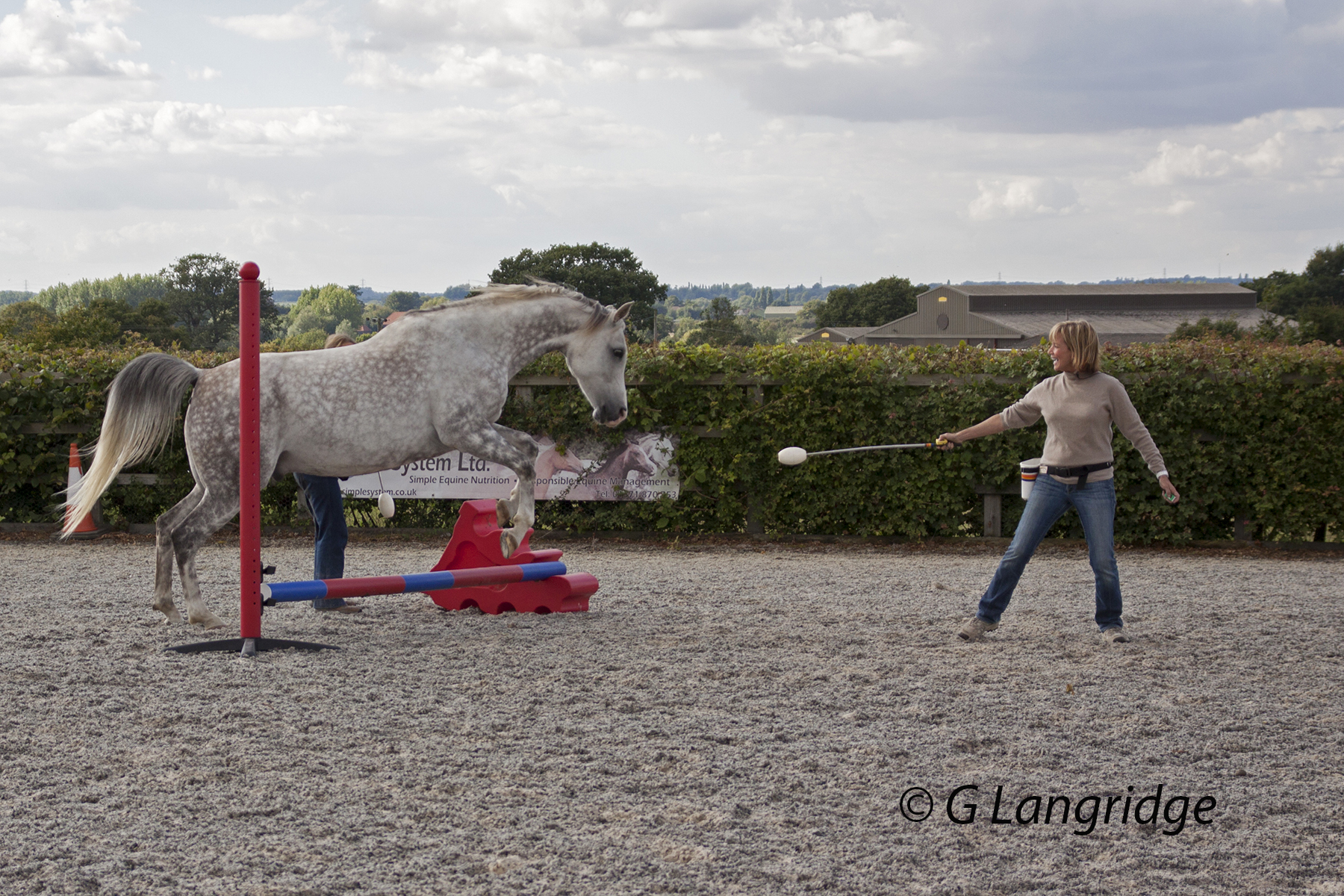
The final horse was the yard owners arab, the previous session had been more of a desensitising to the scary arena. Day 2 was about forwards – at liberty using the A to B technique, first sending the horse short distance between 2 people then longer distances and finally over a little jump.
The horse seemed to get the game quickly but Shawna – as always – seemed to be a horse magnet!
So it look a little while for him to go over the jump and not stop at Shawna.
Shawna then inadvertently demonstrated “greedy trainer syndrome”. This is where the trainer asks more of the horse than they can cope with, in this case Shawna raised the jump and over faced the horse. The fence was lowered and he jumped a couple of times and then was jackpot reinforced and allowed to run round freely, as an end to the session.
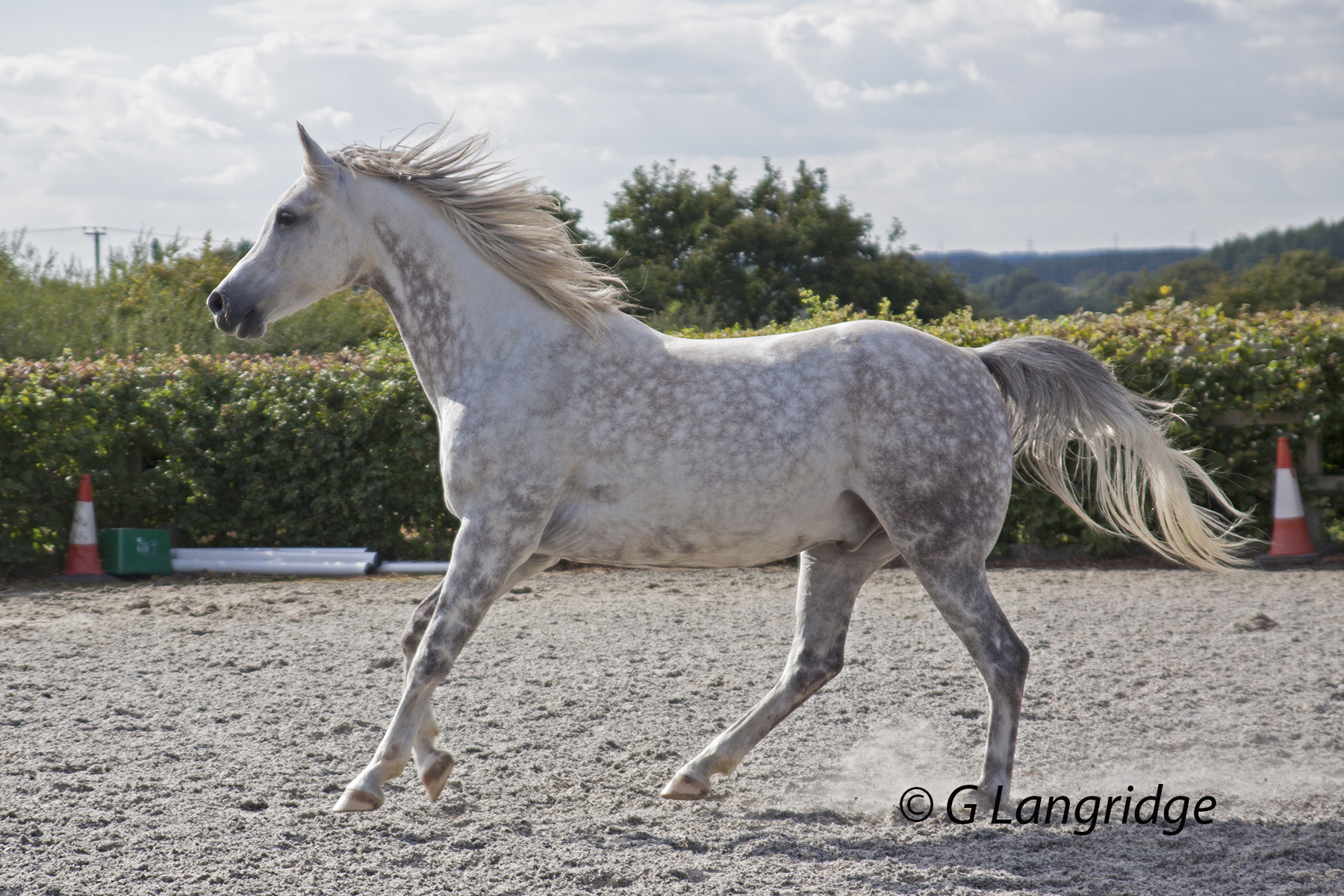
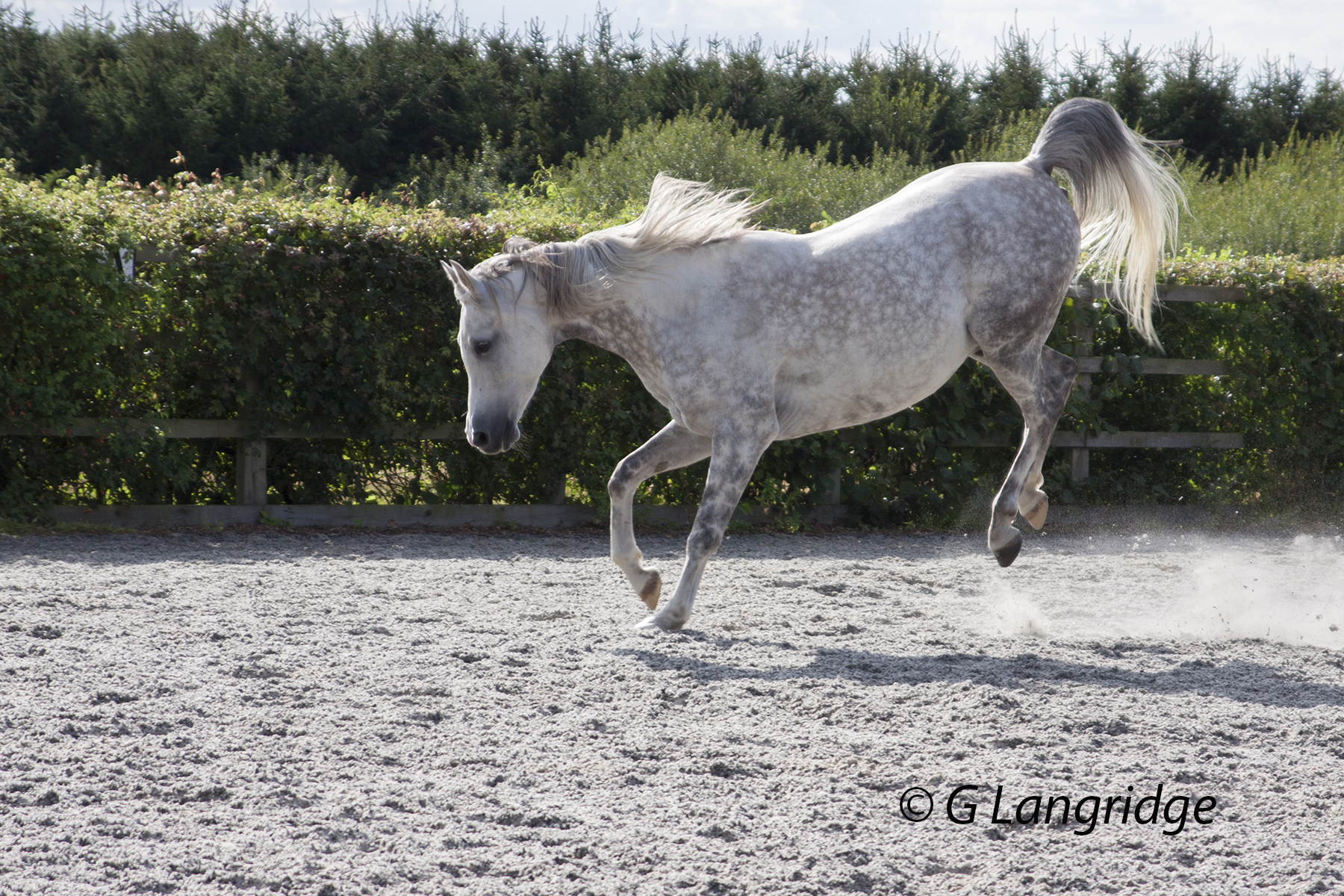
Grey arab horsegreya rab horsegrey arab horse

What did I learn – a great deal about being patient and not over facing or over stimulating the horse. Slow and sure is better than fast and furious.
How to use cones or similar to create forward motion – first with 2 people and then alone – sending the horse to targets.
Timing is crucial, bridge/click the exact moment the horse does the behaviour you wish to reinforce.
The value of stationary targeting – especially useful when trying to take horse out of fields. Although difficult if the horses are not all your own to train.