Terminology

An interesting note on Facebook about the terms people use to describe some horse training techniques. Some describe the release in pressure/release or the retreat in approach and retreat as a reward, this makes it more acceptable but is not correct. The release follows the addition of an aversive stimulus and is at the best relief but not a reward, it is negative reinforcement in that something the horse finds aversive is removed.

I must remember to use the correct terminology as well. Some groups on Facebook get very upset when I say that what they do is negative reinforcement, some admit they use it but don’t think positive reinforcement works for horses.

Personally I think we can use all quadrants of operant conditioning in training but keep the negative reinforcement as a safety measure, or use non-escalating pressure (e.g tension on a lead rope with no increase in pressure – just waiting until the horse relaxes or moves forward). Also the positive punishment can be used in extreme circumstances if it averts a dangerous situation.

New books

I received books about clicker training for Christmas – Alexandra Kurland’s Clicker Training for your Horse is excellent. Lots of sensible advice on using all quadrants of operant conditioning.
There is usually more than one solution to a problem, so the more tools we have in our tool box the better we are able to solve problems. Whether this is positive or negative reinforcement, or redirecting or counter conditioning we can decide what the best way is for our particular animal.
As my daughter has just acquired a foal all this information will be very useful. Many chapters are on foal and young horse handling.
So now after a festive family Christmas I will be off to the field to do more target training. Also I won’t chastise myself for using a little light negative reinforcement – using tactile cues e.g leg aids. What I don’t like is the escalation of pressure to elict behaviour, we now know there is a better way.

New Saddles

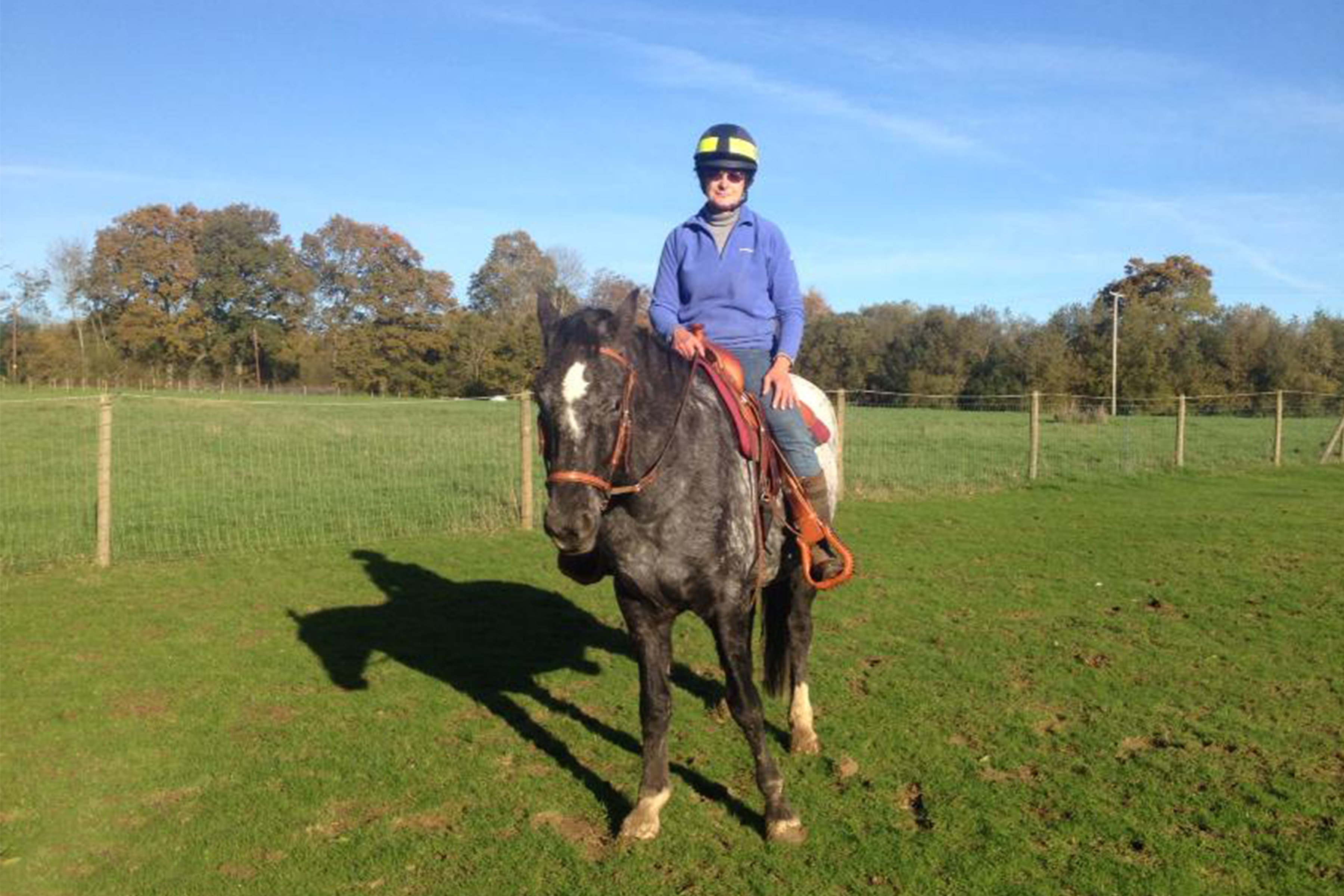
We now have new western saddles for Benny and Smoke – both Equiflex ones.

Very comfy to ride on and Benny is getting used to the strings – did some Systematic Desensitation and Counter Conditioning.

my cob Benny
Benny and his new saddle
Smoke and his new saddle.

More Bridge and Target Training

Recently I have been using a verbal bridge and target with Smoke and he is getting very calm with taking the treats. I made a target using a Kidz carrot stick with a glove on the end as I thought this useful for taking out riding. He follows it very well now.
Now Liz is back riding I thought I had better do some more work with Benny.

Today I went to work some more with my target stick with a glove on the end. Different glove today but they both (Benny and Smoke) targeted immediately. This glove is partly yellow so will be good to take out riding. The problem I have is that they all want to come into the arena. First I wanted Benny but he wouldn’t squeeze past Mel so Smoke got in first. Then after working with Smoke I opened the gate and let Benny in. Smoke then followed the target to the gate and eventually went back in to the field – with plenty of treats of course. Both were very good although Smoke seems to stick with me following the target for longer. Benny was very good at lateral flexions using the target. All at liberty as it stops me inadvertently adding a pressure cue from the rope. I really must train them to station but haven’t quite got the method fixed in my head.

This is all fascinating stuff and well worth the effort to perfect.

Animal Learning Theory

Animal Learning Theory

Animal learning theory is fascinating, I have read a lot about it but never really understood the different components. It is not a training method but can be used to construct or deconstruct a method.

Max Easey did a course for a group of us in West Sussex and we all went home with lots to mull over!

Classical Conditioning is learning through association, e.g. a horse will associate the sound of his owners car with the possible arrival of food. Or the wag of a finger can mean if he doesn’t do something an aversive will follow.

Counter – conditioning is presenting something they like at the same time as presenting a mildly fearful stimulus or in an environment they find mildly aversive.g treats and a scary object. It is also called perception modification. The food is only presented once they relax.

Operant Conditioning is learning by consequences:-

Positive Reinforcement – add something he likes as a consequence of performing a behaviour to increase the likelihood that he will repeat it under the same conditions.

Positive Punishment – add something he doesn’t like as the behaviour is happening to decrease/discourage a behaviour.

Negative Reinforcement – add and then take away something he doesn’t like as the behaviour is happening increase the likelihood that he will repeat it under the same conditions.

Negative Punishment – take away something or deny access to something he likes to reduce/discourage a behaviour.

All have pro’s and con’s, negative reinforcement e.g pressure/release has consequences for our relationship with the animal if we apply an aversive.

Positive punishment is also detrimental if we are associated with the aversive as we add something he doesn’t like e.g. a whip if he finds that aversive. A whip can be used as a target and not be aversive. Can cause fear which may lead to aggression or depression.

Negative reinforcement – where you put pressure on the animal as an aversive then take it away when he performs the behaviour harms the relationship if the animal looks on you as all or part of the aversive element.
An example would be back up – we ask for a back by making it uncomfortable for him to go forward – the degree of pressure used depends on where on the motivation scale the stimulus is in relationship to other motivations, so may need to be escalated. This is aversive otherwise the animal would not move, on the slightest move back the pressure is released to gain relief from the aversive. So eventually a wag of a finger makes him go back – this is so he avoids the aversive element. Likewise the draw towards you works because he considers you aversive so when you go back he feels relief when you remove yourself if you are the aversive.
Negative reinforcement can cause resentment and aggression.

This is not what I want with my horse so will be exploring positive reinforcement and negative punishment. So I reward the tries and behaviours I want and ignore and withhold the rewards for unwanted behaviour.

Timing is crucial with every motivator, as the animal needs to know immediately the consequence of his actions. All motivators (even positive reinforcement and negative punishment) can cause frustration if the animal doesn’t get what he wants.

Some mild steady pressure can guide him to the solution but it is better for him to investigate and find the answer for himself or use a target.

There will be times when in a extreme situation negative reinforcement/positive punishment may be needed for safety.

I will add more as I explore the bridge and target training with the horses.

Smoke and the bridge

Good session bridge training with Smoke – my daughters youngster. Went to catch him and he waited until I was about a foot away and came to meet me. Yesterday he just walked off as soon as I was anywhere near.
Took him to the arena and let him loose – he followed me to the gate and I went outside the arena and stood by the gate. He was calm and I bridged and he looked away fairly quickly to get his treat.
Next I introduced a target – he wasn’t sure about this and backed off. I stood quietly holding it and let him come to it, bridged for just sniffing and treated when he turned his nose away. He had a few moments of trying to get a treat but I walked away and let him calm down. He is still not sure of the target but he did touch it a few times so I left it there and went back in the arena, he stood next to me – no mugging and I gave him a few more treats. Then we walked back out into the field and I left him with some treats on the floor.

Hope this improves over the next few days – he didn’t walk so close today – usually he has his nose on my arm. Very pleased with Smoke, must not ignore Benny though.

Lesson

We just had a good lesson with Tracey Duncan, Benny still votes with his feet when under pressure but he needs to learn to stay connected and make life easier for us both. Lots of galloping around until he decided to stay more connected. We then went over to the sandschool, he was much less anxious this time and after a couple of times running off we got some nice figures of eights and trotting over a pole – after I tacked him up.
We then walked and trotted a clover leave pattern. He did try to nap to the gate so had to focus really hard to keep him straight and listening.
Ended the session with a canter, only half a school as I am not very good at sitting to it and felt he was getting strong towards the gate.
Used a stick on his shoulder to ask him to go forward – something I always did with my other horses as they bucked if I use it on their hindquarters. Just a tap and then wait 3 seconds before another tap if he didn’t respond.

Good session for us both – thank you Tracey.

I have been riding my daughters horse Smoke so hence the lack of Benny post – a friend has been riding him.

Feeling the heat!

Benny is feeling the heat, he has started itching and has rubbed some of his mane off. I bought some soothing cream to put on and washed it with lavendar wash.
I got his girth mixed up with Smokes so arrived to ride with a girth way too short. The solution was to ride bareback, managed to get on Ok and walk round but still not brave enough to trot.
Today armed with the correct girth I played with Benny but he didn’t seem very lively – much too hot to expend any energy! When I got on he was quite happy to walk or rather amble about. A little encouragement got him into trot and we did some good point to point and circles. A few steps of shoulder fore on a circle and some nice steps of shoulder and quarters in down the long sides.
I definitely need to get in the saddle more often, am waiting for my western saddle to arrive – then we will be off trail riding again.
Benny does seem more laid back now – I think he has at last settled down into the herd.

Back Care

Benny slipped over in the field when Mel spun round and he was in the way. I played online with him and he seemed fine at all gaits. A few days later when I went to ride him he seemed a little stiff, walked him round and did a few turns, circles, weave patterns and then smaller circles. He seemed reluctant to go forward and as i had the Light Rider on him I wondered if that was the problem, after changing to the cradle bridle he was no different. Luz got on to see it it was me holding him back and she also found him stiff and slightly lame on the side he fell. it is a good thing we could both recognise his soreness before it got worse.
Pat Carlton was contacted and she came a few days later to check him. After some manipulation for a sore back, poll and shoulder he had a few days of just inhand work.
Just as I was about to organise myself for a ride, Liz was kicked my Mel and has a sprained wrist. So I will ride on Sunday and also ride Smoke Liz’s other horse.

I have been to Sherree Ginger for some confidence coaching and am banishing my negative thoughts, a little at a time I will ride in the school, then the field and finally out on the trail. With a wonderful network of friends and family to support me. It will take time to reconnect my neural pathways to a positive state but I can visualise a time when I would get on anything. It is achievable and once my new western saddle arrives we will be out and about again.

More Connection

Been a little while since I did much with Benny, holidays and outings with my daughter and her horse have taken priority. I walked him in hand last week when I got back from holiday as my western saddle does not fit correctly so is for sale. I am awaiting a replacement and trying to save some more pennies! Ideally I would like an Equiflex lightweight saddle – so hopefully the Western Saddler can find one to fit.

So I have been watching some Equine Liberty Sports videos to give me something to do in the meanwhile. We have done the first few exercises successfully, Be With Me, Come To Me and hip over.
Today I had him on line to start and practiced the classical inhand position, used a pointing finger to ask Benny to walk on next to me but with me at his shoulder. This he managed very well and turned with the hip over movement to go the other way.Next asked him ot circle with the finger pointing where I wanted him to go, he tried to leave once but as we were only walking I just upped my energy and pointed to get his attention back.
I then turned him loose whilst I ate my lunch and he grazed. After lunch I walked next to him as he wandered around and when he grazed I bent down and pulled up some grass – this really did get his attention. Then some liberty play, I asked him to trot and using the pointing finger and a stick as a guide he trotted round the arena, when he tried to come in I upped my energy and pointed again to ask him to go round once more. stopped him with a look at his hindquarters the first time a and drew him to me, a rub and a scratch were all he got and he didn’t even ask for a treat! The subsequent times I stopped him all I said was “whoa” and he stopped then turned to face me and I invited him to come towards me. On asking for canter I used voice commands and again he stopped on a whoa. All in all a good session, he did get a treat afterwards.