March Update

Mojo has been struggling with foot lifting, I now have help in the form of Kristie Jillings of Equine Harmony

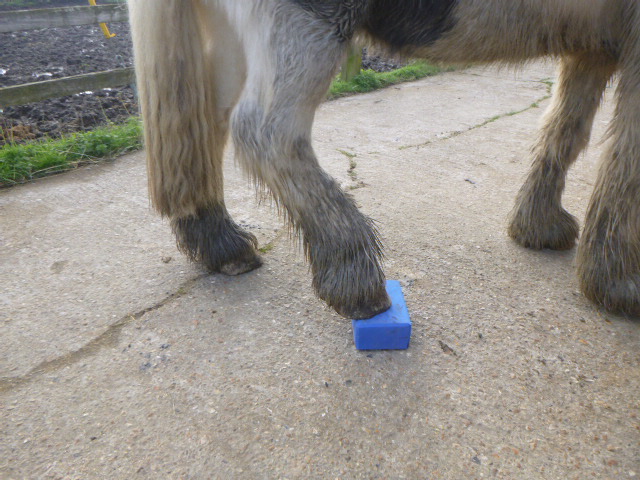
We have been training for duration of the foot lifting and now have some yoga blocks to help with his balance. So he puts his feet on the blocks for an increasing duration. So far he is fine with the fronts on the blocks and will let me place his hinds on them.

The idea is to get him to step on with the fronts one cue, then try and do the same with the hinds. Then transfer this to the hoof stand.

We continue with his stretches and exercises over raised poles and he is moving better now.

Mojo with his hind foot on a yoga block
This is his more difficult hind. Photo taken by me 5 year old granddaughter.
Mojo doing pole work.

Mojo Up Date

It has been a while since I wrote anything on this blog, winter is always a difficult time of year for horse owners. Our fields are muddy and Mojo is a mud monster. He is still out unrugged, he does come in if the weather is particularly foul or the fields get too poached.
Consequently I have only done basic care with him, a little bit of target training on the yard so he remembers, and some standing still on the yard too. He has a stationary target and stands there and eats hay whilst I groom him or pick out his feet. I am revisiting foot lifting as his fronts are perfect now but he still struggles a bit with the hinds, some times more than others. One of the liveries said when she got him in from the field he seemed a little stiff – probably slipped in all the mud. I checked him and did his stretching exercises – I do these with a target stick and he was very supple laterally. He is not so good at stretching down between his front legs but that was more that he was unsure of where the target was at first. He stretched his near hind but was a little stiffer on the off side, this is always the side the physios pick up on.

We have regular physio visits and/or massage therapy. Plus saddle checks – not the I sit on him very often but it is important that he is comfortable.

I do hope the wet weather stops soon and the fields can recover, we are fortunate to have a good school that doesn’t freeze or flood, so I can take him in there to do pole work or long lining – I must get on and do these again but can’t rustle up the enthusiasm in the wind and rain. Horses like just to be horses and as long as they are cared for and happy they will be OK. Plenty of forage in the field and friends to groom and hang out with, some shelter by the trees and a stable to come in to occasionally to dry out and have a sleep.

I will make a list of things we need to revisit and reintroduce tack in the school before riding him, I don’t want him always to associate the arena with being ridden. The arena needs to be a place where fun things happen and I wont ride unless I know he is OK with everything to do with being ridden.

Gone are the days when I just got on a horse, even when they are fidgeting or moving away from the mounting block – yes I have done that in the past but I know better now. This equestrian journey is never ending – as it should be for everyone. We never know everything and learn all the time – if we don’t we get stuck in the past and never progress in our horsemanship.

Mojo Ridden

Mojo was ridden by Liz Hibberd, he was very cool today, we used the “walk on” cue and the target. Then phased out the target and Liz just cued him to walk.
He had one little spook when he trod on his own feathers – I really must cut them again.


He even had a little trot at the end, then lots of praise, scratches and treats.


Liz also sat on Indi for the first time and walked a few steps, we used my hand as a target and then the “walk on’ cue. Indi was very relaxed and we called it a day after a few steps.

Is the avoidance of an aversive a reward?

Is release of pressure a reward?

Following on from the previous post I have been researching the role of dopamine in emotional reactions. A very limited literature search – the subject is vast and I am not an expert. There are of course other hormones and neurotransmitters involved in all processes.

Dopamine is a neurotransmitter involved in movement via the substantia nigra, but dopamine is also produced by the ventral tegmental area of the brain. It is this area that seems to be stimulated when a reward is received or anticipated. Dopamine in these instances make us feel good. (1)

In horse training, when using the addition of an aversive stimulus to initiate a behaviour, e.g traditional and natural horsemanship, it is the removal of the aversive stimulus that is reinforcing. This is negative reinforcement as described in learning theory.

Research has shown that a transient release of dopamine occurs when an aversive stimuli is removed. (1)

So if this is correct then it may be a reward, but horses don’t seem to actively seek the application of an aversive event to gain that “reward”. They actively learn to avoid the aversive stimulus, by complying at the first indication (a cue) that an aversive stimulus might follow if they don’t comply.

Research goes further to explain this phenomenon –

“a new theoretical explanation of conditioned avoidance: (1) fear is initially conditioned to the warning signal and dopamine computes this fear association as a decrease in release, (2) the warning signal, now capable of producing a negative emotional state, suppresses dopamine release and behavior, (3) over repeated trials the warning signal becomes associated with safety rather than fear; dopaminergic neurons already compute safety as an increase in release and begin to encode the warning signal as the earliest predictor of safety (4) the warning signal now promotes conditioned avoidance via dopaminergic modulation of the brain’s incentive-motivational circuitry.” (2)

It is clear from the above that if we use aversive stimuli we must put a cue in place to predict the aversive – so the horse can avoid the application of the aversive.

When we use appetitive stimuli to reinforce a behaviour it is the anticipation of the appetitive that initiates the release of dopamine. (1) So horses actively seek the reward and can get quite animated in doing this and may offer more than we expect.

So in training should we limit the use of aversive stimuli and increase the use of appetitive stimuli?
Horses may feel good if they avoid an aversive stimulus but how do they feel during the conditioning (training) process.

Hence the title “Is the avoidance of an aversive a reward?”

All these are fascinating questions and I do not know the answers – but it does make me more aware of how and why horses learn and how they may feel about the process.

References
(1) https://www.psychologytoday.com/blog/mouse-man/200904/what-is-dopamine
(2) http://www.ncbi.nlm.nih.gov/pubmed/23759871

What’s in a word?

What is in a word?

Take learning theory and peoples interpretations, some say release of pressure is a reward some say it is a relief at best.

What is certain is that in operant conditioning terms it is negative reinforcement, therefore for the release/relief to happen there has to be an aversive stimulus applied first. Once the animal complies with our request the stimulus is removed.

So it may be leg aids – use and remove as soon as the horse complies, it may be ground work – apply an aversive stimulus to form a behaviour e.g teaching a horse to back up. Often people teach back up using a light touch on the chest – getting firmer until the horse backs, the pressure is removed on the slightest of movements.

I don’t wish to argue about various methods of horsemanship – it is a personal choice but the more I learn about the emotions involved the more I wish to use positive reinforcement as much as possible.

We do live in a world where most people use aversive stimuli to form behaviours, so our horses need to understand other peoples cues.

Dictionary defintions:

Reinforcement – The action or process of reinforcing or strengthening; The process of encouraging or establishing a belief or pattern of behaviour

Stimuli – A thing that arouses activity or energy in someone or something; a spur or incentive; A thing or event that evokes a specific functional reaction in an organ or tissue

Reward – A thing given in recognition of service, effort, or achievement; A fair return for good or bad behaviour:

Relief – A feeling of reassurance and relaxation following release from anxiety or distress; The alleviation of pain, discomfort, or distress

Release – Allow or enable to escape from confinement; set free: Allow (something) to move, act, or flow freely; Remove restrictions or obligations from (someone or something) so that they become available for other activity: Allow (something) to return to its resting position by ceasing to put pressure on it:

Aversive – Someone or something that arouses a strong dislike or disinclination.

References
http://www.oxforddictionaries.com

http://www.equitationscience.com/aversive-stimuli – some are challenging the notion that horses are not safe unless we use negative reinforcement.

Connection Training
Academy of Positive Horsemanship

Read and decide, which would you prefer for yourself? Also worth looking at the emotions involved in negative versus positive reinforcement.

http://www.thehorse.com/articles/33927/study-human-interaction-shapes-horses-negative-emotions

Jaak Panksepp describes the 7 basic emotional systems all mammals exhibit.
http://www.ncbi.nlm.nih.gov/pmc/articles/PMC3181986/

How Horses Learn, Feel and Communicate

This is the feedback I gave Jo Hughes about the course I am studying:

How Horses Learn, Feel & Communicate

I am studying a course run by Jo Hughes of the Academy of Positive Horsemanship, on how animals learn, feel and communicate.
This is an extremely useful course for anyone who has contact with horses, we all need to learn to communicate and ethically train horses. Horses are learning all the time – whether we are actively doing a training sessions or just taking them to and from the field and stable.
This course is a mixture of video presentations, articles from various websites and questions to get us thinking about why we do what we do and how the horse may feel about this. The scientific content is at a level anyone can understand.
One example is looking at videos of flood desensitisation and assessing the possible emotions felt by the horse. Then we had to find videos to illustrate this technique. It was a bit daunting as sometimes it is difficult to decide what is or is not flooding. P.S flooding is not a technique that is recommended.
Jo is very patient and makes excellent videos presentations, she is always willing to answer questions, and assist in our training problems.
I can whole heartedly recommend this course.
Gill Langridge

If you wish to know more go to her website and sign up for the next course.
Academy of Positive Horsemanship

We owe it to our horses to learn as much as possible, the more tools in our toolbox the better able we are to pick the best for our horse.

There are no rules or methods, only principles – every horse is different and we need to be flexible in our handling and training.

The more I learn, the more I realise there is to learn, happy learning to everyone, where ever you are on your lifelong journey of never ending self-improvement.

Learning about behaviour

Had a lovely evening yesterday with Suzanne Rogers and some like minded people, learning about horse behaviour. It is good that there are many people who want to learn more – even though all yesterday were holisitic horse owners. They considered the whole animal – physical and emotional wellbeing is essential for a happy horse.
We looked at the five freedoms and got some ideas how to enrich the environment of stabled and field kept horse. Some horses need to be stabled for a variety of reasons but we can help them cope. Let them see friends over the door, place hay in different areas, put vegetables in their stable in a random fashion. Also it is good to look at whether a small holed haynet or a treat ball causes the horse to become frustrated – something I never really thought about before.
Therapy horses were also mentioned – we know that horses are good therapy for people with a variety of problems but we also need to look at what effect that has on the horses emotional wellbeing.
More information on this website – http://www.learningaboutanimals.co.uk/horseclub.html