Counter Conditioning

Counter conditioning alongside systematic desensitisation is very powerful. If we do slow desensitisation we can get horses accepting of aversive stimuli, but if we pair that with an appetitive – food or scratches or anything the horse values and wants more of – then we can change how they feel about the aversive. It can even become something they want, rather than something they just tolerate.
Too often we halter horses and spray them, clip them  etc, without thinking about how the horse feels, horses sometimes provide a lot of feedback in the form of pulling away, fidgeting or even being openly petrified, but often they just shut down as they feel they can’t say “no”. So what do some people do in those scenarios were they acknowledge the horse has a problem? They may hold them tighter, tell them off and even sedated them to be clipped.
How much better is it to take time to desensitise and counter condition? Well Mojo was petrified of fly spray, the first time I sprayed him was in his stable and he nearly squashed me against the wall he spooked so much.
What did I do about it? Well I started systematic desensitisation and counter conditioning. Starting at a distance with the spray so he noticed but did not react, all at liberty – then they can flee if necessary.  I used my verbal bridge signal “good” and rewarded him – sometimes with a scratch, sometimes with a treat.
Gradually over the last few weeks he will stand next to me and not flinch when the water is sprayed, (I used water to conserve the fly spray – but need to counter condition the smell of the fly spray once he is OK being sprayed.)
Today I did this in the field and he stayed and stood still whilst I sprayed water high in the air so the droplets actually fell on him, a few weeks ago he would have startled big time and run off.
I can now spray his legs from about a metre away but if I get too close he looks aways – so there is still some conflict present.
We must be very mindful of avoiding conflict – he wants the treats or scratches but is still unsure about the spray – this is why slow progress is better than force.
Clipping will be next but as he was sedated last time it may take much longer to overcome that fear.
He is still a little touch sensitive on his head, but getting better, he was targeting my hand today with his cheek – that is a new behaviour and not solid yet.

His feathers are still a sensitive area, but I can brush them and put cream on the sore bits if I run my hand down his legs, he gets a big butt scratch for that.

I have had Mojo for just over 2 months now so he has come a long way. He is very quick to learn new things and very eager to participate in the shaping programs.
The Plan

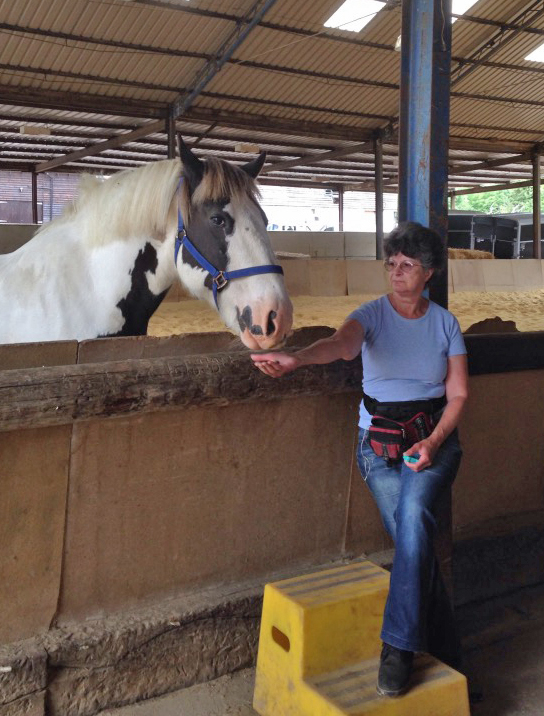
Well I now have a plan for Mojo. He needs more confidence to explore on his own, he is quite happy to follow and be told what to do, but he now needs to learn he has a choice. I need to make him a toy box to spark his curiosity, also some novel objects to use in desensitising him to being randomly touched all over. This will all take time – he is totally unconfident on his own, he will follow on a lead rope and if I use targets at this stage he may well follow but still not be completely unafraid.

I need to spend time desensitising to touch before completing the fly spray desensitising.
Also his feather mite problem needs addressing before doing the foot handling training.

I will take him for walks around the wood to get him confident – it took a long time to get him to the field without resorting to escalating negative reinforcement. A little negative reinforcement – in the form of pressure on the lead rope and immediate release when he walked forward was needed, as he wasn’t confident to walk through the woods without the support of another horse.

Catherine Bell gave me some good advice – I now need to remember it all and write a proper shaping plan.

Catherine put some objects in the school to let him look at and approach if he wanted, he did walk over the tarp when I had him online. He was not confident to approach the bunting, but he didn’t spook or run away.

At liberty he investigated the bag with the objects in, then wandered off to eat the grass at the edge of the school.

The school sessions will be at liberty so he can investigate on his own, also the desensitising sessions will be with out the counter conditioning – we don’t want him to feel he has to put up with being touched, fly sprayed etc because he wants the treats. We can cause horses to approach fearful things with clicker and target training but it may not help them overcome their fear, this is a form of approach-avoidance conflict.

I get the feeling he would do things if I insisted but he would not be completely comfortable and it is so easy for these types of horses to be pushed to and over threshold. There were no big signs of fear or anxiety just very subtle facial expressions – a little triangulation above his eye, a little flaring of the nostrils and some forced exhalation but not exactly snorting.

Mojo Week 2

Week 2

Monday

The podiatrist came today to do Mojo’s feet, he is very sensitive to having his feathers touched but obviously I haven’t had time to do anything about that yet. The podiatrist is very gentle and takes whatever time it takes to get Mojo calm and relaxed – I stood by his head and at one point he almost fell asleep.
I had spent some time with him in the stable grooming and getting him to stand and touch his headcollar before putting it on, I will have to desensitise and counter condition haltering too – he does tend to turn his back when he doesn’t want something. I just stood in the stable – ignored the turning round and held out the halter. Bridged and treated him touching it a few times, I would have liked to take longer with more small sessions but had to halter him to take him out to the podiatrist. Therefore I had to put on the halter sooner than I would have liked but he was calm about it and did get a jackpot.
He stood nicely for the podiatrist who was pleased with him, I need to also teach him to pick up his feet on a verbal cue, I am glad I had Benny to train before Mojo as I did teach him to pick up his feet on a cue.
 Previous horses have always picked up there own feet, I have no idea how I taught it but I would think it was just classically conditioned. Likewise with haltering and bridling – I was at a loss when I got Benny as he didn’t seek the halter or bridle like my previous horses.
So much to learn and get right!

Tuesday

This morning I just went and groomed him in the stable – no treats or bridging. He was sleepy as had just come in for breakfast so he let me touch him all over and groom all his legs, and put on the cream on his scabby bits (mallenders) with out any fuss.
I picked up 3 of his feet to clean them but the 4th remained firmly planted. More work is needed in getting him to pick them up voluntarily but I will wait until I have watched Jo Hughe’s new video and know I am conditioning the clicker correctly.
He is OK now with the sound of the clicker – the quieter one – so that is all good.
The problem I have is that when he gets fed up with anything he turns his back on people in the stable. I just stood still until he decided to turn round again – I think it may be better to do much of his training in a larger space.
It is making me think though – I am determined to use as much positive reinforcement as possible but do feel at the moment it might be a mix of that and mild negative reinforcement.

This afternoon I have found something else that Mojo doesn’t like – fly spray! Plenty for me to do with him before even thinking of riding him. He likes grooming so the touching all over isn’t really an issue – just sudden movements seem to startle him. He does have a tendency to turn his rear end towards people when he has had enough attention. I think that must have been reinforced by people leaving. I just stood by the door – just incase I needed to exit quickly but it didn’t feel like he was going to do anything untoward. He soon turned round and came back for some more grooming.

Lots of systematic desensitisation and counter conditioning (classical conditioning) for me to do before training anything else.

Conditioning the bridge signal

To commence reward based training with Mojo I have first to classically condition the bridge signal. A bridge signal is to tell the horse he has done the correct behaviour, it is applied as soon as the behaviour we want occurs – the reward can then be given once the horse is calm and relaxed e.g not mugging or looking for the reward.

To condition the signal we start with the unconditioned stimulus(UCS) (food or scratches etc) and get an unconditioned response (UCR) – the horse accepting the reward. We then pair the UCS with a neutral stimulus (NS) (the bridge signal) – this can be a verbal noise or a clicker. The NS then becomes a conditioned stimulus and the UCR becomes a conditioned response as it becomes associated with the reward. So the bridge signal says “yes that is what I want”.

I decided to use a clicker to mark as a bridge signal.

Day 1

My first clicker session with Mojo didn’t go too well. My aim was to classically condition him to the clicker – so pairing the sound with the reward. However poor Mojo jumped and ran off when I clicked, it was a rather loud clicker – so now I have a softer sounding one to use to desensitise him to the sound before going any further.

Day 2

I have just been down to see him and his owner was there so we took him to the indoor school and I tried with the quieter clicker and he was fine. A few times with that and I tried the louder one and again no reaction apart from looking for a treat. I got him to stand nice and calm with his head straight. So I now feel happier about it all.

For more information about the terms used here Karen Pryor as a list which I found useful.

Clicker Training glossary

Jo Hughes is in the process of making a video to show how to get the head straight and to help with impulse control – so I will watch that before doing any more with Mojo. I am away for a week so will recommence once I come back. Mojo is out in the field all day and night, so is enjoying just being a horse with his friends. I will of course go and see him in the field before I go.

Conditioning the bridge signalConditioning the bridge signal
Conditioning the bridge signal