April 2016 Update

What a difference between today when I fly sprayed Mojo and last year when he tried to jump on me.
He was eating his hay and just stood whilst I sprayed him on the left side. Then he decided the smell was a bit strong, but after a sniff and a few treats he was ok when I went round the other side.
I also long lined him and he is OK on the left but still tried to put himself back on that side when I changed sides. So I got his frisbee and threw that in front of him and he walked forward and forgot all about me being on the “wrong” side.
Then added the legs and he walked round with them on. I took off the lines and pulled the legs off and pushed them off and tapped his rump with the boot. All he did was come a bit closer to the mounting block.

I have been working on leading him from the right side and he is getting better. A few days a go I had him at liberty and we walked round the school but he did try to move to the other side. So I got the frisbee and threw that for him to follow, once he was concentrating on that he was fine and very relaxed going forwards. Yesterday I did it over some poles and he was long and forward over them following the frisbee.

He did leave once to go and see if the people by the fence had anything for him, but he soon came back.

Buyer Beware!

There seems to be a rise in video courses aimed at helping people help themselves. The expansion of social media makes it easy to disseminate information to the masses.

Whilst I feel there is a need for this type of learning and there are some excellent courses available online – please choose carefully.

Choose a course that is backed up by the science of learning, where the providers can answer your questions personally.

Recently I studied with Jo Hughes of the Academy of Positive Horsemanship and learned about the ethology, and body language of equids and how emotional systems cannot be separated from behaviour. This along with learning theory gives us the tools to help our horses.

Connection Training has just launched new courses on the theory and practice of positive reinforcement. Connection Training have many courses from basic horse handling to training lateral movements inhand and under saddle all using positive reinforcement.

Horses are individuals and we need to tailor our training to each one. There is no one size fits all – so next time someones says a horse is right brained or left brained ask them exactly what that means in terms of behavioural science. We know from human psychology that left and right brained theory is inaccurate. It may be better to think of horses being either optimistic or pessimistic, but beware of labels. Ask them to explain what they do in terms of positive and negative reinforcement.
Many natural horsemanship program sound kind to the horse but use a lot of negative reinforcement with varying degrees of escalating aversive stimuli. I am not saying we should never use negative reinforcement but be aware of how it affects the emotions of the horse.

We do not need to buy into a system, follow a particular clinician or even believe everything we are told, even the most experienced horse trainers get things wrong.

All quadrants of operant conditioning along with classical conditioning are useful and help us understand what we are reinforcing or punishing in our interactions with horses.

So it is up to each person to choose how and what they learn, I do feel that with the increasing price of lessons and the intrusion of health and safety and political correctness we have lost a valuable resource in our UK riding schools.

Many people buy horses and then learn by trial and error – to the detriment of the horse or they have a few lessons on well trained horses and think they can ride anything. Owning a horse is a big commitment and we owe it to them to learn as much as we can.

My background is BHS Stages 1 and 2 plus lessons with classical riders, and many years spent caring for horses. I was manager of a livery yard, for a while, I never stopped learning.

Recently I have been overcoming some confidence issues with help from some very supportive people – a psychologist and an excellent instructor and a lovely pony belonging to a friend.

The lesson on my daughters horse was good too – this is me and Smoke, yes I do use negative reinforcement when riding other peoples horses but now I know how and why it works.

My daughters horse Smokin Hotshot and me.
Smokin Hotshot

Why Do You Do What You Do?

Just take a few moments to consider why we do what we do with our animals. I am following Cathy Siretts blog on mindfulness https://themindfulnessjourney.wordpress.com – it is useful to apply mindfulness in the work we do with animals too.

Do you want your horse to do things for a reward or to avoid an unpleasant/aversive stimulus?

Do you want to need to escalate pressure if the horse doesn’t comply with a request? At some point if using pressure/release (negative reinforcement) you may well need to go from the lightest of touch to the harshest of pressure. E.G going through the phases in Parelli training, using a whip or spurs in conventional training.

What do you do if your horse runs off at the first signs of pressure? Do you use a bracing position so they can’t escape? Have you ever consider how the horse feels in that scenario? Positive reinforcement trainers advocate giving the horse a choice – so often start at liberty.

Do you know what equine appeasement behaviour looks like?

Does your horse come to be haltered or do you have to play a game first? Is your horse staying with you to get something or to avoid something?

Want to learn more then look at http://connectiontraining.com or http://horse-charming.com or https://clickerhappyhorse.wordpress.com

Jo Hughes has a just started the Academy of Positive Horsemanship. http://www.equi-libre.co.uk/academy-of-positive-horsemanship – a wealth of resources but a paid for site.

I do use some pressure/release but do not agree with escalating – there has to be a better way with these sensitive animals. They give us so much and rely on us when we keep them in captivity, we owe it to them to be the best horse people we can be.

Benny taught me so much, he still is a little hesitant to go out alone but is getting better with hosepipes etc since we started using positive methods. He was the one who reared and ran off when pressure was applied – he was definitely sent to teach me to be a more empathetic horsewoman.

Everything we do in our horses presence teaches them something – sometimes they learn things we don’t want – so it pays to be mindful in every interaction with them.

The difference between using positive reinforcement as opposed to negative reinforcement is the emotional response of the animal. Behaviours may look the same and the cues can be the same but how does the horse feel? Only the horse truly knows.

If you wish to know more use the above links and get some expert advice, this is not a method but more tools in your toolbox.

Wishing you all a very Happy New Year.

Connection Training Clinic Day 1

A few thoughts about the recent clinic in Essex.

We gathered in the stable block and talked about the areas we wanted to work on either at the clinic (for those with horses there ) or at home for the auditors.

There were a variety of issues discussed:

gaining trust
getting more whoa
getting more go
desensitisation to nasal spray
bridling a slightly head shy horse
a competition horse who went over threshold at a dressage event due to horses round the arena approaching from the right side
a horse not interested in treats or training in hand in general
even the venues owners own horse who didn’t like the arena

Getting motivation was quite a key topic, making it worthwhile for the horse to want to target objects or to stand at stationary targets. Not to be stingy with the reward!

The first session was working on getting the horse to calmly target the target stick – all the participants had a history of using reward based training. It was therefore building on and refining what they were already doing.

The session on getting more whoa was interesting as the horse seemed very calm and most unlikely to be a “bolter”. I put bolt in brackets as true bolters I think are in an extreme state of fear and not just enthusiastic and strong out hacking. Sometimes we inadvertently cause them to get over aroused – excited, especially in the company of other horses.

Shawna worked on using the target to get the horse to move and then stopping and targeting – click and treat for the stop – then add rein cues to the process. The horse got a bit confused when the rider clicked as he was still looking to Shawna as the person with the treats.
At the end of the session the rein cue had begun to mean stop.
This same horse needed to be given a nasal spray, so the process of desensitisation was discussed and he got used to having his nostrils touched but there was more work to be done on another day.

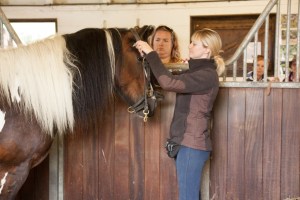
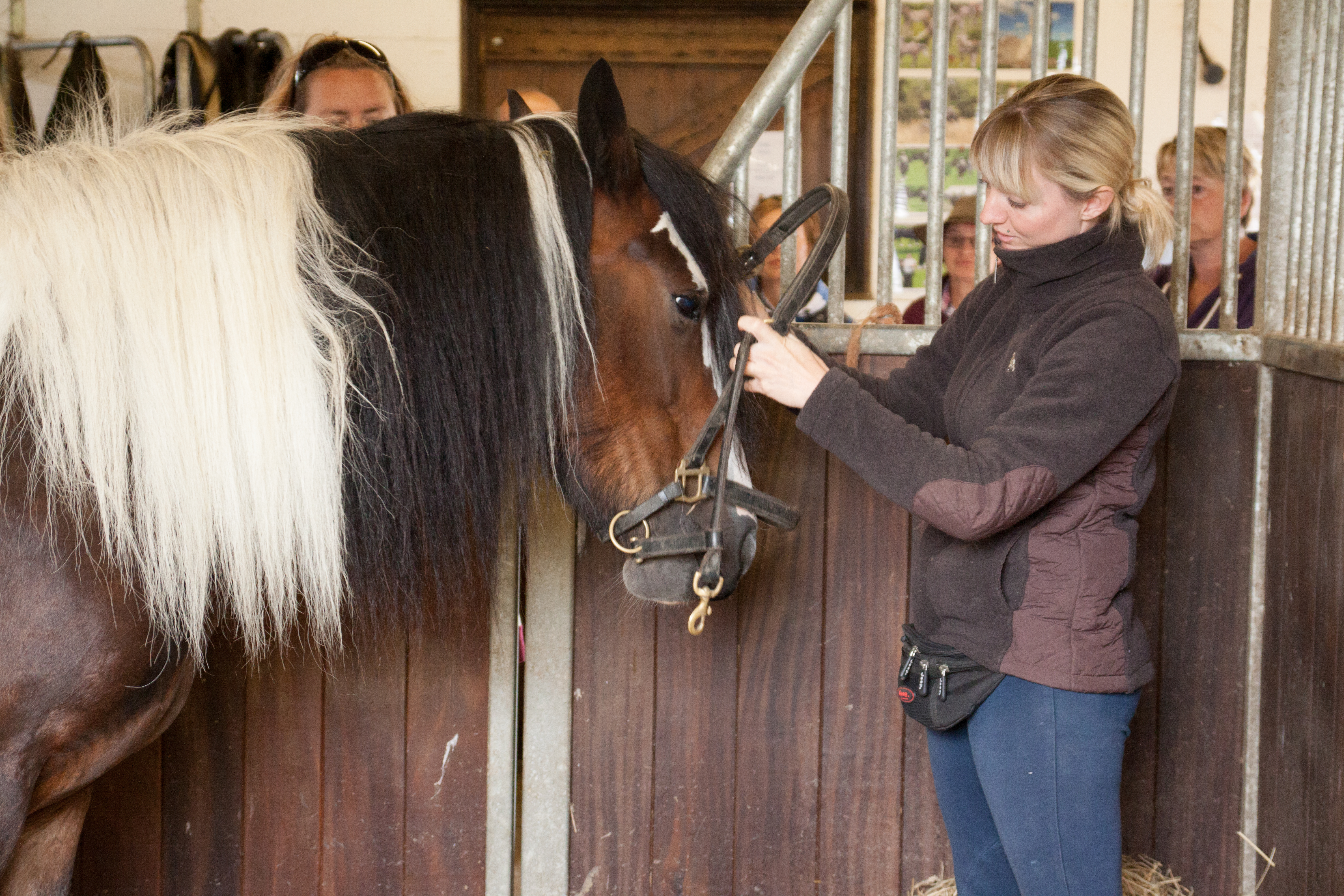
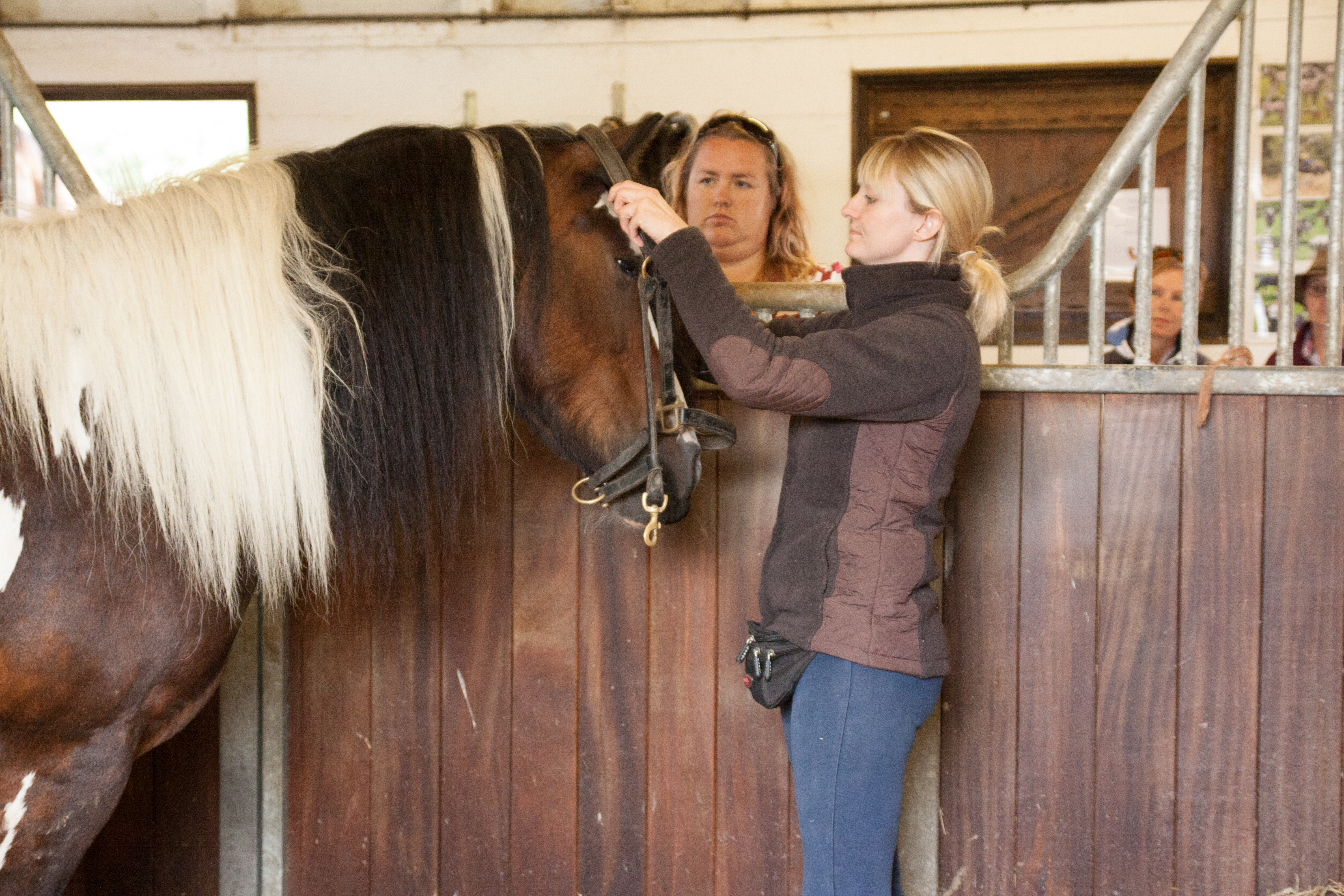
The horse with bridling issues was the one with going forwards in the school issues. Shawna worked with the horse in the stable with the owner using a leather head collar at first, gradually introducing the noseband over the nose. Desensitising to the whole process, still more sessions needed to get it solid but the horse seemed less anxious about the bridle in the end.
horse being bridledtraining a horse to be bridled


Next into the arena with the same cob – the problem was the rider wanted more forward motion with out escalating pressure. Shawna had the horse moving towards a target pole and the rider clicked and treated for the slightest forward movement.

The horse with the anxiety issues when horses or people approached from a particular side was interesting. The owner said eyes had been checked but a few people thought there may have been a more physical issue than a purely behavioural one.
Shawna had the owner with the horse online on the good side to start taking him to the side of the arena were the audience was. Several people stood up and moved as the horse went by, not much reaction on the supposed good side Changed the rein and did the same thing – a bigger reaction on that side but not overly spooked.
Clicked and treated for any calmness as he passed people. The one person went outside the arena and stood on a chair, as the horse went by she waved her arms – and the horse did a major spook and looked quite panicky. He was rewarded for being calm – he did calm down quite quickly. A few more circuits with less extreme movement from the person the other side of the hedge, gradually resulting in the horse being calmer and calmer. This too was a form of desensitisation.

Then the resident horse who seems to dislike the arena. The target was used to get him calmly walking round the arena. Gradually getting him closer and closer to the scary corner!

Shawna seemed like a magnet for the horses and sometimes the owners had difficulty getting their horses attention back to them. Shawna did move from the horse area to the spectator area a few times, with lots of breaks for the horse in between chunks of training.

What I learned from day 1 – take things at the horses pace, don’t be a greedy trainer and ask too much or too soon. Give the horses time to process and calm down after a short session. Don’t be stingy with the rewards either, jackpot after a session and leave the horse with a good feeling. Timing is everything, click/bridge for the behaviour your want at exactly the time the behaviour occurs.

A few photos from the day are on Facebook – the rest are in a Photobox gallery.

Facebook images
Connection Training Clinic

Recently I attended a clinic run by Connection Training – hosted in Essex.
Run by Shawna Karrasch and Hannah Weston.
It was great to meet so many people I had been in contact with on Facebook.

There was a variety of horses with training issues, some wouldn’t go forward and some wouldn’t stop. All people had some knowledge of reward based training so were looking for extra things to do with their horse.

I learned about sending the horse from A to B to increase forwardness and targets to get some whoa whilst adding a soft rein cue.

Clicker/reward based training is way more than just tricks.

There some photos in my Photobox Gallery