Winter

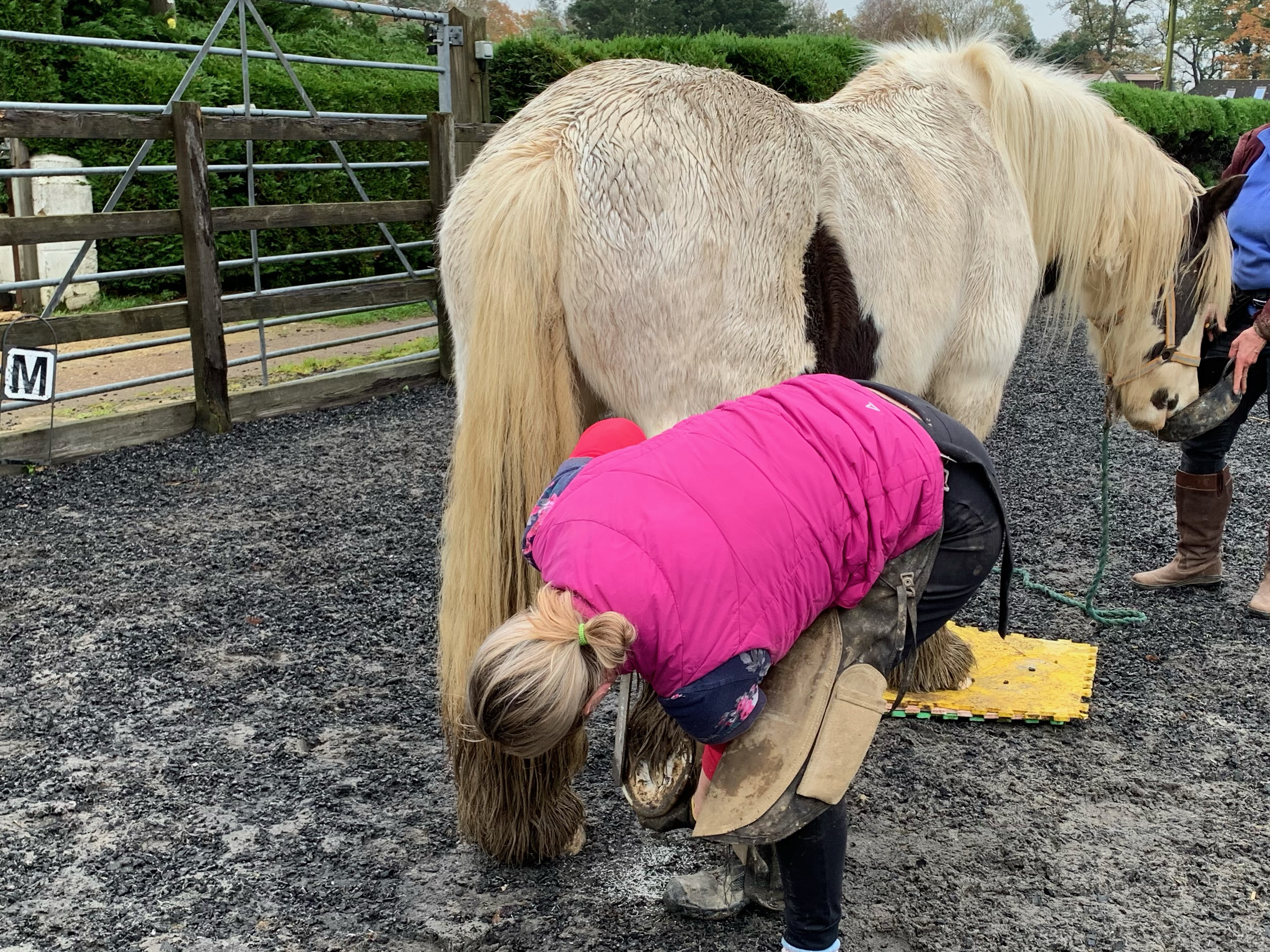
Winter is always a tricky time for horse owners, rain and muddy fields make life challenging at times. Mojo is out most of the time unless the weather is very bad, but he doesn’t like being in for too long. I went one day and he had been a bit of a handful for the yard owner as he didn’t want to be in his stable. However he was very good for me doing his feet and he enjoyed being the in the arena to stretch his legs.
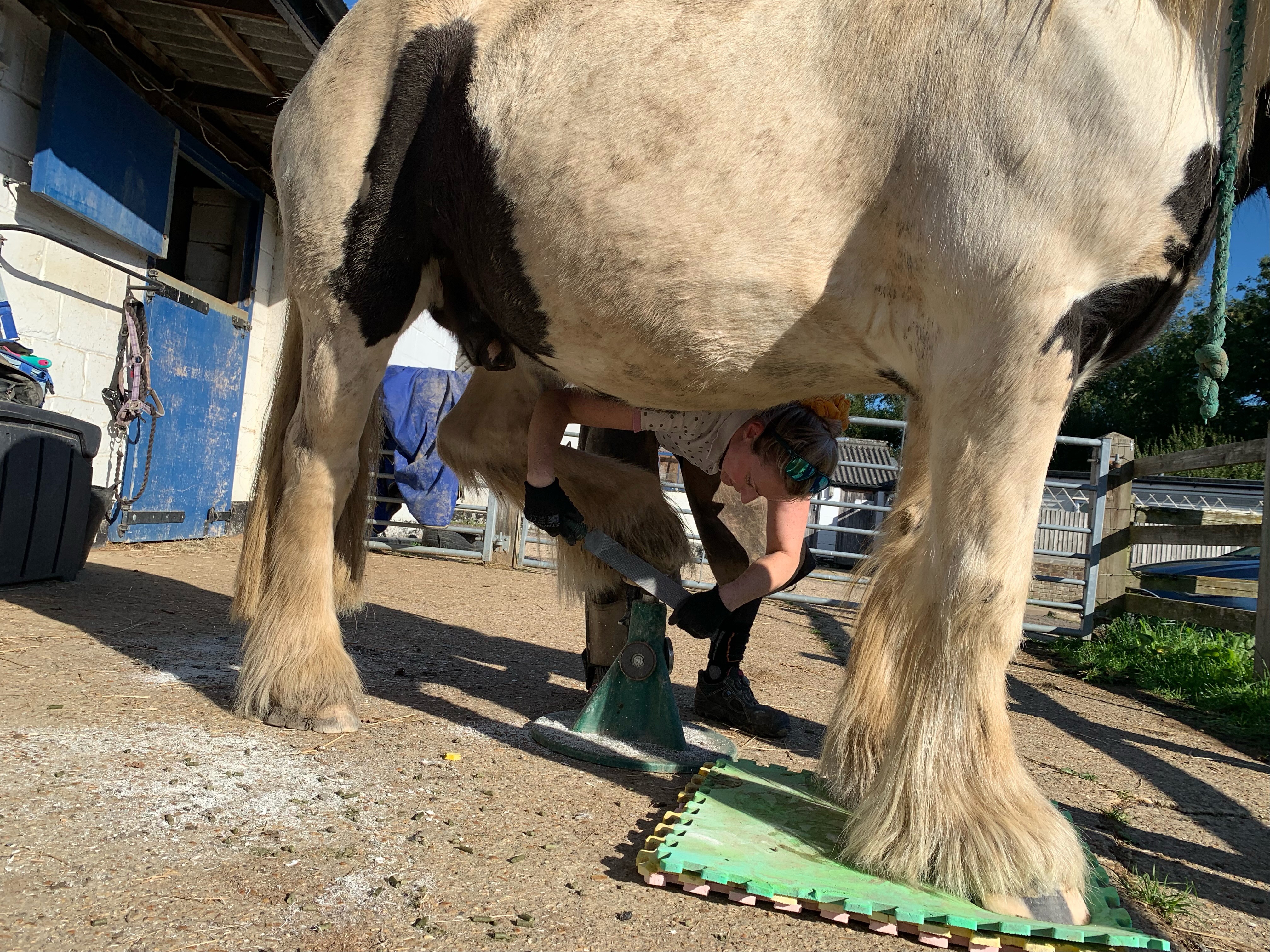
The hoof trimmer had been a few times and mostly he is now good with offering his feet, he has a little rest between doing the ends, and usually a hay net now instead of constant feeding. He still has carrots or something else yummy as his hinds are off the floor.
I did have to cut some tangles out of his mane and tail, and trim his feathers – so they don’t drag in the mud.

A very dirty horse having his feet trimmed.
Mojo having his feet trimmed.
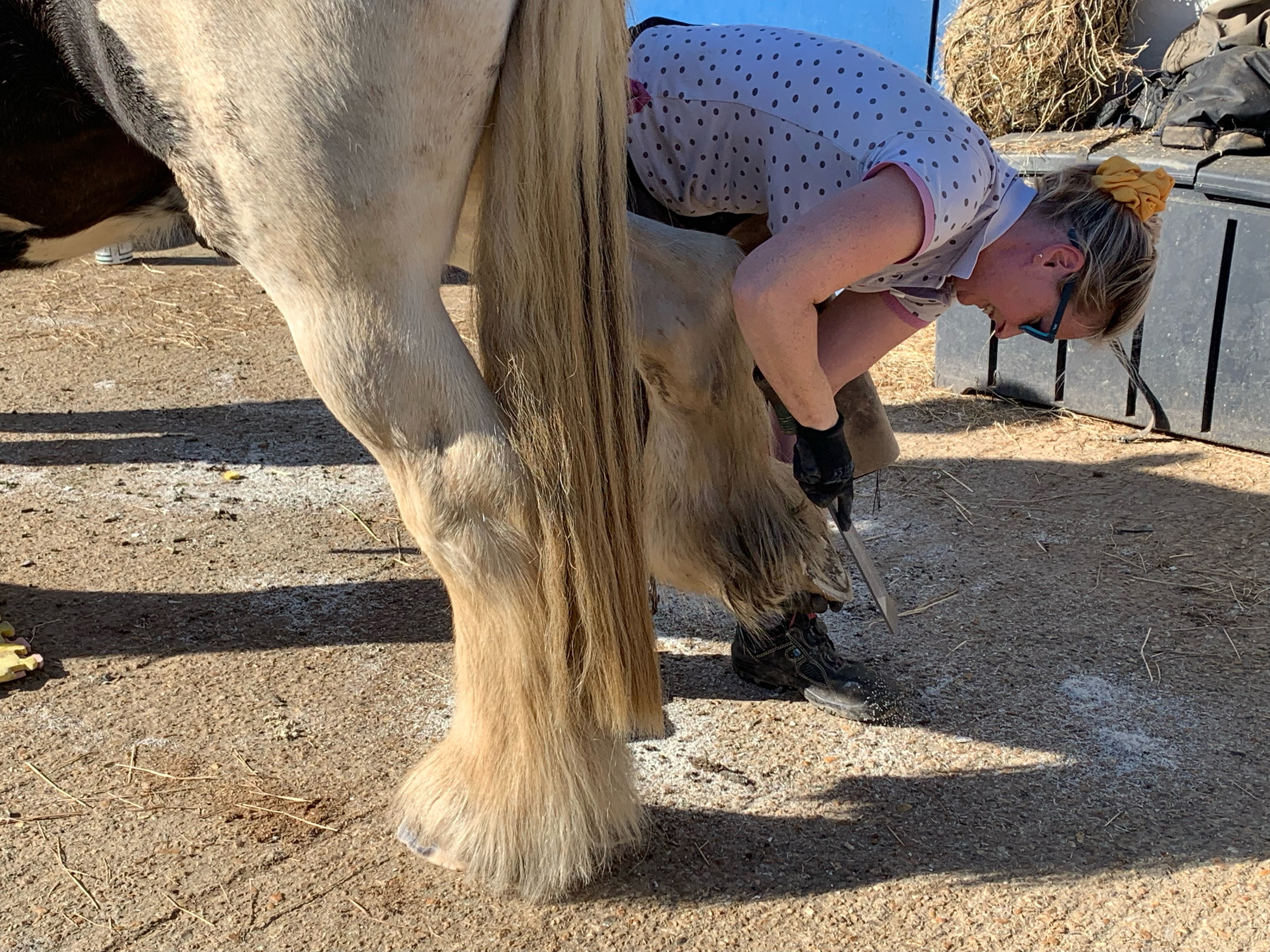
A horse having his hind feet trimmed.
Mojo having his hind feet trimmed.

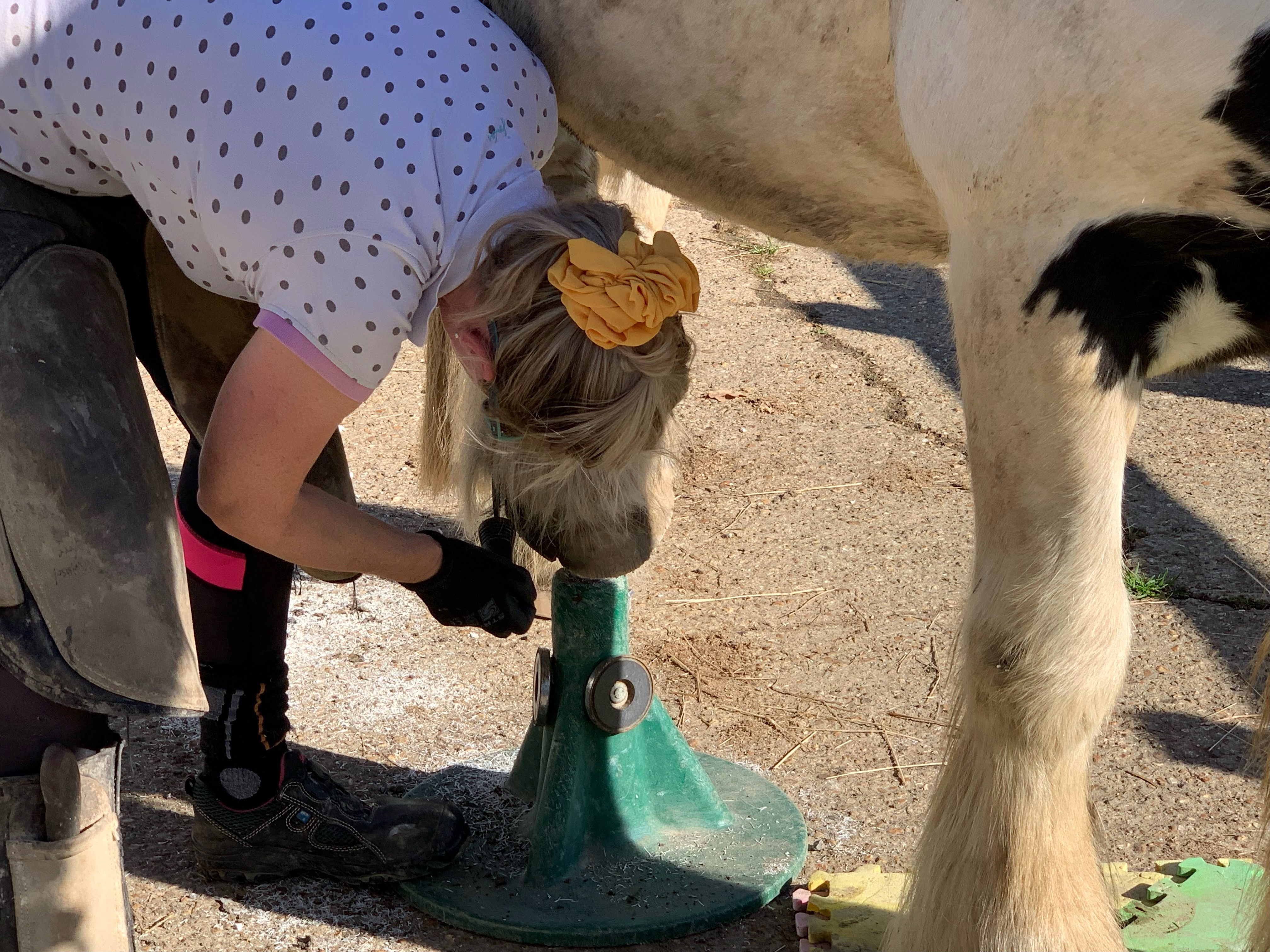
Mojo and his feet

Mojo had the hoof trimmer today, 29th November 2022. He was good with the fronts and stood with his front feet on the mats so she could do his hinds. I also gave him some calming spray – it contains valerian and seemed to work. Although it is difficult to tell whether it was the mats and treats, or the calmer that did the trick. I don’t give him anything to pick out his feet and he has been good with them since his last trim, and has let us put them on the hoof stand. So once he seems ok more often I will not give him any.

Today he got a bit fidgety as we had to move him from the yard due to a hay delivery, so we went in the school to do his hinds. However he soon settled and had his hinds on the hoof stand for trimming and the flair rasping.

Progress

Update 18th October 2022

Mojo has been good with picking up his feet in the field and in the school, so it occurred to me that he may be sore on his front feet rather than the hinds.

The plan was then to take him in the school before the hoof trimmer came and do some pole work, then to use the play mats for him to stand on whilst he was having his hind feet done.

He was good with the fronts, so we then put down 3 mats for him to stand on, he was very calm and let Penny do both hind feet with no fuss and even putting them on the hoof stand didn’t trigger any bad reactions. I did click and treat each time he had his feet in the air.

Mojo – Around a round pen

February 22nd 2021

Mojo had been got in by the yard – too muddy for me to get in the field. He seemed relaxed but did have his ears back, so may be there was some frustration creeping there. I tried to slow down and speed up my walking but there was no way he was going to trot.
Trot needs much more work – he will trot if I have his head collar and lead rope on. I will re-watch the videos with regard to getting trot on cue. He will trot over poles if I throw a frisbee or have him on line. Will try and video that next time.

Around a round pen.

I am doing the Connection Trainings course on starting to lunge, this starts with going round a round pen.

We have done this before but Mojo was a little unsure what to do.

Around a round pen.

Mojo wasn’t too sure what to do as we haven’t done this for a while. He was a little distracted by the sand school mirror and the other liveries going down the drive.

The first video shows him following the longer target and he is a bit sticky and shows some frustration when it keeps moving.

The next video I tried a longer stick but he got totally confused by that, so we did some poles exercises and some cone targeting. He then seemed ready to have another go.

The last video I walked on the outside of the pen and he seemed more confident doing that, then I went back in the pen, and he followed my hand rather than the target stick. He is a little distracted as one of the other horses is going down the drive.

2017 and onwards.

What will 2017 bring?

I am studying to be an equine behaviourist but so far am unsure whether I want to practice as a behaviourist. The equine part of the equation seems to be the easiest component. Changing peoples long held believes is very difficult, so many don’t even understand the basics of how animals learn. I don’t blame the average horse owner as they are not taught this at riding schools or even in colleges at diploma level.
If people are using pressure to motivate horses they need to understand that it is the relief of that pressure that reinforces the behaviour. This is basic negative reinforcement but I did not learn about this from the British Horse Society or even when I was doing natural horsemanship. I did learn that it is the release that teaches the behaviour but not that it was the use of an aversive stimulus nor was negative reinforcement ever mentioned.
It was only when I investigated clicker training that I learned about positive and negative reinforcement. The more I learned the more convinced I was that positive reinforcement is better for the emotional health of the horse, it gives them a choice. They can say “no” instead of being too afraid to object due to the adverse consequences of non-compliance. Even when I was doing natural horsemanship the horse was not allowed to walk away as this was seen as being “disrespectful”.

Benny taught me so much – he was very adept at escaping the escalating aversives and he introduced me to positive reinforcement.

Mojo is teaching me even more, horses can teach us so much, if we listen, than any human can.
We do not need to subscribe to any particular genre of horsemanship, we need to learn as much as we can from as many sources as possible. Only then can we truly decide what is in the best interest of the horse. To be blinkered or brainwashed by clever marketing is very limiting but unfortunately very common.
So I do find the human animal very hard to understand  – it is the human who has to change if the horse is to have a better life.

The Cook Book

The Cookbook Approach to Horse Training

There are many who would really like to know all the answers, to be able to work through a book to train the perfect equine. There are many who try to provide this service, they produce glossy ads and videos showing how you can have a rapport with your horse. Some even give you a step by step program to obtain the perfect partnership.

What is wrong with the Cookbook approach?

Well for a start each horse is different, as is each owner/rider. No horse has ever read the book so has no idea what people want him to do, he is just busy being a horse.
Any book or program can only provide a framework – the trainer needs enough knowledge to know how to adapt and improvise.

If we have a cookbook what happens if you don’t have all the ingredients for a recipe? It probably all goes wrong unless you have enough knowledge to be able to adapt a recipe or make one up from scratch.

The same can happen in horse training if all you do is watch a few videos or read a few books without a true understanding of the subject.

What knowledge does an owner need to be able to be the trainer of their horse?

They need to know how horses learn – so an understanding of operant and classical conditioning.
Some physiology and an understanding of biomechanics will help to keep the horse healthy and sound.
An understanding of equine body language and emotions is also needed.
Certain programs can teach you the basics of horse care – the BHS Horse Owners Certificate looks at the care of the horse physical needs.

Studying the learning theory and emotional side of things may be a bit more tricky. There are however excellent behaviourists around who can help and several good online resources.

However pick a course or person who is not attached to an organisation that uses only pressure/release types of training. This may have a place in training but it should not be the only way to motivate a horse. Avoid those who use escalating pressure to teach behaviours to horses. Horses are very good at learning to avoid the pressure but it can be detrimental to their emotional state.

Some organisation teach equine psychology but have an emphasis on their own brand of training, so they justify the use of aversive stimuli and ignore positive reinforcement. Some never mention that what they use is negative reinforcement so many are under the illusion of it being positive reinforcement.

We do have to be careful as any training done badly will cause problems – this goes for both negative reinforcement programs and clicker training programs. There is much more to reward based training than a clicker and some food.
To learn safely and effectively try to find someone who can come out to you or who can do some video lessons and give good feedback.

All the time I learned to ride and train via both the BHS and natural horsemanship it was never explained that I was using negative reinforcement. Natural horsemanship did teach how to apply the aversive stimulus (pressure) and that is was the release of that aversive that reinforced the behaviour. However it was never called aversive or negative reinforcement.

Most people aren’t stupid and can understand the basics of learning theory if they are given the facts. Only then can they decide what motivation to use. The horse can be motivated by learning to avoid the application of pressure (-R) or he can learn to seek something he wants (+R).

Chasing, driving, applying more pressure can lead to a horse who suppresses his natural flight response. It can even lead to complete learned helplessness. This can be seen in traditional and natural horsemanship training, the dead to the leg riding school horses, the totally bombproof horses, natural horsemanship trained ones who don’t do anything unless told (because they fear the correction).

We need a balance – a safe horse but one with character, one who feels safe to express an opinion – even when it isn’t one we agree with. How many people mount horses who don’t willing stand at the mounting block – I know I have in the past got on my horse and before I was fully onboard she would walk off.
We can of course teach this with negative reinforcement  – making the wrong thing uncomfortable and the right thing easy. However do we really have a willing horse if he only performs a behaviour to avoid the consequences of not doing so?

We can equally cause conflict if using +R if the horse is still afraid but wants the food. This is why we need to learn more than the basics, learn about different rates and types of reinforcement, learn to fade out targets and clickers for established behaviours. Learn what conflict looks like and how to recognise fear and frustration and how to avoid triggering flight responses. Learn what to do if things don’t go to plan, learn to read all the very subtle signs our horses give us.

What ever we can teach using negative reinforcement can equally be taught using positive reinforcement – the difference is how the horse feels about the process. We do need knowledge and imagination and lots of patience.

Dominance, leadership, respect are often spoken about but have little place in our relationships with horses.
Trust, partnership and providing all our horses needs is far better in my opinion.
Thought for the week

I keep reading how clicker trained horses happily take wormers, are easy to bridle, learn new things quickly etc, etc. As if they have monopoly in having happy horses. Well I have had a variety of horses over the years and they all bridled themselves, all had unique personalites and were allowed to express opinions. I listened when they showed me they were unhappy with lunging or anything else.
We need to get away from this separation of training methods. We need to all work together to make the lives of horses better. We need to train without triggering fear. We need to understand horse behaviour and how they learn and how emotions are interwoven into behaviour.
Yes I agree positive reinforcement is better than escalating negative reinforcement. But we need to stop sounding holier than thou because we use more positive than negative reinforcement.
It is known that emotionally good use of positive reinforcement is beneficial, we also know that over arousal when using +R is not good.
If we can help one another instead of bickering then the horse would benefit. We ought expend our energies in helping those who really do use abusive methods find a better way. If that is teaching them the correct use of mild negative reinforcement and helping them read the horses emotions then is that a bad thing?
I strive to use positive reinforcement but we all know life happens and it is not always possible. We need to stop making people feel guilty, non of us are perfect and we all need encouragement as we learn.
PS not all pressure is negative reinforcement, not all pressure is bad. We may need to use different words to avoid confusion. Plus it is the horse who decides what is or is not aversive.

Mojo Trotting

I have struggled to get Mojo a bit more animated when following a target, probably due to me not going fast enough. So my daughter came to help today, we put 2 cones out as he stations nicely at these and then she got him to follow the target stick and upped the reinforcement for trotting, he was getting quite lively towards the end. However Liz can run faster than I can so I need to get his trotting on a cue so he can trot to the cones by himself.

Before this he was very wary meeting a new person, a few big startle responses as Liz touched him, but he soon decided she was trustworthy and really seemed to enjoy the session.

When you have a horse who is nervous like Mojo you have to go slowly and desensitise to so much. It is like starting a horse from the beginning. Restarting often takes much longer than starting a youngster with no experience of aversive methods.

Counter Conditioning

Counter conditioning alongside systematic desensitisation is very powerful. If we do slow desensitisation we can get horses accepting of aversive stimuli, but if we pair that with an appetitive – food or scratches or anything the horse values and wants more of – then we can change how they feel about the aversive. It can even become something they want, rather than something they just tolerate.
Too often we halter horses and spray them, clip them  etc, without thinking about how the horse feels, horses sometimes provide a lot of feedback in the form of pulling away, fidgeting or even being openly petrified, but often they just shut down as they feel they can’t say “no”. So what do some people do in those scenarios were they acknowledge the horse has a problem? They may hold them tighter, tell them off and even sedated them to be clipped.
How much better is it to take time to desensitise and counter condition? Well Mojo was petrified of fly spray, the first time I sprayed him was in his stable and he nearly squashed me against the wall he spooked so much.
What did I do about it? Well I started systematic desensitisation and counter conditioning. Starting at a distance with the spray so he noticed but did not react, all at liberty – then they can flee if necessary.  I used my verbal bridge signal “good” and rewarded him – sometimes with a scratch, sometimes with a treat.
Gradually over the last few weeks he will stand next to me and not flinch when the water is sprayed, (I used water to conserve the fly spray – but need to counter condition the smell of the fly spray once he is OK being sprayed.)
Today I did this in the field and he stayed and stood still whilst I sprayed water high in the air so the droplets actually fell on him, a few weeks ago he would have startled big time and run off.
I can now spray his legs from about a metre away but if I get too close he looks aways – so there is still some conflict present.
We must be very mindful of avoiding conflict – he wants the treats or scratches but is still unsure about the spray – this is why slow progress is better than force.
Clipping will be next but as he was sedated last time it may take much longer to overcome that fear.
He is still a little touch sensitive on his head, but getting better, he was targeting my hand today with his cheek – that is a new behaviour and not solid yet.

His feathers are still a sensitive area, but I can brush them and put cream on the sore bits if I run my hand down his legs, he gets a big butt scratch for that.

I have had Mojo for just over 2 months now so he has come a long way. He is very quick to learn new things and very eager to participate in the shaping programs.