Horses tend not to generalise well, so if you train only in one place they will not be as confident in a new place. Which is why many people don’t understand why their horse is not as good at a show as at home.
So whilst training try to do so in a variety of settings and on both sides of the horse.
I have been teaching Mojo to come to the mounting block and he is now very good, I have moved the block around in the arena. So today I walked him to the end of the school and pulled out a jump block. He was busy being nosey over the fence, so I stood on the block and called him. He immediately came and sidled up to the block, lining himself up. I pulled down the stirrups on the saddle and put weight in the stirrup and he continued to stand next to me. I walked him round a bit more and then went back and stood on the block – he did exactly the same, big fuss and jackpot and we finished there.
I now need to take him outside and do the same – so he knows that when I stand on something and call his name he is to line up next to me. This is so useful when out and about so he lines up to logs or gates or anything else I can use as a mounting block.
Mojo, the barrel and frustration.
I have just finished a shaping course with Jo Hughes and Carolyn Jenkinson of The Academy of Positive Horsemanship
Mojo was much more animated during this course than the last one, he got quite frustrated too when the rewards were not forth coming. I waited for a behaviour I wanted on the 3rd day and Mojo decided that was not a good idea.
I now need (with Jo Hughes help) to improve his impulse control and put the mugging on an extinction program.
Otherwise he is good with following the target and doing the agility obstacles. The umbrella was no problem when I opened and closed it several times. He couldn’t wait to stand on the tarp and his staying still on the mat is better. I now need solid cues for all these behaviours.
Then onwards with the foot lifiting – he did hold it up for a few seconds last time and I need to do this everyday and be consistent and not reward his pawing and stomping.
This is a video of him with the umbrella.
New Loan Horse
I have a new loan horse, Mojo, he is a 9 year old Irish cob abut 15.1 and piebald.
He belongs the the lady whose horse I was having lessons on and he was her daughters horse. Mojo is however a little on the sensitive side with regards to being touched. So I will spend time assessing this and doing systematic desensitisation and counter conditioning. Mojo was the field companion of Benny so I do know him quite well.

Is the avoidance of an aversive a reward?
Is release of pressure a reward?
Following on from the previous post I have been researching the role of dopamine in emotional reactions. A very limited literature search – the subject is vast and I am not an expert. There are of course other hormones and neurotransmitters involved in all processes.
Dopamine is a neurotransmitter involved in movement via the substantia nigra, but dopamine is also produced by the ventral tegmental area of the brain. It is this area that seems to be stimulated when a reward is received or anticipated. Dopamine in these instances make us feel good. (1)
In horse training, when using the addition of an aversive stimulus to initiate a behaviour, e.g traditional and natural horsemanship, it is the removal of the aversive stimulus that is reinforcing. This is negative reinforcement as described in learning theory.
Research has shown that a transient release of dopamine occurs when an aversive stimuli is removed. (1)
So if this is correct then it may be a reward, but horses don’t seem to actively seek the application of an aversive event to gain that “reward”. They actively learn to avoid the aversive stimulus, by complying at the first indication (a cue) that an aversive stimulus might follow if they don’t comply.
Research goes further to explain this phenomenon –
“a new theoretical explanation of conditioned avoidance: (1) fear is initially conditioned to the warning signal and dopamine computes this fear association as a decrease in release, (2) the warning signal, now capable of producing a negative emotional state, suppresses dopamine release and behavior, (3) over repeated trials the warning signal becomes associated with safety rather than fear; dopaminergic neurons already compute safety as an increase in release and begin to encode the warning signal as the earliest predictor of safety (4) the warning signal now promotes conditioned avoidance via dopaminergic modulation of the brain’s incentive-motivational circuitry.” (2)
It is clear from the above that if we use aversive stimuli we must put a cue in place to predict the aversive – so the horse can avoid the application of the aversive.
When we use appetitive stimuli to reinforce a behaviour it is the anticipation of the appetitive that initiates the release of dopamine. (1) So horses actively seek the reward and can get quite animated in doing this and may offer more than we expect.
So in training should we limit the use of aversive stimuli and increase the use of appetitive stimuli?
Horses may feel good if they avoid an aversive stimulus but how do they feel during the conditioning (training) process.
Hence the title “Is the avoidance of an aversive a reward?”
All these are fascinating questions and I do not know the answers – but it does make me more aware of how and why horses learn and how they may feel about the process.
References
(1) https://www.psychologytoday.com/blog/mouse-man/200904/what-is-dopamine
(2) http://www.ncbi.nlm.nih.gov/pubmed/23759871
Thoughts on Desensitisation.
As I am doing a course with Jo Hughes of The Academy of Positive Horsemanship I am reading Dr. Jenifer Ziligs book How to Train Animals 101. The more I learn the more there is to be considered when training horses. Everything we do with them is teaching them something.
Although the course hasn’t got to desensitisation yet I have been seeing more and more videos of people flood desensitising horses.
Some ways to desensitise:
Habituation – exposure over time, also called passive desensitisation. A horse over time habituates to his environment and the weaker the stimulus the more rapid and persistent is the habituation.
This process can be very slow and if we wish horses to habituate to aversive stumuli e.g for possible medical intervention then counter-conditioning with systematic desensitisation is useful.
Counter-conditioning – this is classical conditioning using a reward to change the horses perception of a stimulus. “associating stimuli of opposite value, the combination of which acts to nullify the value towards neutral” (Dr. J. Zeligs – Animal Training 101)
Also 2 ways to approach stimulus exposure:
Systematic desensitisation – using small approximations of the stimulus, can be used with counter conditioning.
Flooding – unrelenting exposure to the stimulus – this is not a recommended technique.
More on flooding by Helen Spence – Flooding and Learned Helplessness
Also from Dr.Sue McDonnell about “sacking out” often used as a euphemism for flooding.
“Unpredictable Fear”
Recently I read this statement:
“Sometimes a horse will put up the greatest resistance just before he comes through. I call it ‘the darkest hour before the dawn’. When the horse has tried all the avenues of his natural instinct of self-preservation and puts up its greatest resistance; is when people will usually give-up or get mad. If they would just be patient, the horse is about to come around.'” – Tom Dorrance.
I would like to deconstruct this statement and ask why the horse feels he needs to take flight or to fight.
The horse has 4 reactions to a fearful situation: first they may freeze – look at the threat, then they may try to flee, if flight isn’t successful – as in a confined space – they may try to fight the threat.
If the threatening predator is still present after all these attempts the horse may give in and freeze or try appeasement behaviours to look less of a threat to the predator.
Then they appear submissive but can actually be in a state of learned helplessness.
In the above scenario the human is the predator – so what happened to the natural horsemanship principle that we should not act like a predator?
The above is a classic way to flood desensitise a horse – don’t give up until the horse gives in – as we all know flooding done incompletely may make the horse put up an even bigger fight next time. The problem is that flooding may never work even if done to the point of the horse giving in.
Why put a sensitive animal like a horse through such a process? If this was done to a deer or other prey animal it would be called cruelty.
So next time you go to a clinic or watch a video of horses being trained try to analyse what is actually happening not what the trainer says is happening.
Out of the comfort zone.
Interesting post from a friend today on Facebook about how her “How Animals Learn” course and posts made some people feel uncomfortable. Why? We need this information so we can make informed choices, life is never just black or white.
We are all learning all the time, the more information we have the better able we are to assess the horse and what he/she needs with regards to training and general care.
If the theory behind how animals learn is uncomfortable then it may be due to misunderstanding, misinterpretation or even misleading ways we have been taught in the past.
We all use learning theory in our everyday life without even knowing we do so, but when someones explains why it works that can makes us really think about what we do and why.
If I praise someone for a job well done or remove toys from my child to punish a behaviour I don’t want reinforcing, it all uses quadrants of operant conditioning. Whether it is viewed as reinforcing or punishment is up to the individual concerned. If my child didn’t want the toys anyway it may not be punishing but can be neutral or reinforcing so they misbehave again.
Take time to read and learn about how our horses, dogs, cats, children learn, it does make life a lot easier as we can pick the type of learning appropriate for each individual.
Connection Training Clinic Day 1
A few thoughts about the recent clinic in Essex.
We gathered in the stable block and talked about the areas we wanted to work on either at the clinic (for those with horses there ) or at home for the auditors.
There were a variety of issues discussed:
gaining trust
getting more whoa
getting more go
desensitisation to nasal spray
bridling a slightly head shy horse
a competition horse who went over threshold at a dressage event due to horses round the arena approaching from the right side
a horse not interested in treats or training in hand in general
even the venues owners own horse who didn’t like the arena
Getting motivation was quite a key topic, making it worthwhile for the horse to want to target objects or to stand at stationary targets. Not to be stingy with the reward!
The first session was working on getting the horse to calmly target the target stick – all the participants had a history of using reward based training. It was therefore building on and refining what they were already doing.
The session on getting more whoa was interesting as the horse seemed very calm and most unlikely to be a “bolter”. I put bolt in brackets as true bolters I think are in an extreme state of fear and not just enthusiastic and strong out hacking. Sometimes we inadvertently cause them to get over aroused – excited, especially in the company of other horses.
Shawna worked on using the target to get the horse to move and then stopping and targeting – click and treat for the stop – then add rein cues to the process. The horse got a bit confused when the rider clicked as he was still looking to Shawna as the person with the treats.
At the end of the session the rein cue had begun to mean stop.
This same horse needed to be given a nasal spray, so the process of desensitisation was discussed and he got used to having his nostrils touched but there was more work to be done on another day.
The horse with bridling issues was the one with going forwards in the school issues. Shawna worked with the horse in the stable with the owner using a leather head collar at first, gradually introducing the noseband over the nose. Desensitising to the whole process, still more sessions needed to get it solid but the horse seemed less anxious about the bridle in the end.
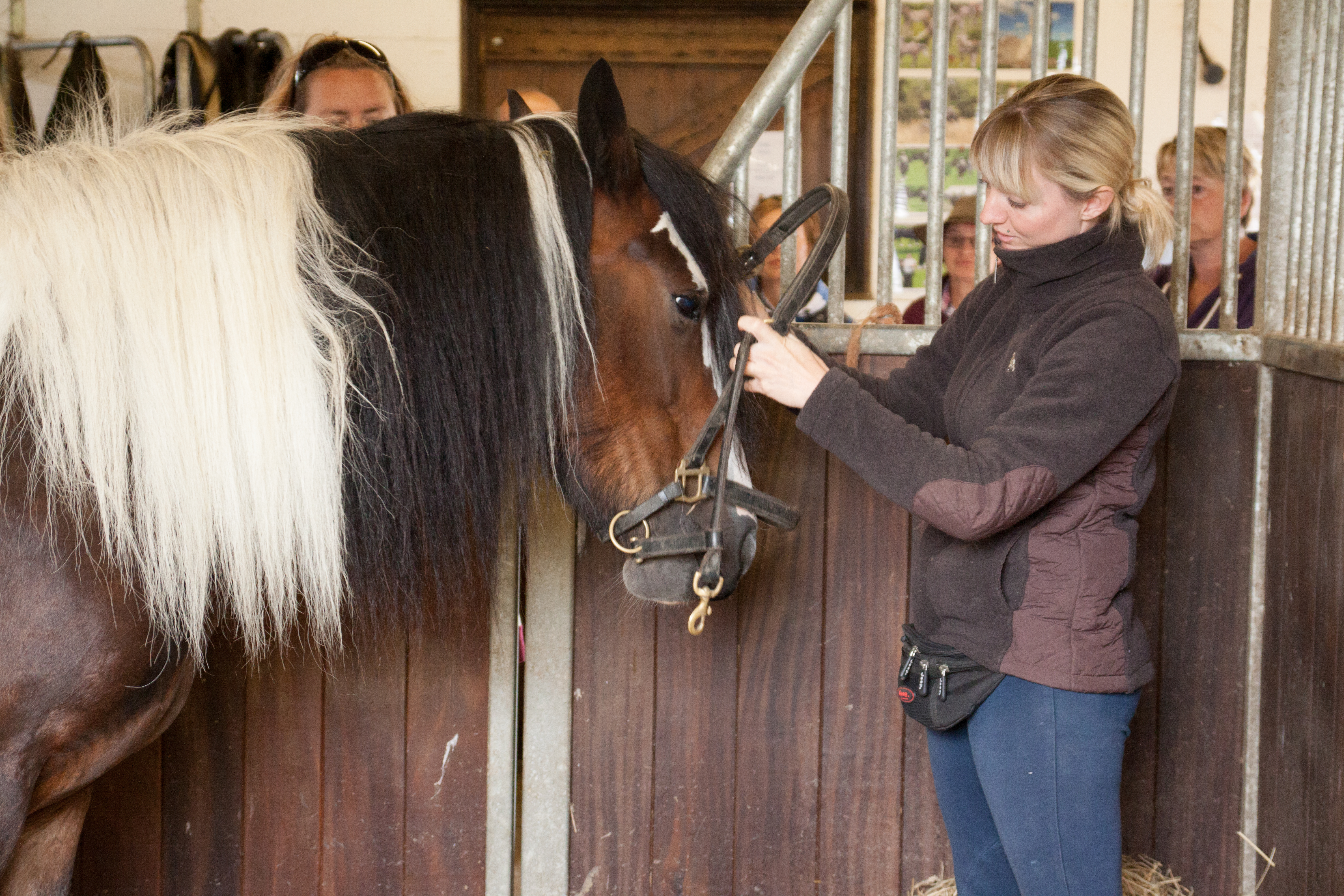
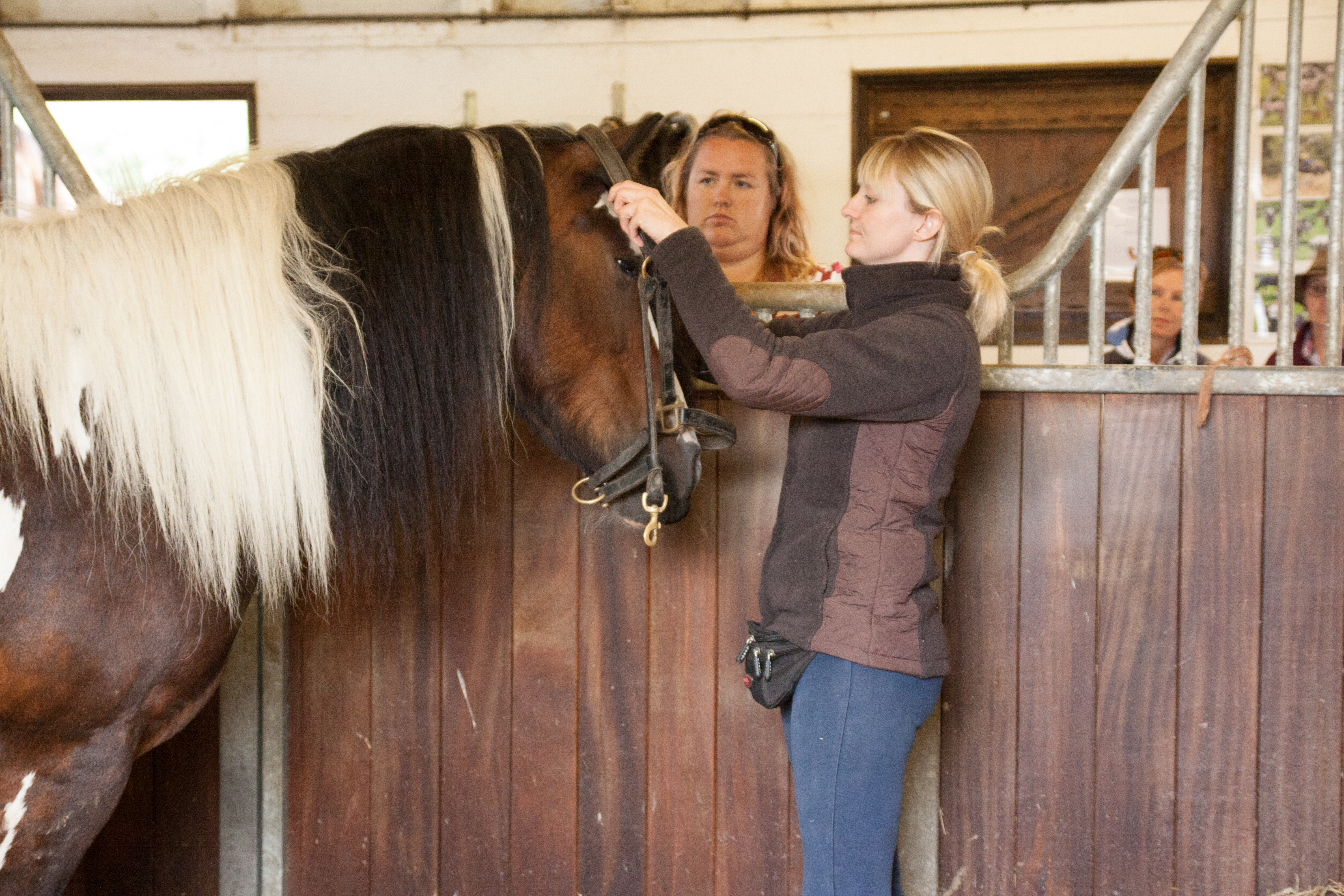
Next into the arena with the same cob – the problem was the rider wanted more forward motion with out escalating pressure. Shawna had the horse moving towards a target pole and the rider clicked and treated for the slightest forward movement.
The horse with the anxiety issues when horses or people approached from a particular side was interesting. The owner said eyes had been checked but a few people thought there may have been a more physical issue than a purely behavioural one.
Shawna had the owner with the horse online on the good side to start taking him to the side of the arena were the audience was. Several people stood up and moved as the horse went by, not much reaction on the supposed good side Changed the rein and did the same thing – a bigger reaction on that side but not overly spooked.
Clicked and treated for any calmness as he passed people. The one person went outside the arena and stood on a chair, as the horse went by she waved her arms – and the horse did a major spook and looked quite panicky. He was rewarded for being calm – he did calm down quite quickly. A few more circuits with less extreme movement from the person the other side of the hedge, gradually resulting in the horse being calmer and calmer. This too was a form of desensitisation.
Then the resident horse who seems to dislike the arena. The target was used to get him calmly walking round the arena. Gradually getting him closer and closer to the scary corner!
Shawna seemed like a magnet for the horses and sometimes the owners had difficulty getting their horses attention back to them. Shawna did move from the horse area to the spectator area a few times, with lots of breaks for the horse in between chunks of training.
What I learned from day 1 – take things at the horses pace, don’t be a greedy trainer and ask too much or too soon. Give the horses time to process and calm down after a short session. Don’t be stingy with the rewards either, jackpot after a session and leave the horse with a good feeling. Timing is everything, click/bridge for the behaviour your want at exactly the time the behaviour occurs.
A few photos from the day are on Facebook – the rest are in a Photobox gallery.
More Bridge and Target Training
Recently I have been using a verbal bridge and target with Smoke and he is getting very calm with taking the treats. I made a target using a Kidz carrot stick with a glove on the end as I thought this useful for taking out riding. He follows it very well now.
Now Liz is back riding I thought I had better do some more work with Benny.
Today I went to work some more with my target stick with a glove on the end. Different glove today but they both (Benny and Smoke) targeted immediately. This glove is partly yellow so will be good to take out riding. The problem I have is that they all want to come into the arena. First I wanted Benny but he wouldn’t squeeze past Mel so Smoke got in first. Then after working with Smoke I opened the gate and let Benny in. Smoke then followed the target to the gate and eventually went back in to the field – with plenty of treats of course. Both were very good although Smoke seems to stick with me following the target for longer. Benny was very good at lateral flexions using the target. All at liberty as it stops me inadvertently adding a pressure cue from the rope. I really must train them to station but haven’t quite got the method fixed in my head.
This is all fascinating stuff and well worth the effort to perfect.
Smoke and the bridge
Good session bridge training with Smoke – my daughters youngster. Went to catch him and he waited until I was about a foot away and came to meet me. Yesterday he just walked off as soon as I was anywhere near.
Took him to the arena and let him loose – he followed me to the gate and I went outside the arena and stood by the gate. He was calm and I bridged and he looked away fairly quickly to get his treat.
Next I introduced a target – he wasn’t sure about this and backed off. I stood quietly holding it and let him come to it, bridged for just sniffing and treated when he turned his nose away. He had a few moments of trying to get a treat but I walked away and let him calm down. He is still not sure of the target but he did touch it a few times so I left it there and went back in the arena, he stood next to me – no mugging and I gave him a few more treats. Then we walked back out into the field and I left him with some treats on the floor.
Hope this improves over the next few days – he didn’t walk so close today – usually he has his nose on my arm. Very pleased with Smoke, must not ignore Benny though.
 Positive Horsemanship.